
GET IN TOUCH
Ask For Sample?
How a 10% Polymer Pool Clarifier Fits Professional Pool Care Programs?
Clear pool water rarely comes from one product. It comes from a routine that works: sound water chemistry, steady circulation, clean filters, and careful checks.
Even then, a pool can look slightly dull. Fine dust may hang in the water. Small particles may remain after heavy use. The bottom is visible, yet the water lacks that crisp, polished look customers expect.
This is where a 10% polymer pool clarifier can have a useful role.
For pool service companies, commercial operators, and pool chemical brands, the value lies in how the product supports an established care program. Used at a suitable dose, a polymer clarifier helps bring fine suspended particles together so the filtration system can remove them more effectively.
But a bottle marked “10%” still leaves a few questions. What does that figure mean? Should the product be added every week? Can the same formula suit every filter?
Let’s look at how a 10% PolyDADMAC-based clarifier can fit into professional pool care—and what makes its use practical.
First, What Does “10% Polymer Pool Clarifier” Mean?
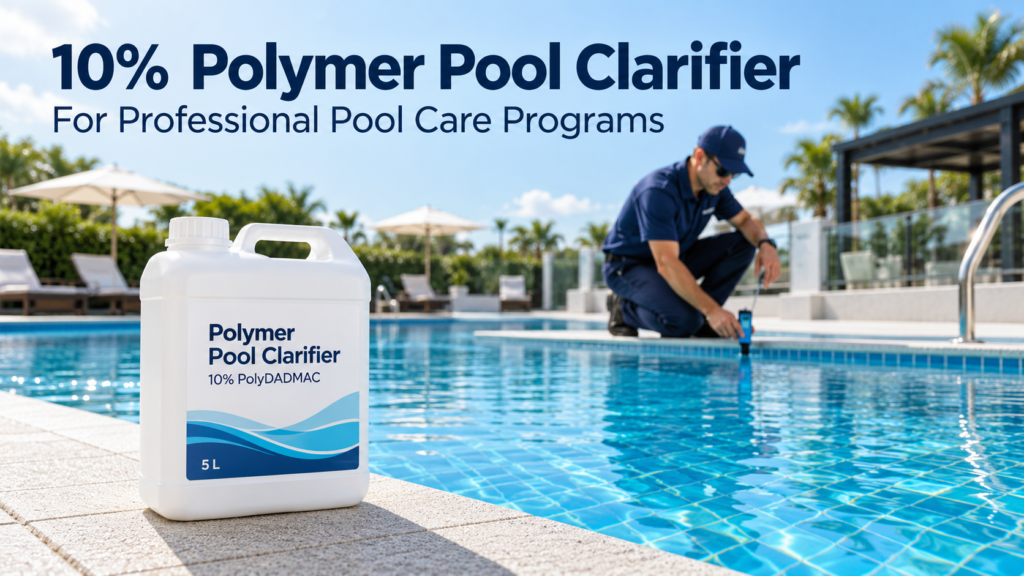
In this article, a 10% polymer pool clarifier refers to a liquid formulation containing a nominal 10% PolyDADMAC active ingredient. PolyDADMAC is short for poly(diallyldimethylammonium chloride), a positively charged, water-soluble polymer.
Eautrix identifies its polymer pool clarifier as a 10% PolyDADMAC formulation, with CAS number 26062-79-3. Buyers should confirm the concentration basis and acceptance range in the agreed product specification.
That concentration describes the product inside the container. It does not mean pool water should contain 10% polymer.
The distinction matters. A formulated product is added to a much larger volume of water, at a dose set by its directions and the treatment conditions.
Think of it like a cleaning concentrate. The strength in the bottle helps define how much you need, but the working dose is a separate figure.
Also, “10% polymer” alone does not tell buyers everything about performance. Polymer characteristics, formulation quality, the particles present, and the filtration system all influence the result.
Two products with the same stated percentage may therefore need separate evaluation.
Give Clarifier a Clear Job in the Maintenance Program
Professional pool care works better when each treatment has a defined purpose.
Disinfectant maintains the required sanitizer residual. Water balance management helps control conditions that affect comfort, equipment, and water quality. Brushing and vacuuming remove deposits and debris. Filtration captures material carried through the circulation system.
A polymer clarifier supports that last task.
Many fine particles in water carry a negative surface charge. A cationic polymer can reduce the repulsion between suitable particles, helping them form aggregates that are easier to capture.
The practical goal is simple: help the filter collect material that would otherwise remain suspended.
That does not make clarifier a cure for every cloudy pool. It cannot repair a damaged filter, restore missing disinfectant, or solve all forms of mineral precipitation.
A useful professional question is:
What is causing the haze, and can this product help the filtration system remove it?
That question keeps treatment focused. It also helps prevent the familiar cycle of adding one chemical after another while the underlying fault remains untouched.
Start With the Pool, Then Decide on the Product
A good service visit begins with observation.
Has the pool become cloudy since the last visit? Has swimmer use increased? Has a storm washed material into the water? Is the pump running as planned?
The technician should then check the key conditions covered by the site’s maintenance procedure:
- Disinfectant residual and pH
- Other relevant water balance readings
- Pump operation and circulation
- Filter pressure and flow
- Visible debris, deposits, or algae
- Recent chemical additions
These checks help separate a particle-removal issue from a chemistry or equipment problem.
For example, fine dust in a well-maintained pool may be a reasonable clarification target. Cloudiness caused by poor circulation needs an equipment response. Suspected algae requires an appropriate treatment plan before water polishing becomes the priority.
Clear appearance also cannot confirm microbiological safety. CDC guidance for public pool operators emphasizes water-quality management and maintaining filtration and recirculation systems according to manufacturer recommendations. Clarification belongs within that broader operating framework.
A professional program gives clarifier a specific task—and checks whether the pool is ready for it.
Where Routine Clarification Can Make Sense?
Some service accounts face a steady load of fine material.
Outdoor pools may collect windblown dust and small airborne debris. Busy pools receive material from swimmers. Pools near building work or exposed landscaping may face recurring particle loads.
For suitable sites, a validated maintenance dose can become part of a regular service routine.
The word “validated” matters here. A weekly visit does not automatically mean a weekly chemical addition is needed.
Instead, the service company can assess whether scheduled use produces a repeatable benefit under that pool’s conditions. The dose and frequency should remain within product directions and reflect actual demand.
A practical routine could include checking the water, servicing the filter where needed, adding the approved dose, and recording the response.
If the water stays clear without further treatment, that is useful information too.
The aim is a stable pool care program with predictable results. More product is not, by itself, evidence of better care.
Use It After Heavy Pool Use—With a Check First
A busy weekend can change a pool’s treatment needs.
More swimmers can bring more suspended material into the water. At a hotel, club, or managed residential pool, this may show up as a slight haze after a peak-use period.
A polymer clarifier may help when fine particles are part of the problem and the filtration system is working well.
Still, the correct response begins with testing. Heavy use can affect disinfectant demand and other operating conditions. Clarifier cannot take over those duties.
Once the main checks are complete, the operator can decide whether a label-approved treatment is justified.
This is especially useful when service teams plan around known demand: holiday weekends, swimming lessons, or scheduled events.
Planning does not mean adding a larger dose “just in case.” It means allowing time to inspect the pool, apply the right treatment, and assess the result before the next busy period.
After Rain or Dust, Remove the Big Stuff First
Storms often leave a mixed problem.
There may be leaves on the surface, grit on the floor, fine particles in suspension, and changes in water chemistry. One bottle cannot do all those jobs.
Start with physical cleaning. Empty baskets. Remove large debris. Vacuum where required. Check circulation and test the water.
Only then should clarification enter the decision.
A 10% polymer pool clarifier may support the removal of fine suspended material left after the main cleanup, provided the product is suitable for the system.
This order saves confusion. If a filter basket is full and circulation is poor, adding clarifier gives the treatment little chance to work as intended.
There is also a useful communication point for service companies. Explain to customers that storm recovery is a sequence of tasks. Water improvement may depend on debris removal, chemistry correction, and filter operation together.
That explanation sets a fair expectation without promising a fixed clearing time.
Treat Dosing Instructions as Part of the Product
A professional clarifier needs instructions that technicians can follow without guesswork.
“Add a little” is not enough. Neither is “use as needed” with no measured rate.
Directions should identify the pool volume, treatment amount, application method, and any limits on repeat dosing. They should also explain whether the stated dose refers to the finished product or active polymer.
This last point is easy to overlook.
For a formulation confirmed as 10% active polymer by weight, 100 grams of finished product contains 10 grams of active polymer. That is a concentration relationship, not a recommended pool treatment rate.
If the directions use milliliters, density also matters when converting between product mass and volume.
For service teams, a verified dose chart can remove much of this friction. It should use the units technicians see at work, such as milliliters per cubic meter or fluid ounces per stated number of gallons.
The best chart is clear enough to use beside the pool, with wet hands and a busy schedule.
Why “ppm” Needs a Definition
Parts per million sounds precise. On its own, it can still be ambiguous.
Does a dose refer to parts per million of the finished clarifier? Or parts per million of active polymer?
Those figures are different for a 10% formulation.
A supplier and buyer should settle this before creating labels, technical sheets, or dosing tables. Otherwise, a seemingly small wording gap can create a large difference in the amount added.
The same care applies when a service company changes suppliers.
Do not transfer the old product’s dose to a new clarifier merely because both labels say “polymer.” Check concentration, formulation, density where relevant, and the new directions.
A short technical review at the start is far easier than troubleshooting several pools later.
For private-label brands, this is also a customer-support issue. Clear dose language gives distributors, service technicians, and end users a shared reference point.
The Filter Has to Finish the Job
A clarifier helps particles become easier to capture. The filtration system still has to collect them.
That is why the product and filter should be assessed together.
Sand, cartridge, and diatomaceous earth systems have different operating and servicing needs. Suitability should be confirmed from both the clarifier directions and the equipment manufacturer’s guidance.
Avoid assuming that any polymer clarifier is suitable for every filter.
During a treatment, technicians should watch filter pressure and flow. Successful particle capture can increase the material held by the filter, which may bring forward the need for cleaning or backwashing.
A useful service record includes the starting pressure, dose, operating conditions, and follow-up observations.
That record helps answer a common question: Did the treatment fail, or did the filter collect the particles and now need service?
The distinction is practical. A chemical adjustment and a filter-cleaning task are very different responses.
Resist the Urge to Add Another Dose Too Soon
When a pool still looks hazy, adding more clarifier can feel like progress.
Sometimes it creates another variable before the first treatment has been assessed.
Excess polymer can reduce clarification performance in some systems, including through changes in particle charge. An unsuitable dose can also increase the burden on the filter.
Professional teams should therefore follow the specified assessment interval and repeat-treatment limits.
If results are poor, review the original diagnosis:
- Was the pool volume correct?
- Was the amount measured accurately?
- Was the product suitable for the filter?
- Was circulation adequate?
- Were other chemicals recently added?
- Was the haze actually caused by suspended particles?
This approach turns troubleshooting into a controlled process.
It also protects the service team from a costly habit: treating uncertainty with another splash of product.
Fit Clarifier Around Other Pool Chemicals
A professional pool program may include sanitizer, pH adjustment products, algaecide, and other treatments.
A clarifier needs a defined place among them.
Compatibility in diluted pool water does not mean concentrated products can be mixed together. Follow each product’s handling and application directions, including any required separation between additions.
Do not combine concentrates in a measuring container or prepare an improvised dosing blend.
If clarification follows an algae treatment, first complete the relevant treatment and cleanup steps. Remaining fine material may then be a clarification target.
For service companies using several branded products, a written chemical sequence helps technicians work consistently. It should reflect the actual labels and technical guidance, rather than a generic rule applied to all pools.
This is one reason supplier support matters. A clear answer about application order can be more useful than another broad claim about “strong performance.”
Keep a Simple Record and Learn From Each Site
A maintenance program becomes more reliable when the team can see what happened last time.
Clarifier records do not need to be complex. A few useful fields can tell the story:
- Pool volume and observed condition
- Relevant water test results
- Product name and batch number
- Amount added
- Filter pressure or flow observations
- Other treatments performed
- Follow-up result
Over time, these notes reveal patterns.
One pool may need clarification only after dusty weather. Another may show haze when filter maintenance slips. A third may respond well to a consistent, approved maintenance schedule.
Without records, those differences are easy to miss.
With records, the team can adjust the program based on evidence. That supports better staff training and more useful conversations with suppliers.
It also helps when a customer asks why a treatment was used. The answer can be specific to their pool.
Judge Cost Per Successful Treatment
A low container price is appealing. It is only one part of the cost.
Professional buyers should also consider the validated dose, handling time, packaging, filter servicing, and the need for return visits.
A higher concentration may reduce the volume transported per unit of active polymer. A lower concentration may offer a larger measuring volume. Neither feature guarantees the best result for a particular service business.
A 10% formulation should be judged through its actual use.
Can technicians measure it accurately? Does it perform consistently? Are directions clear? Does the packaging suit the route? Does supplier support resolve questions quickly?
Avoid assuming a clarifier will reduce sanitizer use, filter run time, or service visits. Such benefits need evidence from the relevant operating conditions.
The sound purchasing question is: What does it cost to achieve the required result consistently?
That is a more useful measure than price per liter alone.
Packaging Should Match the Way Professionals Work
Container size affects daily handling as much as purchasing.
A small bottle can be convenient for low-volume accounts or product trials. Larger containers may suit service vehicles, storage rooms, or centralized operations, provided staff can dispense the product safely and accurately.
Eautrix lists 1-liter, 5-liter, and 25-liter packaging, along with bulk and customized packaging. Its product page also describes label and formulation customization services. Buyers should confirm current specifications and packing details for their order.
Whatever the format, consider the basics: cap security, pouring control, label durability, batch identification, and measuring equipment.
A technically sound product becomes harder to use if the container spills or the dose markings are unclear.
For service teams, packaging is part of the treatment system. It deserves the same practical review as the liquid inside.
What Private-Label Brands Should Confirm Before Launch?
A 10% polymer pool clarifier can add a clear water-maintenance function to a branded pool care line.
The strongest offer pairs the formulation with dependable instructions and consistent supply.
Before launch, buyers should agree on active content, appearance, viscosity where relevant, density, storage conditions, shelf life, and batch release requirements. They should also review the technical data sheet, safety data sheet, and label wording for the intended market.
Performance trials should reflect the pools and filters the brand expects customers to use.
The label should state the product’s role plainly: it supports the removal of fine suspended particles through filtration.
Claims about disinfection, algae control, or guaranteed clearing times require their own evidence and appropriate review. They should not be borrowed from another product category.
For formulation and packaging discussions, review the Eautrix Polymer Pool Clarifier with your intended application, filter types, and market requirements in mind.
A well-supported launch starts with those details.
Make It a Measured Part of the Program
A 10% polymer pool clarifier fits professional care when its role is clear, its dose is defined, and the filtration system can do its share.
It can support routine water polishing, help address suitable particle loads after busy periods, and complement cleanup after dust or rain.
Its value depends on the whole process: diagnosis, measurement, circulation, capture, and follow-up.
For a service company, that means giving technicians a repeatable method. For a commercial operator, it means treating clarification within the site’s operating requirements. For a private-label brand, it means supplying a product with instructions customers can trust.
Clear water is the visible result. A well-managed program is what helps keep that result consistent.
Frequently Asked Questions
1. Is a 10% polymer pool clarifier suitable for weekly professional pool maintenance?
It can be, if the product directions permit weekly use and site evaluation shows a benefit. Base frequency on particle load, filtration performance, and treatment history rather than adding it automatically at every visit.
2. Does 10% PolyDADMAC mean the clarifier is ready to pour directly into any pool?
No. The concentration describes the formulation. Direct application, dilution, addition point, and dose must follow the specific product directions. Confirm filter suitability before use.
3. How do I calculate a 10% polymer pool clarifier dose for a commercial pool?
Use the verified pool volume and the supplier’s treatment rate. Confirm whether the rate refers to finished product or active polymer. If converting between mass and volume, use the confirmed product density.
4. Can a professional pool clarifier replace shock treatment or algaecide?
A clarifier supports particle removal. It does not replace required disinfection or a treatment intended to control algae. Diagnose the water problem first and follow the appropriate treatment procedure.
5. What should distributors request when buying private-label 10% pool clarifier?
Request an agreed specification, technical and safety data sheets, batch quality documentation, clear dosing instructions, filter compatibility information, packaging details, and storage guidance. Evaluate samples under representative conditions before making performance claims.