
GET IN TOUCH
Ask For Sample?
Benefits of Adding a Premium Polymer Pool Clarifier to Your Brand
A customer buys your pool chemicals for one simple reason: they want a pool they can enjoy with less trouble.
Yet even a well-kept pool can lose its sparkle. The water may look dull after a busy weekend. Fine dust may linger after windy weather. Or a light haze may remain after the main water treatment work is done.
That’s where a polymer pool clarifier can earn its place in your range.
For pool chemical brands, distributors, and private-label suppliers, this product offers more than another bottle to put on a shelf. It can help fill a gap in your maintenance range, give dealers a useful problem-solving tool, and create fresh reasons for customers to return.
But there’s a catch. Calling a clarifier “premium” doesn’t make it so.
The value must show up in the formula, the instructions, the packaging, and the support behind it. Get those parts right, and a premium polymer pool clarifier can become a useful link between your brand promise and the customer’s daily pool care experience.
What Makes a Polymer Pool Clarifier Premium?
A premium product should make a clear, useful promise—and have the evidence to support it.
For a polymer pool clarifier, that starts with its intended role. It helps the filtration process remove fine suspended particles that contribute to dull or cloudy water. It belongs within a pool care program that also includes water testing, sanitation, circulation, and filter maintenance.
Eautrix’s product information describes its polymer pool clarifier as a liquid based on PolyDADMAC technology, designed to assist the removal of fine suspended particles through filtration. Eautrix
For a brand owner, though, the formula is only part of the offer.
A credible premium product should also provide:
- Consistent specifications from batch to batch.
- Clear directions for the intended use.
- Practical, well-made packaging.
- Defined storage conditions and shelf life.
- Technical documents that match the supplied product.
- Claims supported by suitable testing.
Think of it like a good measuring tool. It earns trust because it gives users a dependable result and helps them avoid mistakes.
A bright label may win the first glance. A sound product experience gives customers a reason to buy again.
Give Your Product Range a Clearer Purpose
A pool chemical range should help customers understand which product solves which problem.
That sounds obvious. Still, many ranges leave gaps.
You may already sell sanitizers, pH adjusters, and algaecides. Those products serve vital roles, but customers may still ask, “Why does my water look hazy?”
A clarifier gives your range a distinct place to address fine suspended particles and water appearance.
The key is to explain that role without making it too broad. Cloudy water can have several causes, so the product should be presented as a targeted aid following basic checks—not as an answer to every water problem.
This helps your range feel more complete and easier to navigate.
A dealer can explain the sequence in plain language: test the water, address the cause, check the filter, and assess whether a clarifier is suitable for the remaining haze.
That’s a useful conversation. It also helps customers see your brand as a source of guidance rather than a collection of unrelated bottles.
Build Trust Through a Result Customers Can See
Some parts of pool care are hard for customers to judge without a test kit.
Water appearance feels more immediate. People notice when the pool looks dull. They notice when the floor becomes easier to see. And they notice when the water looks inviting again.
A clarifier can therefore create a visible point of contact with your brand.
The opportunity is real, but expectations need care. Results depend on the cause of the cloudiness, the product dose, circulation, filter condition, and other water conditions. A label that promises clear water in a fixed time under all conditions can create needless disappointment.
A more credible message explains both the benefit and the conditions needed to achieve it.
For example:
“Helps your pool filter remove fine suspended particles when used as directed.”
That statement may sound quieter than a sweeping promise. It also gives customers a fairer basis for judging the product.
Trust grows when the instructions, the claim, and the experience tell the same story.
Create Reasons for Repeat Purchases
A clarifier may serve more than one buying occasion.
Some customers seek help with a specific haze problem. Others may use a suitable product within a maintenance program, where the label and actual pool conditions support that use.
For a brand, these different needs can create repeat purchase opportunities.
A customer might first discover the product during pool opening, then return when fine dust affects the water later in the season. A service company may reorder for use across suitable client pools. A dealer may keep stock because customers ask for help with dull water.
None of this makes repeat sales automatic.
The product must work for the intended application. The dose must be easy to measure. And customers must understand when to use it—and when another action is needed.
Avoid building repeat demand around the idea that every pool always needs more clarifier. That can encourage poor use and weaken trust.
A healthier approach is to help customers make a sound decision each time. Useful products earn repeat business through useful results.
Give Dealers an Easier Product to Explain
Your dealer often has only a few minutes to help a customer.
The customer may arrive with a photo, a water sample, or a brief description: “It’s cloudy, but I’ve already added chemicals.”
A well-supported clarifier gives the dealer a focused next step after checking the likely causes.
Your brand can make that conversation easier with a short product guide covering:
- The type of water problem the product addresses.
- Checks to make before treatment.
- The correct dose and measuring method.
- Filtration and cleaning instructions.
- When to reassess rather than add more.
This support has commercial value because it makes the product easier to sell responsibly.
It also reduces the need for staff to guess. A new shop assistant should not have to turn a technical data sheet into customer advice on the spot.
Clear training material can help dealers feel more confident stocking your product. Better still, it helps them give consistent advice across stores and sales channels.
Support a Stronger Price Position
A premium polymer pool clarifier may give your brand room to compete on value, rather than bottle price alone.
But a higher selling price needs a clear reason.
Customers may value reliable performance, simple dosing, a secure closure, a readable label, or access to helpful support. Trade buyers may also value consistent specifications and dependable replenishment.
These benefits should be specific enough to explain.
“Premium quality” says little on its own. “Clearly marked dosing instructions and batch-specific quality records” gives a buyer something concrete to assess.
It also pays to compare products by treatment cost, where valid dose and performance data are available.
A lower-priced bottle may not deliver the lowest cost for a suitable treatment. Equally, a concentrated product may offer little practical benefit if the dose is hard to measure accurately.
The right price position depends on the whole experience.
For your business, calculate the full margin after packaging, freight, dealer discounts, marketing, support, and any returns. A higher shelf price can help, but it does not guarantee higher profit.
Make Cross-Selling More Useful
A clarifier can fit naturally into a wider pool care conversation.
Someone buying opening supplies may also need advice about lingering haze. A customer purchasing filter care products may benefit from an explanation of fine particle removal. A service business may want a broader range from one supplier.
These are sensible opportunities to introduce the product.
The strongest cross-selling starts with a need. It does not begin with a fixed bundle that assumes every pool requires every item.
You could build educational content around questions such as:
- Why is the pool still dull after basic water checks?
- What should be checked before adding a clarifier?
- How does filtration affect clarification?
- When should a customer seek further help?
That content can guide readers toward your product when it fits the problem.
It can also help distinguish the role of a clarifier from other treatments. When customers understand why each product exists, a wider range feels useful rather than confusing.
Use Private Labeling to Build a Recognizable Offer
Private labeling gives you control over how the product appears within your brand.
The bottle, label, pack size, and instructions can all support the needs of your chosen market. A retail customer may want a pack that is easy to carry and measure. A service business may place more value on handling and storage across frequent jobs.
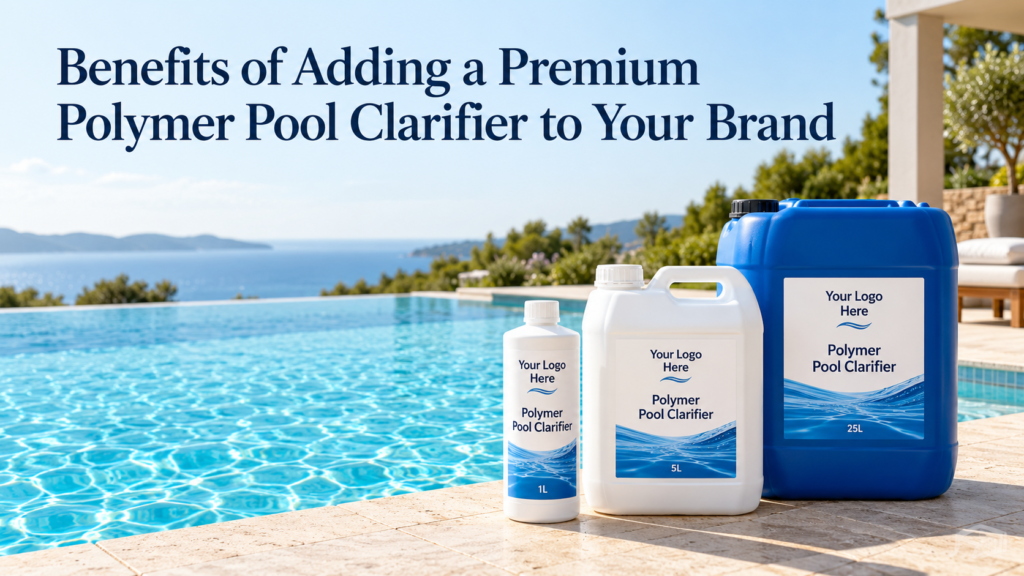
Eautrix lists private-label support, formulation and color customization, and packaging formats that include 1L bottles, 5L jerrycans, and 25L jerrycans. These provide a starting point for discussing a branded range.
Still, a logo alone is a thin basis for differentiation.
Your offer becomes more distinct when it includes clear local-language instructions, a practical dose table, a sensible pack size, and support that dealers can use.
Color can be part of the visual identity, too. It should serve that purpose honestly. A blue liquid should not be presented as proof of stronger performance.
Customers may remember the appearance first. They will judge the product by what follows.
Treat Packaging as Part of Performance
Packaging shapes how people use the product.
A bottle that drips during pouring can waste material and frustrate the user. Small text can make instructions hard to follow. A poorly chosen closure can cause trouble during transport or storage.
These details belong in the product development process.
Ask simple questions during pack trials:
Can the user hold the container securely? Can they pour the intended amount? Does the measuring method suit the dose? Does the label stay readable during normal handling?
Larger packs deserve the same attention. Their value depends partly on how safely and neatly customers can move, store, and dispense them.
There is also a practical limit to concentration. A very small treatment dose may sound attractive, yet it may be hard for a homeowner to measure.
A premium offer should balance treatment strength with real use. The goal is a product customers can apply correctly, with confidence.
Turn Quality Control into a Business Asset
Consistency is one of the least flashy—and most valuable—parts of a chemical brand.
Your customer buys the same product name again and expects the same instructions to remain useful. Your dealer expects the next delivery to match the product they already know.
That makes an agreed specification essential.
Depending on the formula, relevant checks may include appearance, polymer content, pH, viscosity, density, and storage stability. The supplier and brand owner should agree on suitable test methods and acceptance limits.
Records matter as well.
Batch identification helps trace a complaint. Retained samples can support an investigation. A clear process for reviewing formula or raw material changes helps prevent surprises.
A certificate of analysis records selected results against a specification. Application trials answer a different question: how does the product perform under the intended conditions?
Both have a role.
When quality control supports a dependable customer experience, it becomes more than a purchasing requirement. It helps protect your brand’s reputation.
Reduce Avoidable Complaints with Better Instructions
Some complaints begin long before the customer opens the bottle.
They begin with vague claims, unclear units, or missing directions.
Consider a dose written only as “ppm.” Does the user know whether that means finished product or active polymer? Can a homeowner convert it into a volume to pour?
A consumer label should turn the approved treatment dose into a clear amount for a stated pool volume. It should also explain the measuring method.
Other useful directions may cover:
- What to check before adding the product.
- How to add it safely.
- How to operate filtration during treatment.
- When to inspect or clean the filter.
- When to reassess the water.
- What to do if the expected improvement does not occur.
The exact guidance must suit the tested formulation and intended use.
Good instructions do more than prevent errors. They help customers feel supported. A person standing beside a cloudy pool wants a clear next step, not a small chemistry puzzle on the back label.
Build Better Content Around a Real Customer Need
A polymer pool clarifier gives your brand several useful content topics.
You can explain fine suspended particles, filter checks, dose measurement, and the reasons water may remain dull. You can also show how to read the product label or estimate pool volume.
This content helps customers before they buy and after they take the product home.
For search, the goal should be to answer a distinct question well. A page about choosing a clarifier serves a different need from a page about measuring a dose.
Keep each page focused, and connect it to the relevant product information.
For example, a buyer comparing packaging and private-label supply can visit the Eautrix Polymer Pool Clarifier product page.
Useful content also gives dealers material they can share. A clear guide may answer the same question dozens of times without making the customer wait for a reply.
That’s a practical form of brand support.
Launch with Evidence You Can Stand Behind
A premium launch needs more than a finished label.
Start with the customer and the intended application. Then define what the product should do, how users will measure it, and which claims your evidence can support.
Trials should reflect the conditions you plan to discuss in your marketing. Record the water conditions, dose, filter type, circulation, observations, and any issues.
If you use before-and-after images, make the comparison fair. Similar lighting and camera positions help prevent a visual change from overstating the treatment result.
You should also agree on the supply details before promoting the product widely: lead time, packaging specifications, shelf life, documentation, and how changes will be handled.
For export markets, confirm the requirements that apply to the intended product, claims, label, and destination.
This groundwork makes the offer easier for distributors to review. It also gives your sales team firm answers when a buyer asks, “What supports that claim?”
Build the Premium Promise Around Everyday Reliability
The strongest reason to add a premium polymer pool clarifier is its potential to solve a defined customer problem while strengthening your wider range.
It can support dealer conversations, create suitable repeat purchase occasions, and give your brand a useful role in water clarity care. Private labeling can carry that value into a recognizable product of your own.
The word “premium” should be earned through the details.
A consistent formula. A dose people can measure. Packaging that works. Instructions that make sense. Support when the customer needs help.
For brands planning a new clarifier line, the next step is to assess a sample against a written specification and a clear use case. Review the pack, test the instructions, and discuss supply terms alongside the chemistry.
That is how a promising product becomes a credible part of your brand.
Frequently Asked Questions
1. What are the main benefits of adding a polymer pool clarifier to a private-label brand?
It can fill a water clarity gap in your range, support cross-selling, and create repeat purchase opportunities. The commercial value depends on suitable performance, clear instructions, sound pricing, and dependable supply.
2. How can a pool chemical brand justify a premium clarifier price?
Use specific, supported benefits such as consistent specifications, practical packaging, clear dosing, and technical support. Compare treatment cost where valid data are available, and avoid relying on the word “premium” alone.
3. Is a higher-concentration polymer pool clarifier always better?
No. Concentration must be considered alongside polymer properties, performance, stability, and dose measurement. A product should provide a suitable treatment dose that its intended users can measure accurately.
4. Which packaging sizes suit private-label pool clarifier sales?
Smaller packs may suit retail buyers, while larger containers may serve pool maintenance businesses. Choose sizes based on treatment dose, purchase habits, storage space, handling, and local demand.
5. What should distributors check before choosing a polymer pool clarifier supplier?
Review specifications, samples, application evidence, batch records, packaging quality, shelf life, technical documents, and lead times. Confirm that the supplied product and supporting information match the intended market and claims.