
GET IN TOUCH
Ask For Sample?
Clear vs Blue Pool Clarifier: Does Color Affect Performance?
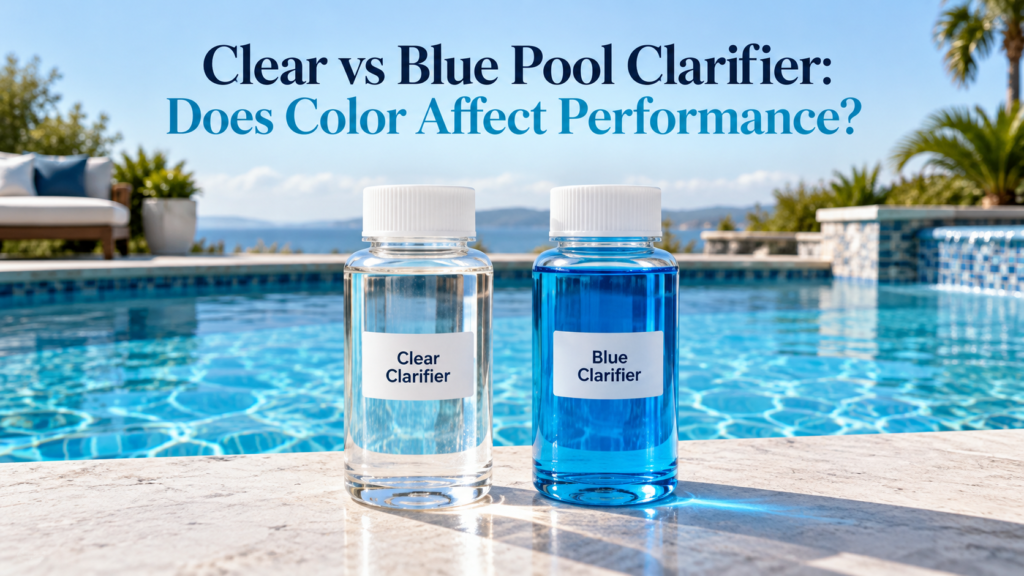
Two bottles sit on the shelf. One holds a colorless liquid. The other contains a bright blue solution. Both promise clearer pool water.
Which one should you choose?
The blue bottle may look more familiar. Its color brings to mind a clean pool on a sunny day. The clear liquid may appeal to buyers who prefer a product without added dye. Yet neither appearance tells you how well the clarifier will work.
Color alone does not determine pool clarifier performance. The active ingredients, their concentration, the dose, and the pool’s filtration conditions matter far more.
There is one qualification, though. Clear and blue products are not always the same formula in different colors. Two suppliers may use different polymers, additives, or treatment instructions. You need to compare those details before deciding that either product is stronger.
For pool service companies, distributors, and private-label brands, this distinction can prevent a costly buying mistake. Let’s look at what the color means—and what you should check instead.
First, “Clear” and “Colorless” Are Not Quite the Same
In everyday product descriptions, “clear clarifier” often means a liquid with no obvious added color.
Strictly speaking, however, clear describes transparency. Colorless describes the absence of a visible hue. A blue liquid can be transparent, just as a colorless liquid can be cloudy.
This matters when writing a purchase specification.
“Clear blue liquid” means you can see through the product, even though it has a blue tint. “Colorless transparent liquid” describes a product with no visible color and no visible haze.
An original, undyed polymer formulation may also have a slight natural tint. That does not automatically mean poor quality. Its appearance should be judged against the supplier’s agreed specification.
For buyers, the useful question is simple: does the delivered product match the approved sample and written requirements?
Color is one part of that check. It is not the whole quality test.
What Actually Makes a Pool Clarifier Work?
Pool water can contain fine suspended particles that make it look dull or hazy. Some are difficult for the filter to capture efficiently on their own.
A polymer clarifier helps those particles interact and form aggregates that are easier to remove. Depending on the polymer and conditions, this can involve reducing the electrical repulsion between particles, bringing them together, or a combination of effects.
Think of loose crumbs on a kitchen counter. A single tiny crumb can be awkward to pick up. Gather several together, and the job becomes easier.
The comparison is imperfect, but it captures the basic idea: the clarifier helps make fine material more manageable for the removal system.
PolyDADMAC is one example of a cationic polymer used in pool clarification. “Cationic” means it carries a positive electrical charge. That charge helps it interact with suitable suspended particles in the water.
The filter still has work to do.
A clarifier cannot repair damaged filter media, restore poor circulation, or replace normal pool sanitation. Whether the liquid starts out colorless or blue, its success depends on the full treatment process.
Why Do Some Pool Clarifiers Have a Blue Color?
A blue appearance may come from an added colorant. In that case, the colorant gives the product its visual identity, while the polymer provides the clarification function.
Blue can be a useful commercial choice. It fits the look of many pool care ranges and may help customers recognize a familiar product on a retail shelf.
For a private-label brand, a consistent shade can also support a consistent package design.
Eautrix, for example, lists original and blue-dyed color options for its PolyDADMAC-based pool clarifier. Its product page presents color customization alongside formulation and packaging services.
That does not prove that every blue clarifier on the market uses the same chemistry. It simply shows that color can be a configurable feature of a polymer product.
The practical lesson? Ask the supplier whether blue and undyed versions share the same base formula. Do not guess from their appearance.
Does Blue Dye Improve Clarification?
A blue colorant should not be assumed to improve particle removal.
If a manufacturer adds a small, compatible amount of dye to an otherwise unchanged formulation, similar clarification performance is a reasonable expectation. However, that expectation still needs validation. The dye, its carrier, and any other formulation changes must be suitable for the finished product.
This is why “color never matters” is too broad a statement.
Color itself is not a reliable measure of performance. Yet the ingredients used to create that color are part of the formula, and the whole formula deserves testing.
A buyer should distinguish between two situations:
- The same base clarifier is offered with and without an approved colorant.
- Two different clarifiers happen to have different colors.
In the first case, color may be mainly an appearance choice. In the second, performance differences could come from many factors unrelated to the hue.
A blue product might perform better than a particular colorless product. A colorless product might perform better than a particular blue product. Neither result establishes a rule about color.
Is a Darker Blue Clarifier More Concentrated?
Not necessarily.
Color intensity depends on the colorant, its concentration, the bottle, the lighting, and the depth of liquid you are looking through.
Active polymer concentration is a separate property.
A strongly colored liquid may contain relatively little active polymer. A colorless formulation may contain much more. You cannot measure those differences by holding the bottles up to the sun.
Even packaging can mislead the eye. A blue bottle may make a colorless liquid appear blue. A large sample container may make a lightly dyed product look much darker than it does in a small measuring cup.
When comparing products, ask for the active content and the method used to define it.
Also check whether the supplier is reporting active polymer, total solids, or another measure. Those terms should not be treated as interchangeable without clarification.
A shade chart can help control appearance. It cannot replace a chemical specification.
Clear vs Blue Pool Clarifier: What Should You Compare?
A side-by-side comparison becomes much more useful when it focuses on treatment details.
| Comparison point | Clear or undyed clarifier | Blue clarifier | What buyers should check |
|---|---|---|---|
| Appearance | May be colorless or have a natural tint | May contain an added blue colorant | Approved appearance specification |
| Active chemistry | Cannot be identified by appearance | Cannot be identified by appearance | Polymer identity and formula description |
| Strength | Not shown by lack of color | Not shown by depth of blue | Active content and recommended dose |
| Filter suitability | Depends on the product | Depends on the product | Label directions and filter restrictions |
| Storage behavior | Requires stability evaluation | Requires stability evaluation, including color | Shelf life and storage conditions |
| Treatment value | Depends on dose and results | Depends on dose and results | Cost per treatment |
| Brand presentation | Suits an undyed product concept | Suits a blue product concept | Customer preference and packaging design |
Notice how often the answer is “depends on the product.”
That is not an evasive answer. It is the reason a technical comparison is more useful than a color comparison.
The bottle catches your eye. The specification should guide your purchase.
Will Blue Clarifier Make the Pool Water Blue?
A blue clarifier is generally purchased to improve clarity, rather than to serve as a pool color treatment.
Once added to a pool, the product becomes highly diluted. Whether its color remains visible depends on the dye, its amount, the treatment dose, and the pool conditions.
Do not assume that all formulas behave the same way.
Ask the supplier whether a visible tint is expected at the recommended dose. If water appearance is important to your customers, include it in the product trial.
There is another source of confusion here: blue water and clear water are different observations.
A pool may look blue from a distance while still containing enough haze to obscure floor details. Pool finishes, lighting, viewing angle, and water depth all influence the color people see.
Judge clarification by improved visibility and reduced haze. “It looks bluer” is not a reliable result on its own.
Can Blue Clarifier Stain Pool Surfaces?
Color alone cannot answer this question.
The possibility of staining depends on the complete formulation, the surface, the concentration at the point of contact, and how the product is applied.
A spill of concentrated liquid is also a different situation from a correctly diluted pool treatment.
For a blue formulation, buyers should ask about colorant suitability and any documented precautions for liners, plaster, grout, and other surfaces. For an undyed product, surface compatibility still matters. The absence of dye does not establish that every ingredient is harmless to every material.
During use:
- Follow the product’s application directions.
- Avoid leaving concentrated spills on surrounding surfaces.
- Use clean measuring equipment.
- Follow the specified circulation conditions.
- Do not mix concentrated pool chemicals together.
For private-label development, surface compatibility should be part of the evaluation plan when relevant to the intended market.
A claim such as “will never stain” needs evidence. A blue shade, by itself, provides none.
What Matters More Than Color? Start With the Formula?
The active polymer is the first place to look.
Two products may use different polymer types, different grades of the same polymer, or different blends. These differences can influence how they interact with the particles present in a particular pool.
Then consider concentration.
A concentrated product may require less liquid per treatment. But that does not mean the highest concentration is always the easiest product to use. A lower-dose concentrate may require more careful measurement, particularly in small pools.
Other formulation details may matter too. These include pH, viscosity, and additives that affect storage or handling.
This is why matching a chemical name alone is not enough to prove that two products are equivalent. Even products based on the same broad chemistry can have different practical behavior.
For a service company, the most useful formula is one that delivers repeatable results at a manageable dose, with clear instructions.
For a distributor, that same repeatability helps reduce customer complaints and support calls.
The Right Dose Beats the Right Shade
It is tempting to add more clarifier when the pool still looks cloudy. After all, if a little helps, surely more will help faster?
Pool treatment does not always work that way.
Too much polymer can interfere with the intended clarification process under some conditions. It may also contribute to filter loading or deposits. Eautrix’s guidance on clarifier selection identifies overdosing as a potential cause of poorer results.
Use the dose specified for the actual product and pool volume. Do not borrow a dose from a different clarifier because both liquids look blue—or because both are labeled “polymer.”
The dose also needs a clear basis.
Does a technical recommendation refer to the finished product or the active ingredient? Is it expressed by mass or volume? If the wording is unclear, resolve it before treatment.
These details may seem small. In practice, they can make a much larger difference than product color.
Your Filter Does Not Care About the Bottle’s Appearance
A clarifier and a filter work as a team.
If the filter cannot capture and retain the resulting particles, changing the liquid from clear to blue will not solve the underlying problem.
Check that the product is suitable for the filter type and follow both sets of instructions. Sand, cartridge, and diatomaceous earth systems have different maintenance needs, and product restrictions can vary.
Do not assume that every product called a clarifier follows the same treatment method, either.
Some treatments are designed to support filtration. Others promote settling and require a different removal process. The label should tell you which approach applies.
During a trial, watch the system as well as the water. Record filter pressure, flow, cleaning needs, and any unusual deposits.
A product that gives a quick visual improvement but creates difficult maintenance later may offer less value than it first appears to.
The useful result is clear water with manageable operation.
How Can You Test Clear and Blue Versions Fairly?
If you want to know whether adding blue color affects a particular clarifier, test versions of the same base formulation.
Comparing unrelated products can tell you which one suits your application better. It cannot isolate the effect of dye.
A fair evaluation should control as many conditions as practical:
- Use representative water from the same source.
- Confirm that the base polymer and active content are comparable.
- Measure doses accurately.
- Keep mixing conditions and observation times consistent.
- Compare against untreated water where appropriate.
- Record haze reduction, visible color, and unusual behavior.
For technical work, a suitable turbidity instrument can help quantify changes in cloudiness. Ask the testing team whether sample color could influence the chosen measurement method.
A jar test can be useful for early screening. Still, jars do not reproduce a working pool filter.
Follow promising laboratory results with a controlled filtration trial. Keep records of the water conditions, circulation, treatment dose, and filter response.
Photographs can support those records, provided lighting and viewing angles are consistent. They should supplement the measurements, not replace them.
For Private-Label Buyers, Color Is a Product Design Decision
Clear and blue options can both make commercial sense.
An undyed product may suit a brand that wants a simple appearance or fewer added colorants. A blue version may suit an existing pool care range or a market where customers expect that presentation.
Neither choice requires a claim of better clarification.
For private-label orders, agree on more than “blue” or “clear.” Define the appearance closely enough that both parties know what an acceptable batch looks like.
Useful purchasing details include:
- Active ingredient and agreed content.
- Appearance and acceptable color range.
- Relevant pH and viscosity limits.
- Storage conditions and shelf life.
- Packaging and closure requirements.
- Treatment directions and filter suitability.
- Required quality and safety documents.
Ask for a representative sample and retain the approved reference.
Color consistency matters to branding. Performance consistency matters to repeat orders. A sound specification should address both.
Compare Cost per Treatment, Not Just Price per Bottle
A cheaper bottle may cost more to use if it requires a larger dose.
Likewise, a premium blue product does not offer better value merely because its appearance seems more polished.
For a simple comparison, divide the product price by the number of treatments available at the recommended dose for your chosen pool volume.
Then consider the practical results.
Did it reduce haze? Was dosing easy? Did the filter remain manageable? Was another treatment needed? How much staff time did the process require?
For pool service businesses, these questions affect margins. For distributors, they affect customer satisfaction.
When comparing clear and blue versions, ask the supplier whether color changes the price, minimum order quantity, or production requirements. Those may be legitimate commercial differences, even when the base clarification performance is similar.
Pay for the treatment result and the product quality your market needs.
Do Not Let a Blue Appearance Hide a Pool Problem
A clarifier can support particle removal, but it does not replace water testing or disinfection.
If cloudiness keeps returning, investigate the cause. Possible contributors include poor filtration, circulation problems, ongoing debris, water balance issues, or algae-related conditions.
The color of the clarifier offers little help in diagnosing these problems.
Also, clear-looking water alone does not prove that sanitation is adequate. Water chemistry and visibility need separate checks.
The CDC advises swimmers to avoid unusually cloudy water and to make sure the drain at the bottom of the deep end is visible. CDC
For commercial pools, follow the applicable operating rules and visibility requirements. A more attractive blue appearance should never be treated as a substitute for those checks.
The goal is water that can be properly inspected, maintained, and managed.
Choosing an Eautrix Clarifier for Your Market
When choosing a clear or blue pool clarifier, start with the pool conditions, filter system, and intended treatment routine. Then decide which product appearance suits your customers.
For details on the formulation and available customization, visit the Eautrix Polymer Pool Clarifier page.
When requesting samples, explain whether you need an undyed product, a blue version, or both for comparison. Ask the supplier to confirm whether the samples share the same base formulation and treatment directions.
That gives the trial a clear purpose.
You can assess performance first, then select the presentation that fits your brand. A well-chosen color may help sell the first bottle. Reliable results help sell the next one.
Frequently Asked Questions
1. Is blue pool clarifier stronger than clear pool clarifier?
Not necessarily. Blue intensity does not show active polymer concentration. Compare the formulation, recommended dose, and treatment results before judging strength.
2. Can clear and blue PolyDADMAC pool clarifiers perform the same?
They can have similar performance when they use the same base formula and an appropriately validated colorant. Ask the supplier to confirm equivalence and test representative samples.
3. Will blue pool clarifier permanently change my pool water color?
Do not assume that it will. Any visible tint depends on the colorant, dose, dilution, and water conditions. Check the product guidance and evaluate water appearance at the recommended dose.
4. Is undyed pool clarifier safer for liners than blue clarifier?
The absence of dye alone does not establish better liner compatibility. Safety and staining behavior depend on the complete formulation, surface material, and application method.
5. Which is better for a private-label pool clarifier: clear or blue?
Choose the version that meets your performance requirements and suits your market. Confirm active content, storage stability, packaging compatibility, and dosing instructions before selecting the final color.