
GET IN TOUCH
Ask For Sample?
Using Polymer Pool Clarifier After Heavy Pool Usage
A pool can look bright and clear in the morning, then turn dull after a full day of swimming. The water may still be blue, but the sharp view of the floor has softened. Under the pool lights, a thin haze becomes hard to miss.
Sound familiar?
Busy swimming days put extra strain on both water treatment and filtration. Swimmers bring in dirt, skin particles, sweat, sunscreen, and other material. Some of it can be skimmed away. Some increases chlorine demand. Some stays suspended as fine particles that are harder to filter.
Polymer pool clarifier can help remove lingering fine-particle haze after heavy pool usage—once sanitizer levels, water balance, and filtration have been checked. It supports particle removal. It does not replace disinfection or fix a faulty filter.
The right approach starts with a simple question: what, exactly, needs to be removed?
Why Does a Busy Pool Lose Its Sparkle?
Think about a family pool party on a warm afternoon. Guests move between the garden and the water. Children splash in the shallow end. Sunscreen is reapplied. Towels, toys, and bare feet collect dust from the deck.
Each swimmer adds a small amount of material. Together, those small amounts can become a substantial load.
This is often called bather load: the number of people using the pool. For maintenance purposes, the length of their visits matters too. Ten people swimming for several hours can place a different demand on the water than ten people taking a quick dip.
A busy pool may have several problems at once:
- Fine particles suspended in the water.
- More debris in skimmer and pump baskets.
- Higher demand for sanitizer.
- Surface films around the waterline.
- A filter that is collecting material faster than usual.
Chlorine levels can fall as chlorine reacts with contaminants from swimmers. CDC guidance identifies sweat, dirt, and other body waste as factors that reduce chlorine concentration. That is why a test taken before the gathering may no longer describe the water afterward.
Yet low chlorine is only one possible cause of the haze. A pool may have an acceptable sanitizer reading and still contain fine suspended solids. The water needs both proper treatment and effective removal of dirt.
What Does Polymer Clarifier Actually Do?
A polymer pool clarifier helps small suspended particles gather into groups that a suitable filter can capture more readily.
The term polymer describes a molecule made from repeating units. In pool clarification, the polymer’s properties help it interact with particles in the water.
Many cationic clarifiers carry positive charges. These can help destabilize negatively charged particles, reducing the forces that keep them apart. Depending on the formulation, polymer chains can also help link particles together.
In plain English, the clarifier makes scattered fine dirt easier to collect.
But there is a second half to the job: the filter must capture it. Adding clarifier does not make the unwanted material disappear.
Eautrix’s Polymer Pool Clarifier uses PolyDADMAC technology to support the removal of fine suspended particles. As with any finished formulation, its application instructions should guide product selection and treatment.
It helps to picture clarifier and filtration as a team. The clarifier helps gather the particles; the filter takes them out of circulation.
Neither can cover every weakness in the other.
First, Work Out Whether Clarifier Is Needed
Heavy use alone does not mean you must add clarifier.
If the pool remains clear, the water tests are within the required ranges, and circulation is sound, extra treatment may bring little benefit. A label-approved maintenance program is a separate matter, but a busy afternoon is not a reason to pour in an unmeasured dose.
Clarifier becomes more useful when fine haze remains after the basic checks and cleaning have been completed.
Here is a practical way to sort the symptoms:
| What you notice | What to check first | Where clarifier may help |
|---|---|---|
| Light haze after a busy swimming day | Sanitizer, pH, circulation, and filter condition | Removal of remaining fine particles |
| Leaves, insects, or grit | Skimming, baskets, and vacuuming | Only if fine haze remains afterward |
| Strong odor or eye irritation | Free and combined chlorine; indoor ventilation | It is not a treatment for chloramines |
| Green water or slippery surfaces | Possible algae and sanitizer failure | Residual particles after algae control |
| Milky water after a chemical addition | Dose, water balance, and chemical interactions | Only after the cause is identified |
| Weak return flow | Baskets, valves, pump, and filter | Restore flow before clarification |
These are clues, not final diagnoses.
The useful distinction is between fine-particle haze and a broader water-quality problem. A clarifier may help with the first. The second needs its cause addressed.
Start with a Fresh Water Test
Before adding polymer clarifier after heavy pool usage, test the water again.
At minimum, check free chlorine and pH. Where relevant, also measure total chlorine so you can assess combined chlorine. Further tests may be needed if water balance is uncertain or the pool has a history of recurring cloudiness.
CDC recommends testing chlorine and pH at least twice daily, with more frequent testing when many people are using the pool. Public and commercial facilities must also meet their applicable operating requirements.
Use a suitable test method and follow its directions. Take the sample from a representative location, rather than directly beside a return where a freshly added chemical may distort the reading.
Write down the result.
A few numbers recorded after the party can save a great deal of guesswork the next morning. They also help you distinguish falling sanitizer from a filtration problem.
If sanitizer is below the required level, restore it according to the treatment instructions. If pH needs adjustment, correct it and allow the product to circulate as directed.
Then reassess the haze.
A Strong “Pool Smell” Needs Its Own Attention
A busy pool sometimes smells more strongly of chemicals. It is tempting to read that smell as proof that plenty of chlorine is present.
The smell alone cannot tell you that.
Chlorine can react with body waste to form chloramines, a type of combined chlorine. These compounds can contribute to irritation and air-quality problems, especially around indoor pools. Polymer clarifier is not a reliable treatment for them.
If swimmers report irritated eyes, or the pool has a persistent sharp odor, check the sanitizer readings and follow the appropriate treatment procedure. Indoor facilities should assess ventilation as well.
This is one reason “add clarifier after every party” is an incomplete maintenance rule. The water may need several different kinds of care, and each should have a clear purpose.
Remove the Dirt You Can Already See
Before asking a small dose of polymer to help with fine particles, remove the larger debris.
Skim the surface. Empty the skimmer baskets. Check the pump basket according to the equipment instructions. Vacuum visible dirt from the floor, and brush surfaces where material has collected.
Pay attention to the waterline after a busy day. Surface deposits need suitable physical cleaning; they should not simply be left for the filter to handle.
Also check the water level. Poor skimming can occur when the level is unsuitable, and a circulation problem may be mistaken for a chemical problem.
These steps are ordinary maintenance, but they matter. A pool with blocked baskets and a dirty floor gives clarifier a much harder job.
The aim is to leave the filtration system dealing mainly with the material that cannot be removed easily by hand.
Give the Filter a Fair Chance
Look at the filter pressure and return flow before dosing.
Compare pressure with the normal clean-filter reading under similar pump-speed and valve settings. A reading without context is less useful than it seems.
If the filter has reached its manufacturer’s cleaning threshold, clean or backwash it as directed. If pressure and flow are normal, do not assume a backwash is needed simply because you plan to add clarifier.
After treatment, continue to monitor the system. As captured material builds up, cleaning may become necessary.
For sand-filter systems, Eautrix’s guide to using polymer pool clarifier with a sand filter explains how filter condition, operating mode, and dosing work together.
Check filter compatibility too. Products sold as clarifiers can differ in chemistry and intended use. A product suitable for one filter system should not automatically be assumed suitable for every other system.
That is particularly relevant when switching between sand, cartridge, and diatomaceous earth filters.
Measure the Dose—The Number of Guests Is Not a Measuring Cup
“How much clarifier should I add after a pool party?”
The answer comes from the instructions for the exact product and the volume of water being treated.
Pool clarifiers vary in concentration. A dose remembered from an old bottle may be wrong for a new formulation. Maintenance doses and cloudy-water doses may also differ.
Where the label provides a liquid dose per volume of pool water, use:
Product needed = pool volume ÷ label reference volume × label dose
For example, suppose a hypothetical label states 5 mL per 1,000 L. A 40,000 L pool would require:
40,000 ÷ 1,000 × 5 = 200 mL
This example explains the arithmetic only. It is not a treatment recommendation for Eautrix or another product.
Use a dedicated measuring device. Check the units carefully—milliliters, liters, US gallons, and imperial gallons are not interchangeable.
If instructions use ppm, confirm whether that means active polymer or the finished formulation. A mass-based instruction may also require product density before it can be converted to a liquid volume.
When that basis is unclear, ask the supplier for written clarification. A short question is better than a large dosing error.
More Clarifier Can Mean More Trouble
A heavily used pool can tempt you to add a little extra “just to be safe.”
Resist that urge.
Some polymer clarifiers can become less effective when overapplied. Excess product may worsen cloudiness or increase the burden on the filter. Manufacturer instructions commonly warn against overdosing and define when another application is allowed.
The visible depth of the haze is not a reliable dose calculator.
Nor is the number of swimmers.
Treat the water condition using the product’s stated dose range. If the pool is far cloudier than the product’s normal instructions cover, investigate the cause or seek technical guidance.
Do not keep stacking doses because the water has failed to clear within an hour. That can make it harder to tell whether the issue is slow filtration, poor circulation, a chemistry fault, or too much treatment.
Patience works best when it is paired with measurements.
When Should You Add It After a Busy Day?
An after-use period is often convenient because it gives you time to test, clean, treat, and monitor the pool without interruption.
A sensible sequence is:
- Inspect the water and pool surfaces.
- Test sanitizer and pH.
- Remove visible debris and check circulation.
- Correct treatment or equipment problems.
- Add a measured clarifier dose if fine haze remains.
- Run and monitor the filter as directed.
This sequence also makes the result easier to judge. You know what you changed and why.
If the water requires shock treatment, follow the sanitizer and clarifier instructions for compatibility and spacing. Some formulations may be affected by high sanitizer levels, and other treatment products can interfere with clarification. There is no single waiting period that applies to every combination.
For the same reason, do not mix concentrated pool chemicals in a bottle, bucket, or measuring vessel. Add each product separately using its specified method.
Keep the Water Moving Through the Filter
For a filtration-type polymer clarifier, the treated water needs to reach the filter.
Follow the label’s application method and filtration period. Some liquids are added directly to circulating pool water; other products have different instructions.
Do not substitute a settling routine unless the product specifically calls for one.
This matters because a filtration clarifier and a settling flocculant can require quite different handling. One is intended to help the filter capture particles. The other may form material that settles and needs to be vacuumed out using a suitable waste route.
On a typical sand-filter multiport system, FILTER sends water through the media. RECIRCULATE bypasses it. Moving water around the pool is useful for mixing, but bypassing the filter does not complete the particle-removal step.
During operation, watch both pressure and flow. A pump running for hours with weak circulation may achieve much less than you expect.
How Long Will the Pool Take to Clear?
There is no fixed clearing time for every pool after heavy use.
The result depends on the amount and type of suspended material, product selection, dose, circulation, filter condition, and whether the original cause of the cloudiness has been corrected.
A lightly hazy pool may improve during the treatment period stated on its label. A more heavily loaded system can take longer and may need filter cleaning along the way.
Use the next inspection as a decision point, rather than a deadline for guaranteed crystal-clear water.
Look from the same place under similar light. Check a fixed feature on the floor or wall. Record pressure and note whether return flow has changed.
An evening view under pool lights can look different from a morning view in bright sun. Comparing like with like helps you see the actual trend.
Still Cloudy the Next Morning? Check Before Repeating
If the pool remains hazy, pause before adding another dose.
Ask:
- Has free chlorine fallen again?
- Is pH within the required range?
- Did the pump complete the required filtration period?
- Is flow strong and consistent?
- Does the filter need cleaning?
- Was the correct dose measured?
- Were other chemicals added close to the clarifier?
- Are there signs of algae, scale precipitation, or filter failure?
Fresh dirt can also keep entering the water. A windy night, nearby building work, or dusty deck may add material after treatment begins.
If water clarity is improving, continue the label-directed process and maintain the filter. If it is unchanged or worse, review the diagnosis.
Repeat only when the product’s instructions permit it. Persistent cloudiness deserves a cause-based investigation, especially if it returns after every busy day.
Clear Water and Safe Water Need Separate Checks
A pool that looks clear still needs adequate disinfection.
Likewise, a good chlorine reading does not cancel a visibility problem.
If the deepest area or required bottom features cannot be seen clearly, keep swimmers out until visibility and other operating conditions meet the applicable requirements. Do not use a clarifier’s short re-entry interval as permission to reopen water that remains unsafe.
Known contamination incidents need their own response procedures. Clarifier is not a substitute for those procedures.
CDC advises swimmers to avoid unusually cloudy water and emphasizes the importance of proper disinfectant and pH levels.
After treatment, assess the whole pool: chemistry, visibility, circulation, and any product-specific restrictions.
The aim is a pool that is ready for use, not merely a better-looking surface.
Make the Next Busy Day Easier
The most useful after-party routine begins before the party.
Check water chemistry, empty baskets, and make sure the filter is ready for the expected load. During heavy use, test more often and respond to the results.
Encourage a quick rinse before swimming. CDC notes that showering helps remove body waste that contributes to chloramine formation. For indoor pools, adequate fresh-air movement remains part of the maintenance picture.
For pool service companies and facility teams, a simple log can reveal patterns. Record swimmer numbers, hours of use, water readings, filtration time, clarifier dose, and the following inspection.
Over time, those records show whether recurring haze is tied to peak attendance, inadequate circulation time, poor filter performance, or another cause.
Clarifier can be a useful part of that routine. Its role is clearest when it is used for a measured need, alongside the checks that keep the whole system working.
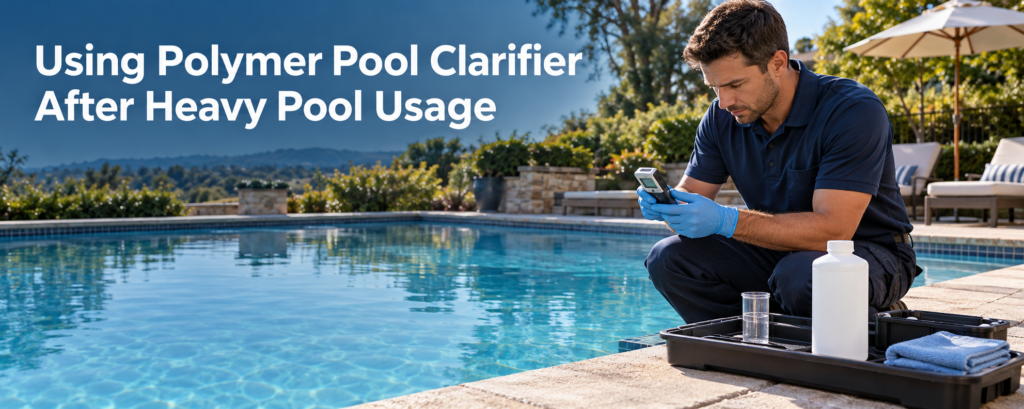
Hero image alt text: Pool technician checks water quality beside an outdoor swimming pool after heavy use, with a white chemical bottle on a service tray.
Frequently Asked Questions
1. Should I add polymer pool clarifier after every pool party?
Not automatically. Test the water, remove debris, and check the filter first. Use clarifier when fine haze remains or when the product’s approved maintenance instructions call for treatment.
2. Can polymer pool clarifier remove sunscreen after heavy swimming?
It may help capture some suspended particles associated with swimmer products. It should not be assumed to remove all sunscreen ingredients, dissolved contaminants, or surface films. Waterline cleaning and normal water treatment may still be needed.
3. Can I add pool clarifier and shock on the same evening?
Possibly, but follow both products’ instructions. Sanitizer level, chemical compatibility, and required spacing vary by formulation. Add products separately and never mix their concentrates.
4. Why is my pool still cloudy after clarifier treatment following heavy use?
Possible causes include poor circulation, a loaded or faulty filter, low sanitizer, incorrect dosing, algae, or precipitation from water imbalance. Recheck these before repeating the clarifier dose.
5. Is polymer pool clarifier suitable for a busy saltwater pool?
A product approved for the pool’s saltwater system and filter can be suitable. A saltwater chlorinator still produces chlorine, so sanitizer testing, water balance, circulation, and label-directed dosing remain essential.