
GET IN TOUCH
Ask For Sample?
Pool Clarifier vs Enzyme Treatment: What Is the Difference?
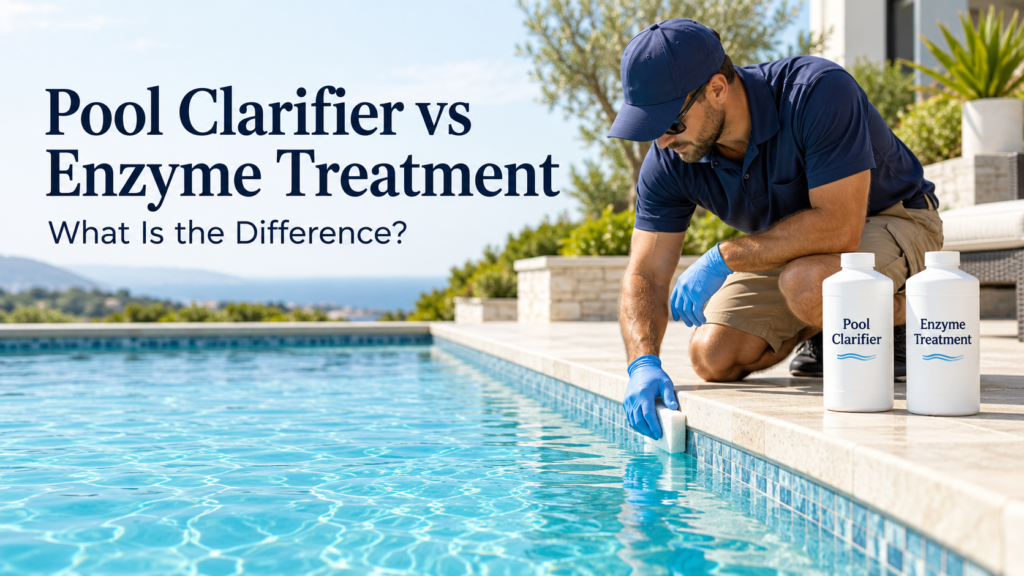
Your pool looks a little dull. There’s a faint haze in the water, and a greasy line has started to form along the tiles. You check the treatment shelf and find two products: a pool clarifier and an enzyme treatment.
Both promise to help keep the pool clean. So, do they do the same job?
A pool clarifier helps the filter capture fine suspended particles. An enzyme treatment helps break down certain non-living organic residues, such as oils and grease. Their effects can overlap, but they act in different ways.
That difference matters. A product that helps with dusty, hazy water may not be the right answer for a stubborn oily waterline. And neither treatment replaces chlorine, proper water balance, or a working filter.
Once you understand what each product targets, choosing between them becomes much easier. You can treat the cause of the problem instead of adding another bottle and hoping for the best.
Same Goal, Different Jobs
Pool clarifiers and enzyme treatments can both support cleaner-looking water. Yet they reach that goal through different routes.
A conventional clarifier helps tiny particles gather into groups that the filter can catch more easily. The dirt still needs to leave the water through filtration.
An enzyme product works on suitable organic compounds. Enzymes are catalysts: they help specific chemical reactions happen more readily. In pool care, suitable formulations can help break down oils and other selected organic residues.
Here’s a quick comparison:
| Question | Pool clarifier | Enzyme treatment |
|---|---|---|
| What is its main role? | Help remove fine suspended particles through filtration | Help break down selected non-living organic residues |
| What might it address? | Fine dust, small debris, and particle-related haze | Body oils, greasy residues, and some lotion or cosmetic components |
| How does it work? | Conditions particles so they can form filterable clusters | Catalyzes reactions involving suitable organic compounds |
| Does it replace chlorine? | No | No |
| Does it repair poor circulation? | No | No |
| Is it always needed? | No; use depends on water conditions | No; use depends on the residue problem |
| Can a product contain both? | Yes | Yes |
Those last two points deserve attention. A well-maintained pool may need neither product, while another pool may benefit from both. The label and the actual water condition should guide the choice.
What Does a Pool Clarifier Actually Do?
Pool filters remove suspended material, but some particles are hard to capture. They may be very small, remain well dispersed, or pass through the filter under the system’s operating conditions.
A clarifier helps make those particles easier to remove.
Many liquid clarifiers use water-soluble polymers. These molecules interact with suspended particles and help them gather into larger clusters. The filter then has a better chance of retaining them. Manufacturer descriptions of conventional pool clarifiers identify this particle-gathering action as their main function.
Think of loose crumbs on a table. Picking up each tiny crumb takes work. Gather them into a few larger piles, and the job gets easier.
The comparison isn’t perfect, but it captures the idea: a clarifier helps the filter collect what was difficult to catch before.
Cationic polymers carry a positive electrical charge. Many fine particles in pool water have negatively charged surfaces, so these polymers can help reduce the forces that keep particles apart. Depending on the polymer and water conditions, particle grouping may involve charge neutralization, bridging, or a combination of effects.
Eautrix’s Polymer Pool Clarifier is based on PolyDADMAC, a cationic polymer with CAS number 26062-79-3. Its published formulation contains 10% active ingredient. That identifies the product’s chemistry; it does not establish a universal dose for every pool.
The key point is simple. A clarifier supports a removal process. It doesn’t make dirt disappear.
What Does an Enzyme Treatment Do?
Enzyme treatments address a different part of the pool’s contamination load.
Swimmers bring more than leaves and dust into the water. Body oils, lotions, cosmetics, and other residues can enter with each swim. Some collect at the surface. Some stick to tiles or filter material.
Pool enzyme formulations are designed to act on selected non-living organic contaminants. Manufacturer guidance describes their use for oils, grease, and related bather residues. The range of materials treated depends on the formula.
An enzyme is selective. It works on suitable chemical structures rather than treating every contaminant in the same way.
That’s why “enzyme treatment” is a broad category, not a promise that one bottle will remove every kind of organic waste. A product may contain one enzyme type, several enzymes, or enzymes combined with other ingredients.
There’s another useful distinction: enzymes are not the same as live bacteria. A conventional enzyme treatment relies on catalytic molecules. Don’t assume it contains living microbes unless the manufacturer says so.
Also, breaking down a compound does not automatically mean that every reaction product has left the pool. Further treatment and normal pool maintenance may still be needed.
For the pool owner, the practical question is less about the word “enzyme” and more about the stated target: What does this particular product claim to treat, and under what conditions?
Is Your Problem Haze, Oil, or a Bit of Both?
Before choosing a treatment, take a close look at the pool.
Is the water uniformly hazy? Is there a slick on the surface? Does the waterline feel greasy? Did the problem appear after a windy day, a busy weekend, or a change in water chemistry?
These clues help, though appearance alone cannot confirm the cause.
Fine suspended debris may be a reason to consider a clarifier once basic checks are complete. An oily film or repeated greasy buildup may be a reason to assess an enzyme product.
But cloudy water has many possible causes:
- Fine suspended particles.
- Poor circulation or inadequate filtration.
- Algae growth.
- Low sanitizer levels.
- Mineral precipitation.
- A recent chemical addition.
- Excess treatment chemicals.
A white haze caused by mineral precipitation is not the same problem as a greasy surface film. Likewise, green water with slippery walls needs a different response from a faint dust haze.
It’s tempting to see all cloudy water as one problem. It isn’t.
Start by testing the water and checking the equipment. Then decide whether an added treatment has a clear job to do.
When Does a Pool Clarifier Make Sense?
A clarifier is most relevant when fine suspended particles remain in the water despite adequate circulation and a functioning filter.
Consider a pool after a windy afternoon. You’ve removed the leaves, emptied the baskets, and checked the filter. The water still has a light haze, but there’s no obvious oily film or sign of active algae.
If testing and inspection rule out other likely causes, a compatible clarifier may help the filter remove the remaining particles.
The same reasoning applies after other maintenance work. Once the underlying problem has been corrected, a small particle load may still leave the water looking dull. A clarifier can sometimes help with that final polishing stage.
However, it cannot compensate for a damaged filter, a poor flow rate, or water that bypasses the filter medium.
Before dosing, ask:
- Is the filter in good condition?
- Is water moving through the system as intended?
- Is the product approved for this filter type?
- Have I checked the pool’s sanitizer and water balance?
- Has another clarifier already been added?
That last question is easy to miss when several people maintain the same pool.
A clear dosing record can save a lot of guesswork—and a lot of extra chemical.
When Is an Enzyme Treatment Worth Considering?
An enzyme treatment may be worth assessing when suitable oily or organic residues keep returning.
Imagine a busy outdoor pool in summer. Swimmers arrive throughout the day, many wearing sunscreen. By evening, the tiles have a greasy mark, and the surface has a faint sheen.
That pattern suggests a different maintenance concern from dust alone.
An enzyme formulation labeled for those residues may help as part of the care program. Still, don’t assume it treats every component of every sunscreen. Sunscreens contain varied ingredients, including mineral particles that are not suitable enzyme targets.
Physical cleaning remains useful too. Wiping the waterline removes material directly rather than leaving the whole job to a chemical treatment.
For a hotel or resort, the decision should be based on repeated observations. Does the same greasy buildup return after peak swimming periods? Do staff spend substantial time cleaning it? Does a measured product trial improve that pattern?
Those are better questions than “Should every commercial pool use enzymes?”
Some pools have a clear need. Others don’t.
Can You Use Pool Clarifier and Enzyme Treatment Together?
In some cases, yes.
A pool can contain both fine suspended particles and oily organic residues. Compatible treatments may address those different parts of the problem.
Some commercial formulations already combine a clarifier with enzymes. Manufacturer descriptions show products in which a particle-binding ingredient supports filtration while an enzyme component addresses selected oils and organic waste.
That doesn’t prove that any two separate products can be added together.
Check the instructions for both. Pay attention to:
- Compatibility with the sanitizer system.
- Suitable pH and temperature conditions.
- Filter restrictions.
- Application method.
- Timing around other treatments.
- Any required interval between additions.
Never mix concentrated pool chemicals together in a bottle, bucket, or dosing container. Combined use in pool water is different from mixing concentrates.
There’s also no universal rule that enzymes must always come first. The right sequence depends on the products and the reason for treatment.
If the labels don’t answer the question, ask the suppliers for specific guidance. A clear answer about the two actual formulations is more useful than a general claim that “pool products work together.”
Neither Product Replaces Chlorine
This is the most important limit in the comparison.
Clear water is appealing, but appearance does not prove that water is properly disinfected. A clarifier is not a sanitizer. An ordinary enzyme treatment is not a sanitizer either.
CDC guidance places disinfectant control, pH testing, filtration, and recirculation at the center of pool operation. Commercial facilities must also follow the pool rules that apply in their location.
So, if sanitizer is low, address that problem.
If algae is growing, follow an appropriate algae-control and sanitation procedure.
If there has been a fecal contamination incident, use the required response procedure. Do not substitute a clarifier or enzyme dose for disinfection.
A pool can look better without being ready for swimming. Keep water clarity and sanitation in the same maintenance plan, but don’t confuse their roles.
Will Enzymes Reduce Chlorine Use?
You may see enzyme products promoted as a way to reduce the organic load that chlorine must handle. That can be a reasonable aim for a suitable formulation, but it is not a fixed outcome.
Chlorine demand depends on many things: sunlight, swimmer use, temperature, algae, contaminants, and the condition of the pool.
Treating certain residues does not justify lowering the required sanitizer level. Nor does it prove that chlorine use will fall by a stated percentage.
If you want to assess a product’s effect, keep records. Track sanitizer consumption, swimmer use, weather, and dosing over a useful period.
A quiet week followed by a busy weekend is not a fair comparison. Neither is a cloudy week compared with a week of strong sun.
For commercial pools, evaluate any claimed saving against the full maintenance cost, including the enzyme product, labor, cleaning, and water use. A smaller chlorine bill alone does not tell the whole story.
Which One Works Faster?
There’s no fair answer without knowing the problem.
A clarifier needs suitable contact with particles and enough circulation for the filter to remove them. Its visible effect depends on the dose, particle load, filter condition, and water movement.
An enzyme treatment has a different task. Its activity depends on the enzyme formulation, suitable residues, temperature, pH, and other operating conditions.
That means the two products should not be judged by one fixed countdown.
For a clarifier, you might track whether the haze is easing and whether filtration remains normal.
For an enzyme trial, you might track how often an oily waterline returns or how much cleaning it needs.
Follow the manufacturer’s stated assessment period. If results fall short, investigate before adding more.
Repeated dosing can turn a diagnosis problem into a dosing problem.
More Product Does Not Mean More Progress
A pool looks cloudy, so you add a little extra. It still looks cloudy later, so you add another dose.
Understandable? Yes. Reliable? No.
Clarifier performance depends on a suitable amount for the product and conditions. Excess polymer can interfere with the intended particle interactions, and some formulations can contribute to filter loading or persistent haze when misused.
Enzyme overdosing also offers no guaranteed benefit. Adding more cannot make an enzyme act on an unsuitable contaminant.
Measure the pool volume carefully. Read whether the dose refers to the finished product or its active ingredient. Use a marked measuring container, and record the amount added.
This matters even more for professional buyers comparing concentrates. Two products with different strengths should not be judged by bottle size alone.
Compare their documented application rates and performance under similar conditions.
The Filter Still Needs Your Attention
A clarifier and a filter work as a pair.
When particle capture improves, more material may accumulate in the filter. Watch the pressure and flow, then clean or backwash according to the equipment manufacturer’s instructions.
Don’t use one universal pressure value for every system. Each pool has its own normal operating condition.
Enzyme treatment also leaves the need for filter care in place. If the filter is already fouled, damaged, or poorly maintained, an enzyme dose is not a complete service procedure.
Check compatibility carefully for sand, cartridge, and diatomaceous earth (DE) filters. A claim on one product does not apply to the whole clarifier category.
And keep clarifiers separate in your mind from settling flocculants. Some flocculant treatments require settled material to be vacuumed to waste. They are not interchangeable with products designed to support normal filtration.
The removal method matters just as much as the bottle label.
A Practical Way to Choose
A simple decision process keeps treatment focused.
First, test and inspect. Check sanitizer, pH, and other relevant water-balance values. Inspect flow, filter condition, baskets, surfaces, and recent chemical additions.
Next, describe the problem. “Cloudy” is a starting point. “Light haze after wind, no oily film, normal flow” is much more useful.
Then, match the treatment to the evidence. A compatible clarifier may suit fine particle haze. A labeled enzyme formulation may suit recurring oily residues. Mixed problems may justify compatible combined treatment.
Finally, measure the result. Record the dose and track the specific symptom you wanted to improve.
If the pool remains cloudy, return to diagnosis. Check for an unresolved source, equipment fault, algae, or a water-balance issue.
You don’t need to keep adding products until something changes. You need a reason for the next step.
What Should Pool Service Companies and Buyers Ask Suppliers?
For professional buyers, the category name is only the beginning.
With a clarifier, ask for the active ingredient, concentration, application guidance, filter compatibility, and limits on use. Clarify whether the dose is stated as product volume, product mass, or active content.
With an enzyme product, ask which residues it is designed to treat and what operating conditions it needs. Request guidance for use around shock treatment and other chemicals.
For either product, ask for technical documentation and a safety data sheet. If a performance claim matters to the sale, ask how it was tested.
This is especially useful for private-label products. A label that says “clears cloudy water” should explain the product’s role clearly enough that users don’t mistake it for an algae treatment or sanitizer.
For Eautrix customers assessing cationic polymer pool clarifier, the practical discussion should start with the pool system, water condition, intended application, and packaging needs.
Good product selection begins with the problem you want to solve.
Choose the Treatment That Matches the Cause
Pool clarifier and enzyme treatment can both earn a place in pool maintenance, but they serve different needs.
Use the distinction as your guide: clarifiers help make fine particles easier to filter; enzymes act on selected organic residues.
A pool with particle haze may benefit from a clarifier. A pool with recurring oily buildup may benefit from an appropriate enzyme formulation. A pool with both problems may need a coordinated approach.
Keep testing, sanitation, circulation, and physical cleaning at the center of the work. Supporting products work best when those basics are already doing their job.
Frequently Asked Questions
1. Is pool enzyme treatment better than clarifier for cloudy water?
It depends on the cause. A clarifier may suit fine suspended particles, while an enzyme formulation may help with selected oily residues. Test the water and check filtration before choosing either.
2. Can I add pool clarifier and enzyme treatment on the same day?
Only if both products’ instructions allow it. Check timing and compatibility, particularly around shock treatment. Add products separately as directed, and never mix their concentrates.
3. Will pool enzymes remove sunscreen from swimming pool water?
Some formulations target oils and suitable organic components associated with lotions and sunscreen. They do not necessarily treat every ingredient, including mineral sunscreen particles. Check the product’s stated claims.
4. Do saltwater pools need clarifier or enzyme treatment?
Saltwater pools can develop particle haze or oily residues, so compatible products may be useful when those problems occur. A salt chlorine generator produces sanitizer; it does not remove every contaminant.
5. Why is my pool still cloudy after clarifier and enzymes?
The cause may remain unresolved. Check sanitizer, water balance, circulation, filter condition, algae, and previous dosing. Further additions should follow a diagnosis, rather than guesswork.