
GET IN TOUCH
Ask For Sample?
Pool Clarifier vs Algaecide: Understanding Their Different Functions
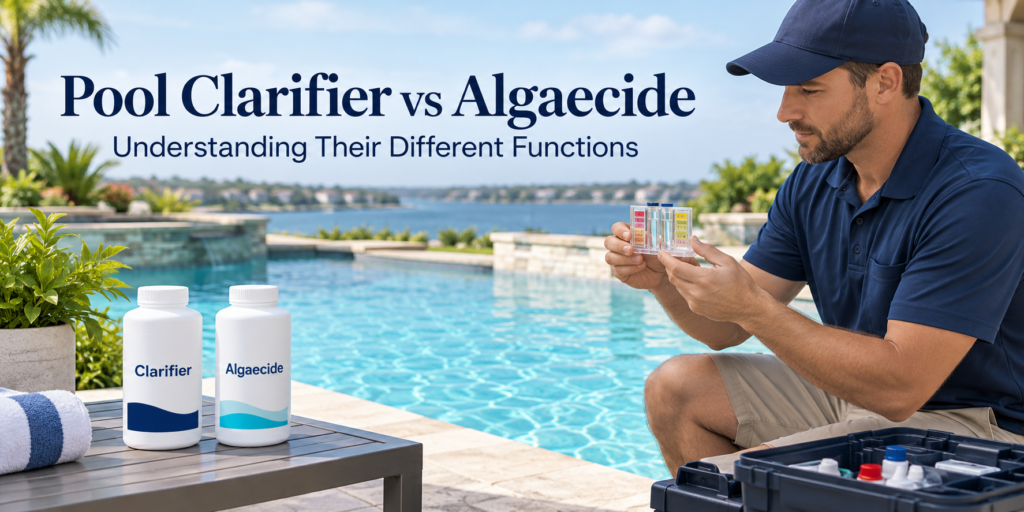
Your pool looks cloudy. Perhaps there’s a faint green tint, too. You check the chemical shelf and find two bottles: pool clarifier and algaecide.
Which one should you use?
It’s a fair question. Both products can help improve the look of pool water, and some labels even promise algae control and clarification in the same bottle. Yet their main jobs are different.
A pool clarifier helps the filtration system remove fine suspended particles. An algaecide helps prevent or control algae, according to its label.
That difference matters. If you treat a particle problem as an algae problem, you may add chemicals without fixing the haze. If you treat live algae with a standard clarifier alone, you may improve particle capture while the growth continues.
For pool owners, service teams, hotels, and chemical distributors, understanding these roles makes treatment decisions much easier. It also helps answer a more useful question than “Which product is better?”
What does this pool actually need?
Two Bottles, Two Different Jobs
Think of pool care as a team effort.
Sanitation controls germs. Water balance supports treatment performance and helps protect pool surfaces and equipment. Circulation moves water through the system. Filtration removes suspended material.
Clarifiers and algaecides support different parts of that process.
A clarifier focuses on particles that make water look dull or hazy. An algaecide focuses on algae that may grow in the water or on pool surfaces.
Here’s a quick comparison:
| Point of comparison | Pool clarifier | Pool algaecide |
|---|---|---|
| Main function | Helps remove fine suspended particles through filtration | Helps prevent or control algae |
| Main target | Small particles that contribute to haze | Algae covered by the product’s label |
| Typical reason for use | Persistent particle-related cloudiness | Algae prevention or treatment support |
| Relationship with filtration | Depends on effective particle removal | Filtration and cleaning still help remove debris |
| Replaces a sanitizer? | No | Do not assume so; follow the approved product label |
| Possible secondary benefit | Improved water appearance | Some formulations also support clarification |
The last row explains much of the confusion. A product can have more than one useful function. Still, those functions must be supported by the specific formulation and its directions.
The word “polymer” on two bottles does not make them interchangeable.
What Does a Pool Clarifier Actually Do?
Some particles in pool water are so small that they remain suspended and are difficult for the filter to capture.
You may not see each particle. You see their combined effect: a soft haze, a dull blue tone, or less detail on the pool floor.
A polymer clarifier helps bring fine particles together so they become easier to remove. Depending on the chemistry, this may involve reducing the electrical repulsion between particles, helping particles attach to one another, or both.
The technical terms include coagulation and flocculation. In plain English, small bits become easier-to-catch groups.
Think of loose crumbs on a table. Picking up each crumb takes time. Gather them into a pile, and cleanup gets easier.
There’s one catch, though: gathering material does not remove it.
The filter must still capture the particles. Water must reach that filter. Collected debris must then be removed through the correct cleaning procedure.
That’s why a clarifier works as part of a system. It cannot repair a torn cartridge, restore flow through a blocked line, or correct a filter bypass.
Eautrix’s <u>Polymer Pool Clarifier</u> is based on PolyDADMAC, CAS 26062-79-3, and is intended to support the removal of fine suspended particles through pool filtration. Eautrix
What Does an Algaecide Do?
An algaecide targets algae rather than ordinary suspended dirt.
Depending on its active ingredient and approved directions, it may help prevent algae from becoming established, control an existing problem, or support a broader treatment program.
Algaecide chemistry varies. Some products use small quaternary ammonium compounds. Others use polymeric compounds or copper-based ingredients.
Those differences affect how a product should be used. They also influence matters such as foam, staining precautions, compatibility, and treatment claims.
So, “algaecide” is a product category, not one fixed formula.
Read the label for the actual purpose. Does it describe routine prevention? Treatment of visible growth? Particular types of algae? A maintenance dose and a separate initial dose?
Those details matter more than a bold promise on the front of the bottle.
Also remember that controlling algae does not make the resulting debris disappear. Pool treatment labels may call for vacuuming after treatment to remove dead algae. The biological problem and the cleanup task are related, but they are separate jobs. www3.epa.gov
Cloudy Water Isn’t Always an Algae Problem
A hazy pool can tempt anyone to reach for algaecide.
But cloudiness is a symptom. It is not a diagnosis.
Fine dust, storm debris, disturbed sediment, treatment residues, poor filtration, and water balance problems can all contribute to an unclear appearance. Algae may also be involved.
The practical challenge is to identify the cause before choosing another chemical.
Start with observations:
- Is the water hazy, colored, or both?
- Are there visible patches on the walls or floor?
- Does brushing release material from the surface?
- Has there been a storm, heavy use, or a circulation failure?
- Was a chemical added just before the problem appeared?
- Are water test results reliable and within the required operating ranges?
No single sign gives the whole answer.
Green water, for example, may suggest algae, but color alone does not prove it. Metals can also affect water color. Likewise, blue water can still contain fine particles or have inadequate sanitation.
A good treatment decision combines water tests, surface checks, equipment inspection, and recent pool history.
That may take a little longer than pouring from a bottle. It often saves much more time later.
Can Pool Clarifier Kill Algae?
A standard pool clarifier should not be treated as an algae killer.
Its particle-gathering function does not establish that it can prevent or control algae.
This distinction is especially useful when comparing cationic polymers. “Cationic” means the material carries positive electrical charges. That property can help certain polymers interact with suspended particles.
But a positive charge alone does not prove algaecidal performance.
Polymer structure, formulation, concentration, and the intended use all matter. A product designed for clarification should be used for that purpose unless its label supports additional claims.
Imagine a pool with algae growing on its walls. Adding clarifier may help collect some suspended material, but it does not address every part of the problem. The surfaces still need attention, and the sanitation and algae treatment program still needs correction.
The useful rule is simple:
Choose a clarifier for its particle-removal role. Choose an algaecide for its supported algae-control role.
Don’t infer one function from the other.
Can an Algaecide Also Help Clarify Water?
Yes, some formulations can.
Certain polymeric algaecides have properties that also support clarification. This is why an “algaecide and clarifier” label can be reasonable rather than contradictory. EPA-accepted labeling includes examples of polymer products sold with both descriptions. www3.epa.gov
Still, that does not mean every algaecide is a general-purpose clarifier.
Nor does it mean a product with both functions performs identically to a dedicated clarifier in every pool.
The result depends on the formulation, dose, particle load, filtration system, and water conditions.
For example, Eautrix describes <u>Algae Control 60</u> as a polymer-based algae-control product that also supports water clarification. Its listed active ingredient differs from the PolyDADMAC used in the dedicated clarifier. eautrix.com
For buyers, this is an important distinction. Two products may both be polymers and both improve water appearance while serving different main purposes.
Ask what each formulation is designed to do. Then check the documents and directions that support that use.
The Pool Is Green—Which Job Comes First?
If live algae are confirmed, start by addressing the conditions that allow the growth to continue.
Check sanitation, water balance, circulation, and cleaning. Use an appropriate treatment program for the pool and the products involved.
An algaecide may form part of that program, but adding it should not distract from a failed pump, inadequate sanitizer delivery, or surfaces that need brushing.
A useful general sequence is:
- Test the water with a suitable method.
- Inspect circulation and filtration.
- Brush and clean affected surfaces as appropriate.
- Carry out the sanitizer and algae treatment steps specified for the system.
- Remove loosened material and treatment debris.
- Reassess any remaining haze before adding clarifier.
This is a decision framework, not a universal chemical schedule. Product directions determine the dose, order, spacing, and re-entry conditions.
Once algae control is established, fine suspended debris may remain. That is when a compatible clarifier may help the filter finish the cleanup.
The aim is to stop the source of the problem, then remove what remains.
The Pool Is Blue but Hazy—Does It Need Algaecide?
Not automatically.
Picture a pool after a windy afternoon. Fine dust has entered the water. The walls look clean, water tests are acceptable, and the circulation system is working.
That situation may call for particle removal rather than additional algae treatment.
A compatible clarifier could help if the haze comes from fine suspended material. But first check that the filter is clean enough to work and that water is actually moving through it as intended.
Now picture another blue, hazy pool. Its filter cartridge is damaged.
The same clarifier may produce disappointing results because the removal step is failing.
That’s the point: matching the chemical to the symptom is only half the job. You must also confirm that the equipment can complete the process.
For service teams, this is a useful habit. Before adding a second treatment, ask what prevented the first treatment from working.
Sometimes the answer is sitting inside the filter housing.
Why Water Can Stay Cloudy After Algae Treatment
It’s frustrating when the green tint fades but the pool still looks dull.
Has the treatment failed?
Not necessarily. Algae control and water clarification happen through different processes. Treatment may leave material that still needs to be captured or vacuumed out.
But don’t assume every remaining cloud is dead algae. Continued growth, poor circulation, filtration problems, or water imbalance may still be present.
Check the evidence again.
Look at the surfaces. Retest the water. Review flow and filter condition. Watch whether the haze improves during the required treatment period.
If fine suspended debris is the remaining issue, clarification may be useful. If the pool is still producing new algae, adding clarifier alone misses the cause.
This is also why a universal promise such as “clear water in a few hours” is unreliable. Pools differ in debris load, filter capacity, water chemistry, and treatment history.
Progress should be judged through water tests, visible conditions, and equipment performance—not the clock alone.
Can You Use Clarifier and Algaecide in the Same Pool?
Often, both can belong in the same maintenance program.
However, using two products in the same pool is different from mixing their concentrates together.
Never combine products in a bucket, measuring cup, or container to save time. Follow each label’s application method and use separate, suitable measuring equipment. CDC guidance specifically warns against mixing different pool chemicals. cdc.gov
Compatibility must also be checked at the product level.
A broad statement such as “works with common pool chemicals” does not answer every question about concentrated contact, unusual sanitizer systems, or closely spaced treatments.
Before using both products, confirm:
- Compatibility with the pool’s sanitizer system
- Suitability for the filter type
- Any required spacing between additions
- Relevant water chemistry restrictions
- Swimmer re-entry directions
There is no single waiting period that applies to every clarifier, algaecide, and shock treatment.
When directions are unclear, request a written recommendation for the specific products. A clear answer is more useful than a guess based on chemical categories.
More Product Doesn’t Mean More Progress
When a pool still looks cloudy, another dose can feel like the obvious next step.
It may also complicate the situation.
Clarifier performance depends on an appropriate dose. Too much polymer can impair clarification in some conditions and place extra demands on the filter.
Excess algaecide creates a different set of concerns. Depending on the formulation, misuse may contribute to foam, staining risks, or other unwanted effects.
The shared lesson is to measure carefully.
Know the pool volume. Use the directions for the actual product concentration. Record what was added and when.
Be especially careful with percentages and parts per million. A recommendation expressed as active ingredient is different from one expressed as formulated product. Mass-based and volume-based doses also need clear units.
For professional buyers, these are useful questions to settle before purchase:
“Does this dose refer to the finished product or the active polymer?”
“Is the measurement in grams, milliliters, or another unit?”
Small ambiguities on a technical sheet can become large errors beside a pool.
Neither Product Replaces a Working Filter or Proper Sanitation
A sparkling pool is reassuring. It is not proof that every operating condition is acceptable.
Clarifiers improve particle removal. Algaecides support algae control. Neither should be used as a reason to neglect the pool’s required sanitizer program.
Likewise, a pool with acceptable sanitizer readings may still need attention if the water is unclear.
Visibility has a safety role. CDC advises checking that the drain at the bottom of the deep end is visible, because clear water helps people see swimmers who may need help. CDC
If haze prevents a clear view of the bottom, keep swimmers out until the problem is resolved and reopening requirements are met.
For hotels and commercial pools, treat clarity and sanitation as separate checks that both need to pass.
That approach also makes troubleshooting easier. You can ask three distinct questions:
Is the water properly sanitized? Is the equipment working? Is suspended material being removed?
One bottle cannot answer all three.
What Pool Professionals and Buyers Should Look For
For a pool owner, the immediate aim is usually clear water and a manageable maintenance routine.
For a distributor or service company, the decision has more layers. The product must be easy to explain, suitable for the intended systems, and supported by clear documents.
A clarifier purchase should focus on its intended particle-removal application, concentration, filter compatibility, dosing method, and handling instructions.
An algaecide purchase should focus on its active ingredient, supported algae claims, preventive and treatment directions, compatibility, and the requirements of the destination market.
For a dual-function product, ask how both functions are supported. Avoid assuming that an ingredient name proves every claim on a proposed label.
Private-label buyers should also distinguish raw-material specifications from finished-product directions. A concentrated polymer supplied for formulation is not automatically a retail product ready for poolside use.
Clear product roles help customers make better choices. They also reduce the familiar complaint: “I added it, but the water still looks the same.”
Sometimes the product is suitable. The expectation is what needs correcting.
Build the Treatment Around the Problem
Pool clarifier and algaecide are useful tools when each has a clear job.
If fine particles are causing haze, investigate filtration and consider a suitable clarifier. If algae are growing, address sanitation, cleaning, and the appropriate algae treatment program. If both problems exist, deal with the growth and then assess the remaining particle load.
And if the pool already looks good?
Keep testing, maintain the equipment, and use preventive products only as directed. Clear water does not require adding every product on the shelf.
Good pool care is a series of informed decisions. Observe. Test. Treat. Check the result.
Once you understand the difference between clarification and algae control, those decisions become far less confusing—and the chemical shelf starts to make sense.
Frequently Asked Questions
1. Should I use pool clarifier or algaecide for cloudy blue water?
Check water chemistry and filtration first. If fine suspended particles are causing the haze and algae are not indicated, a compatible clarifier may help. Cloudy blue water alone is not a reason to add algaecide.
2. Can a polymer pool clarifier remove dead algae after treatment?
It may help the filter capture fine suspended algae debris. It does not remove the material by itself. Filtration, vacuuming, and filter cleaning still complete the cleanup.
3. Is polyquat algaecide the same as PolyDADMAC pool clarifier?
No. They are different polymer chemistries used for different main purposes. Some polyquat formulations also support clarification, but PolyDADMAC clarifier should not be assumed to have approved algae-control uses.
4. How long should I wait between adding algaecide and pool clarifier?
Follow the directions for both specific products. Required spacing depends on the formulations and other treatments involved. If the labels do not explain combined use, ask the suppliers before adding them close together.
5. Can a combined algaecide and clarifier replace chlorine?
Do not assume so. A dual-function product may support algae control and particle removal, but the pool still needs an appropriate sanitation program. Follow the product label and the operating requirements for your pool.