
GET IN TOUCH
Ask For Sample?
Common Mistakes When Using Polymer Pool Clarifier
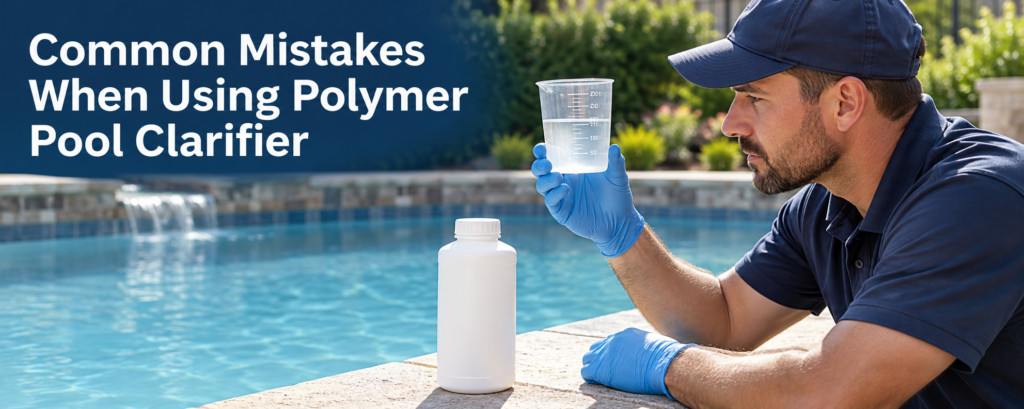
You add pool clarifier, run the pump, and wait for that clean, bright look. Yet the water still seems dull. Perhaps the haze has barely changed. Perhaps it looks worse.
It’s frustrating, especially when you’ve followed a routine that worked before.
But cloudy water doesn’t always mean the clarifier is weak. The dose may be wrong. The filter may need attention. Or the haze may come from a problem that clarifier can’t solve by itself.
Polymer pool clarifier works best as part of a complete pool care routine. It helps bring fine suspended particles together so the filtration system can remove them. It still needs suitable water conditions, good circulation, and a working filter.
The good news? Many common mistakes are easy to avoid once you know what to look for. Let’s walk through them, from that tempting extra splash to the less obvious problems hiding in the equipment room.
First, Know What Your Clarifier Is Trying to Do
Some particles in pool water are so small that they remain suspended and are difficult for the filter to capture. Fine dust, bits of debris, and other suspended matter can scatter light, leaving the water with a faint haze.
A polymer clarifier helps those particles form larger groups.
For cationic polymers, the positive charge can help reduce the repulsion between negatively charged particles. Depending on the polymer and the water conditions, particle aggregation may involve charge neutralization, polymer bridging, or a combination of effects. These are established water-treatment mechanisms, though results in a particular pool depend on its conditions.
Think of it as gathering loose crumbs into piles that are easier to collect.
There’s a catch, though. Gathering particles is only part of the job. They must then leave the water through filtration or another removal method specified by the product.
A clarifier doesn’t make dirt disappear. And a product intended to support filtration should not be treated as though it were a settling flocculant.
That distinction explains quite a few disappointing results.
Mistake 1: Treating Every Cloudy Pool as a Clarifier Problem
Cloudiness is a symptom. It isn’t a diagnosis.
Fine suspended particles may be the cause, but other possibilities include poor sanitation, algae growth, mineral precipitation, weak circulation, or a damaged filter. More than one issue can occur at the same time.
Before adding clarifier, ask a few basic questions:
- Is the sanitizer level suitable for the pool?
- Are pH and other relevant water-balance readings within the required ranges?
- Are the walls slippery or showing visible growth?
- Is the pump moving water as expected?
- Has the filter been inspected and maintained?
- Did the haze appear after rain, heavy use, topping up, or chemical treatment?
These clues help you choose the next step.
For example, a light haze after windblown dust may be a reasonable case for clarification. A green pool with visible algae needs a sanitation and algae-control response first.
Use clarifier for the particles it can help remove. Address the source of those particles as well.
Otherwise, you may keep clearing yesterday’s debris while today’s problem continues to grow.
Mistake 2: Assuming More Clarifier Will Work Faster
This is the classic mistake.
The water looks cloudy, so you add the suggested dose. Then you think, “It’s quite bad. A little extra should help.”
With polymer treatment, that extra amount can work against you.
Water-treatment guidance recognizes that excessive polymer dosing can restabilize suspended solids, making them harder to remove. The exact response depends on the polymer, dose, and water chemistry; it doesn’t happen in the same way in every pool.
The practical point is simple: clarifier has a useful dose range. More is not automatically better.
An excessive dose may leave persistent haze, reduce treatment efficiency, or add to filter-maintenance demands. A cloudy pool after dosing does not prove an overdose, but the amount added should be part of the investigation.
Measure the product. Don’t judge the dose by the size of the splash or the depth of the haze.
If the label provides separate doses for routine maintenance and cloudy-water treatment, use the category that fits the situation. Don’t invent a stronger treatment by doubling it.
Mistake 3: Guessing the Pool Volume
Even careful measuring won’t help if you use the wrong pool volume.
A pool that holds 40 cubic meters needs a different amount from one that holds 60 cubic meters. Yet volume estimates are often inherited from an old note, a previous owner, or a quick glance at the pool.
For a rectangular pool, a basic calculation is:
Length × width × average water depth = water volume
When measurements are in meters, the result is in cubic meters. Each cubic meter equals 1,000 liters.
For example:
8 m × 4 m × 1.5 m = 48 m³, or 48,000 liters
This example assumes a simple rectangular shape and an accurate average depth. Steps, benches, curved sections, and changing floor slopes may require a more detailed estimate.
Use the actual water depth rather than the full wall height.
Once you have a reliable figure, keep it with the pool records. That single number affects clarifier, sanitizer, and many other treatments. It deserves more attention than a rough guess.
Mistake 4: Copying the Dose from Another Clarifier
Two bottles can have similar names and very different dosing instructions.
Polymer type, active concentration, formulation, and intended application may vary. A dose that worked with one product may be too high or too low for another.
Color doesn’t tell you the strength, either. A blue clarifier is not necessarily more concentrated than a clear one.
For bulk products, there’s another detail to check: does the stated dose refer to the supplied liquid or to the active polymer?
A rate expressed in milligrams per liter of active ingredient is different from a rate expressed in milligrams per liter of finished product. Converting a mass dose to a liquid volume may also require the product density.
If the instructions are unclear, ask the supplier before dosing.
This matters for pool service companies that change suppliers and for distributors developing private-label products. A familiar bottle shape should never replace a fresh look at the directions.
Mistake 5: Adding Another Dose Before Assessing the First
Clarifier treatment takes time because filtration takes time.
The product needs to disperse. Particles need to aggregate. Water must pass through the filter, and captured material must stay out of the pool.
A pool may still look hazy during that process.
Adding more product every few hours creates a problem: you can no longer tell whether the original dose was sufficient. You’re stacking treatments before seeing the result.
Follow the product’s stated circulation, assessment, and repeat-dose instructions. There is no single waiting period that fits every polymer clarifier and every pool.
Record when the first dose was added. Check the filter and water conditions while the system operates.
If the water fails to improve within the expected treatment period, investigate. Don’t let impatience turn a measured dose into an unknown total.
Mistake 6: Running the Pump Too Little—or in the Wrong Mode
A filtration-support clarifier needs water movement and particle removal.
Adding it just before the pump timer switches off may give the treatment too little time to work. Poor flow can also limit how well the product spreads through the pool.
Check that the circulation system is operating as intended. Empty blocked baskets, confirm suitable water level, and investigate weak return flow.
On systems with a multiport valve, the operating mode matters. A “recirculate” setting commonly moves water while bypassing the filter. That may mix the treatment, but it does not provide normal filtration.
Use the mode required by the product and equipment instructions. Follow the equipment manual when changing valve positions, including its requirement to stop the pump.
There’s no universal pump schedule for all pools. Pool size, flow rate, filter condition, and product directions all matter.
The goal is effective filtration, not simply a humming pump.
Mistake 7: Expecting Clarifier to Rescue a Dirty or Damaged Filter
Clarifier and filtration work together. A filter problem can limit the whole treatment.
A loaded filter may restrict flow. A damaged cartridge, faulty internal part, or other defect may allow particles to return to the pool. An incorrectly maintained filter can leave you chasing haze with chemicals.
Before treatment, check the equipment:
- Compare pressure with the known clean-filter reading.
- Inspect baskets and accessible components.
- Look for unusual debris returning through the outlets.
- Check cartridges for damage where applicable.
- Follow the filter manufacturer’s servicing instructions.
Remember, pressure is a clue rather than a complete diagnosis. A low or normal reading does not prove that everything is working correctly.
After adding clarifier, continue watching flow and pressure. Captured material still needs to be removed during proper filter maintenance.
A successful treatment may create more work for the filter. That’s expected—the particles are finally being collected.
Mistake 8: Ignoring Filter Compatibility
“Polymer clarifier” describes a broad group of products. It does not guarantee that every formulation suits every filter.
Check whether your chosen product is approved for sand, cartridge, or diatomaceous earth filtration. Also check any restrictions in the equipment manual.
This is especially useful when changing products. Previous success with one clarifier does not establish compatibility with another.
Avoid broad assumptions such as “all clarifiers clog cartridges” or “all polymers work with every filter.” Both statements skip the details that matter.
Tell your supplier the filter type, pool volume, and intended treatment before selecting a product. For commercial installations, include the filtration arrangement and any automatic chemical-feed equipment.
A brief compatibility check can save repeated cleaning and a lot of head-scratching.
Mistake 9: Using Clarifier Like a Settling Flocculant
Clarifiers and flocculants both help with suspended particles, but the required treatment process may differ.
A filtration-support clarifier is generally intended to help the filter capture aggregated particles. A settling treatment may require a period without circulation, followed by removal of settled debris through a specified vacuuming method.
The names can overlap in product literature. That makes the directions more useful than the name alone.
Don’t turn off filtration simply because you expect the clarifier to drop everything to the floor. Equally, don’t send a settling treatment through a filter unless its instructions allow that process.
Before use, confirm how the captured material is supposed to leave the pool.
If the treatment requires vacuuming to waste, check that your system has the necessary setup. Choosing a process you can’t finish leaves the debris sitting in the pool.
Mistake 10: Skipping Water Testing
A pool can look nearly clear and still have unsuitable water chemistry. It can also look cloudy for reasons that an extra clarifier dose won’t solve.
Test before treating.
Sanitizer and pH are essential checks. Depending on the situation, alkalinity, calcium hardness, stabilizer, and other readings may also help explain the problem.
High pH combined with suitable mineral conditions, for example, can contribute to calcium carbonate precipitation. That haze calls for attention to water balance, rather than a reflex dose of clarifier.
At the same time, don’t apply rules from one coagulant to every polymer. Different treatment chemistries have different operating needs.
Use the operating ranges given for the pool, sanitizer system, and clarifier. Accurate test results make those directions useful.
And keep the testing kit in good condition. Expired reagents, poor storage, or inconsistent testing technique can send the treatment in the wrong direction.
Mistake 11: Mixing Clarifier with Other Chemical Concentrates
Compatibility in pool water does not mean concentrates can be mixed in a bucket.
This distinction matters. Products may be suitable for separate use in the same pool once properly dispersed, yet unsafe or unsuitable when combined directly.
CDC guidance states that different pool chemicals should never be mixed together. Read the labels, use the required protective equipment, and keep handling tools free from chemical contamination.
Don’t make a homemade mixture of clarifier, chlorine, acid, and algaecide to save time.
Apply each product separately according to its directions. Follow any stated spacing between treatments. There is no universal interval that covers every combination.
Also, don’t assume every clarifier needs dilution. Some are supplied ready to use; others have specific preparation instructions.
The label should decide what happens in the measuring container.
Mistake 12: Pouring into the Skimmer Without Checking
The skimmer is convenient, so it can become the default place for every liquid product.
That shortcut may be wrong.
Some treatments have specific skimmer or filter-feed directions. Others are intended for direct addition to pool water with circulation running.
A concentrated dose through the skimmer changes where and how the product first contacts the system. It may also bring it near other chemicals or equipment in the circulation line.
Follow the stated application point. Don’t choose the skimmer because it worked for a different product.
If instructions call for distribution around the pool, use that method. If they permit skimmer dosing, follow the stated conditions.
Where you add a chemical can matter just as much as how much you add.
Mistake 13: Leaving the Source of Debris Untouched
Clarifier can help collect fine particles, but it doesn’t empty baskets, skim leaves, or remove debris from the floor.
After a storm, start with the visible mess. Remove large debris, clean baskets, inspect circulation, and test the water. Then decide whether the remaining haze needs clarification.
The same approach helps during pollen season or after heavy pool use.
If dust keeps entering from nearby work, or runoff keeps washing into the pool, a stronger clarifier routine may only treat the result. The source still needs attention.
For busy hotel and resort pools, cleaning and filtration capacity also deserve a review. Repeated haze during peak use may signal that the existing routine is struggling with the load.
Clarifier can support that routine. It cannot perform every task in it.
Mistake 14: Keeping No Record of Treatment
For a homeowner, this may mean forgetting whether the dose went in yesterday or three days ago.
For a service company, it may mean two technicians treating the same pool without knowing what the other added.
Both situations make overdosing more likely.
Keep a short record of:
- Product name and concentration, where stated.
- Amount added.
- Pool volume.
- Date and time.
- Water-test results.
- Filter condition and maintenance.
- Observed change in clarity.
You don’t need a complicated system. A simple log is enough if people use it.
Records also help separate product performance from changing conditions. A treatment after heavy rain is not the same test as a dose in a lightly used, well-maintained pool.
Without that context, memory can be a rather generous storyteller.
Mistake 15: Judging Results Only by the Water Color
Blue water can still be hazy. Light, shade, tile color, and viewing angle can hide or exaggerate cloudiness.
Assess visibility from the same place and under similar conditions when possible. Look at floor details, steps, and the deep end rather than the surface color alone.
For commercial pools, use the clarity checks and operating requirements that apply to the venue.
CDC advises swimmers to avoid unusually cloudy water and check that the drain at the bottom of the deep end is visible. Poor visibility deserves immediate attention, not another casual splash of product.
Clear appearance also does not prove proper sanitation. Water clarity and suitable sanitizer levels are separate requirements.
Check both before deciding that the pool is ready for use.
What If You’ve Already Added Too Much?
First, stop adding more clarifier.
Write down what was used and estimate the total dose as accurately as you can. Then test the water and inspect the filtration system.
Maintain filtration according to the product and equipment guidance, while monitoring pressure and flow. Clean or service the filter when required.
Contact the supplier with the product name, amount added, pool volume, test results, and filter type. Those details are far more useful than “the pool is cloudy.”
Avoid adding an acid, a second clarifier, or another chemical as a guessed antidote.
There is no universal recovery recipe. Depending on the formulation and severity, the supplier may recommend continued filtration, maintenance, or controlled water replacement. Water replacement also requires consideration of the pool structure, groundwater, and local discharge requirements.
Keep swimmers out when visibility or water conditions are unsuitable.
A More Reliable Routine Starts Before the Bottle Opens
Consistent results come from a clear sequence: identify the likely cause, test the water, check the equipment, confirm the dose, and follow the treatment through filtration and maintenance.
Choose a product whose directions fit your pool and filter. Read them each time, especially when switching formulations.
For buyers and distributors, ask for clear dosing units, active concentration, filter compatibility, application instructions, and repeat-treatment guidance. These details make a product easier to use correctly.
Eautrix’s Polymer Pool Clarifier is based on PolyDADMAC technology and is available with concentration adjustment, custom packaging, and private-label support. Buyers should confirm the final formulation and its application directions before preparing labels or customer guidance.
The aim is simple: use the appropriate amount, give the filter suitable working conditions, and judge the result before treating again.
That’s how clarifier becomes a useful tool instead of another bottle in a cycle of guesswork.
Frequently Asked Questions
1. Why is my pool still cloudy after adding polymer pool clarifier?
Possible causes include unsuitable dosing, insufficient filtration, a dirty or damaged filter, active algae, or mineral precipitation. Check water chemistry, equipment, and the product’s expected treatment period before adding another dose.
2. Can too much polymer pool clarifier make pool water cloudy?
Yes, excessive polymer dosing can reduce particle-removal efficiency and may contribute to persistent haze. However, cloudiness alone does not confirm an overdose. Review the amount added, pool volume, water tests, and filtration conditions.
3. How soon can I add a second dose of pool clarifier?
Follow the repeat-dose interval on the specific product label. Allow the first treatment its stated working period, then assess clarity and filter performance. Avoid repeated doses based only on a quick visual check.
4. Can polymer pool clarifier be used with a cartridge filter?
Some formulations are suitable for cartridge filters, but compatibility must be confirmed for the chosen product. Follow both the clarifier directions and the filter manufacturer’s maintenance instructions.
5. Should I add pool clarifier before or after treating algae?
Address active algae and unsuitable sanitation first through the appropriate treatment program. Once that process allows it, a compatible clarifier may help filtration remove remaining fine debris. Follow the directions for each product and never mix the concentrates.