
GET IN TOUCH
Ask For Sample?
How to Use Polymer Pool Clarifier with a Sand Filter?
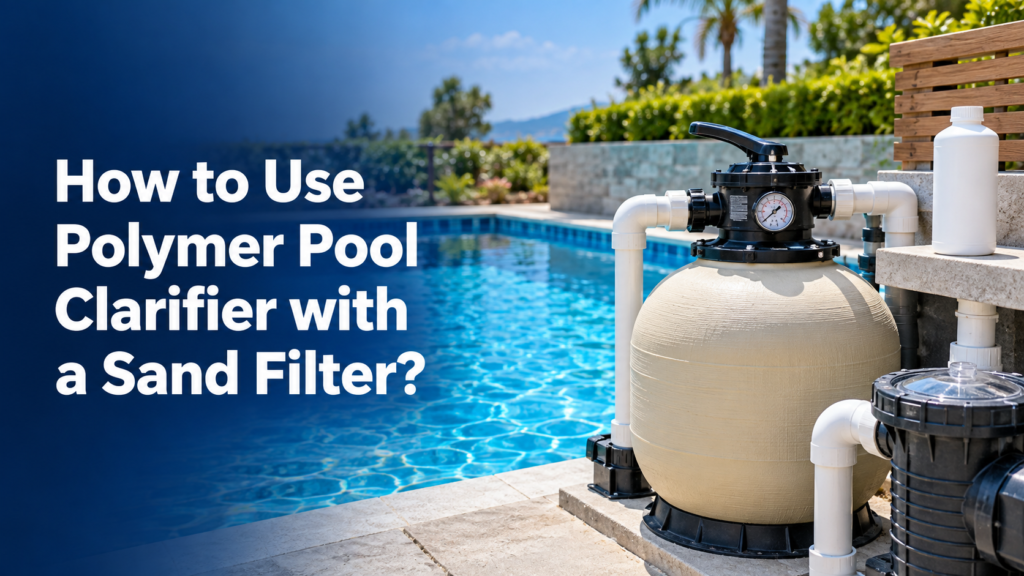
A sand filter can handle a lot of pool dirt. Leaves, grit, and other visible debris are usually easy to spot and remove. Fine haze is another matter. The pump runs, the return jets move water, and the pool still looks dull. Sound familiar?
A compatible polymer pool clarifier can help your sand filter capture some of the fine suspended matter behind that haze. But the bottle is only one part of the job. The dose, water flow, filter condition, and time allowed for filtration all matter.
To use polymer pool clarifier with a sand filter, check the water and equipment, measure the label dose for your pool volume, add it as directed with circulation running, and keep the system in FILTER mode. Watch filter pressure and water clarity, then backwash when the filter manual calls for it.
That is the basic routine. Now let’s walk through the details that make it work—and the small mistakes that can turn a simple treatment into a frustrating week.
Why a Sand Filter Sometimes Needs a Helping Hand?
A sand filter moves pool water through a bed of filter media. As water passes through, the bed holds back dirt. The filtered water returns to the pool, and the cycle continues.
Yet some suspended particles are hard to capture. They may be very small, remain well dispersed, or pass through the bed under the system’s operating conditions. You see their combined effect as a soft haze rather than individual bits of dirt.
This is where a polymer clarifier can be useful. Depending on its chemistry, a polymer may reduce the electrical repulsion between particles and help link them into larger groups. That makes suitable particles easier for the filter to retain.
Think of loose crumbs on a table. Picking up each tiny crumb takes time. Bringing them together makes the task easier. In a pool, the chemistry helps gather the particles; the filter still has to remove them.
There is a useful distinction here: clarifier supports filtration. It does not repair a broken filter, restore lost pump flow, or replace a sanitizer. If the system is struggling for another reason, adding more clarifier will not solve that reason.
First, Make Sure You Have the Right Type of Product
“Clarifier” and “flocculant” can be confusing names. Both may involve particle aggregation, and manufacturers do not always use the terms in the same way.
For this guide, a filtration clarifier means a product intended to help your operating filter remove suspended particles. A settling flocculant means a treatment intended to form material that settles on the pool floor and is then removed by the specified method, often vacuuming to waste.
Read the application directions, not just the front label.
Before using a product with a sand filter, confirm:
- The product is approved for your filter type and pool system.
- Its directions call for filtration or clearly explain a different treatment method.
- The dose is stated for the exact formulation you have.
- The application point and required circulation period are clear.
- Any repeat-dose limits or chemical compatibility instructions are available.
A liquid product is not automatically a filtration clarifier. And a polymer-based product is not automatically suitable for every pool. The finished formulation and its instructions decide how it should be used.
Check the Pool Before You Reach for the Bottle
Start with a water test. Check pH and sanitizer, and review other readings that may explain the cloudiness, such as total alkalinity or calcium hardness. Use targets appropriate to your pool, sanitizer system, and local operating requirements.
Why test first? Because cloudy water is a symptom with several possible causes. Fine dust is one. Active algae, mineral precipitation, and poor circulation are others. They can look similar from the deck but need different action.
If algae is growing, address the sanitizer problem and follow a suitable algae treatment plan. Clarifier may assist with the remaining particulate haze after treatment, but it should not be treated as an algae cure.
Next, check the physical system. Empty the skimmer and pump baskets. Make sure the pool water level supports proper skimming and the return flow looks normal. Check that valves are correctly set and the pump is not drawing air.
Brush surfaces and remove accessible debris as part of normal cleaning. There is little sense in asking a small dose of clarifier to compensate for a floor covered in dirt.
If the deepest part of the pool cannot be seen clearly, keep swimmers out until visibility and other safety conditions meet the applicable requirements. A pool can look inviting at the shallow end while still hiding a visibility problem elsewhere.
Give the Sand Filter a Fair Start
Look at the pressure gauge before treatment. Compare the reading with the clean-filter pressure recorded under comparable pump speed and valve settings.
If pressure is already at the manufacturer’s backwash threshold, clean the filter as directed before adding clarifier. A loaded filter with poor flow is a weak starting point.
But do not backwash just because you are about to add a chemical. If pressure and flow are normal, follow the equipment manual rather than an automatic calendar habit.
Record the starting pressure. It takes a moment and gives you a useful reference later. “It seems high” is much less helpful than “it has risen from the usual clean reading under the same settings.”
Also check that the gauge works. A stuck needle can make a filter seem steady while its condition changes. Pressure is useful only when the reading is reliable and understood alongside flow.
Measure the Dose—A Splash Is Not a Measurement
Polymer pool clarifiers differ in concentration and chemistry. A dose copied from another product may be too much or too little for yours.
Use the current label or supplier’s written instructions for the exact product. Distinguish a cloudy-water treatment dose from a routine maintenance dose. They may not be the same.
If the label gives a volume of product per volume of pool water, the calculation is straightforward:
Product needed = pool water volume ÷ label reference volume × label dose.
Here is a hypothetical example for arithmetic only. Suppose a label specifies 10 mL per 1,000 L of pool water. For a 40,000 L pool:
40,000 ÷ 1,000 × 10 = 400 mL.
Those numbers are not a dose recommendation for Eautrix or any other clarifier. Replace them with the directions on your own product.
Be especially careful with instructions expressed in ppm. Ask whether the figure refers to active polymer or the finished formulation. Those are different quantities. If a mass dose must be converted to a liquid volume, the product density may also be needed.
Use a dedicated measuring device and follow the label’s handling instructions. Do not assume that a bottle cap is a measuring cup unless it is designed and marked for that purpose.
More product does not guarantee clearer water. Excess polymer can interfere with treatment and may worsen haze or increase filter loading. Stay within the stated dose and repeat-treatment limits.
Add Clarifier with the System Set to FILTER
For a filtration-type clarifier, the water needs to pass through the sand bed. Set the system to FILTER and confirm normal circulation before dosing.
RECIRCULATE bypasses the filter on a typical multiport system. It can move water around the pool, but it does not capture particles in the sand bed. WASTE sends water out of the pool and is not the normal setting for filtration clarification.
Follow the product’s application method. Some liquid clarifiers are added directly to pool water with the circulation system running. Others have different instructions. One manufacturer’s liquid clarifier, for example, specifies direct addition to circulating pool water and at least eight hours of circulation; this is a product-specific instruction, not a universal schedule.
If direct addition is specified, distribute the measured dose as directed where water movement will help it mix. Avoid leaving a concentrated puddle on a step or in a still corner.
Do not pour clarifier into the skimmer unless the label explicitly directs that method. Instructions for a gel block, a filter cleaner, and a liquid clarifier are not interchangeable.
Likewise, dilute only when instructed. Do not mix clarifier concentrate with chlorine, acid, or another pool chemical in a bucket. Apply products separately according to their directions and any required spacing.
Let the Filter Work, Then Judge the Trend
Once the clarifier has dispersed, the filter needs time to remove the particles it can now capture. The chemical cannot carry them out of the water by itself.
Run filtration for the period stated on the label. Where instructions are unclear, ask the supplier rather than borrowing a runtime from another formulation. Pool size, actual flow, dirt load, and filter condition can all affect progress.
Check the trend at sensible intervals. Can you see floor markings more clearly? Does the deep end look less hazy? Is return flow still strong? Has pressure changed?
Use the same viewing point where possible. Light and reflections can fool the eye. A shaded pool at dawn may look quite different from the same pool under bright afternoon sun.
Commercial operators may use a turbidity meter as well as visual checks. For a service route, simple records and consistent observations are already a useful step forward.
Avoid making a new dose decision after only a brief glance. Follow the product’s treatment and reassessment period. If improvement is slow, investigate the process before reaching for more chemical.
When Should You Backwash After Adding Clarifier?
There is no fixed rule that every pool must be backwashed a certain number of hours after dosing. The sand filter’s condition and its manual should guide the decision.
As the bed collects particles, pressure may rise and flow may fall. Backwash when the manufacturer’s specified pressure increase or other cleaning criterion is reached. Compare readings at the same pump speed and similar valve settings.
Do not ignore a rapid pressure increase simply to complete a planned treatment window. A filter that needs cleaning needs attention. On the other hand, repeatedly backwashing a system with normal pressure and flow adds water loss and interrupts the filtration process.
For a typical multiport sand filter, the sequence involves stopping the pump, setting BACKWASH, running the specified backwash cycle, stopping the pump again, setting RINSE, and then returning to FILTER after the prescribed rinse. Always stop the pump before changing valve positions. Follow your own manual for durations, pressure relief, restart, and discharge requirements.
After cleaning, restore the water level if needed, confirm normal flow, and record pressure. Backwashing removes captured dirt and pool water. It does not mean you should automatically replace the full clarifier dose. Reassess under the product’s directions.
Do You Need to Vacuum the Pool to Waste?
Not as a routine requirement for every polymer clarification treatment.
A filtration clarifier is intended to support removal through the filter. That differs from a settling treatment whose directions call for collecting settled floc from the floor.
Still, a pool may contain loose dirt that needs vacuuming as part of normal cleaning. Follow the product directions and assess what is actually on the floor.
If a settling flocculant was used, do not assume its sediment can be sent through the sand filter. Use the removal method specified for that treatment and equipment. Some systems also need special arrangements for vacuuming to waste.
The useful question is not “Can my sand filter use chemicals?” It is “Where does this treatment expect the collected dirt to go?” Once that is clear, the valve settings and cleaning steps make much more sense.
Still Cloudy? Check These Causes Before Adding More
A pool that stays cloudy is asking for a closer look. It is not necessarily asking for a larger dose.
First, confirm that filtration is actually taking place. A valve left in RECIRCULATE can create lively return jets while bypassing the sand bed. Water movement alone is not proof of filtration.
Next, review flow. Blocked baskets, suction restrictions, air leaks, and inappropriate operating settings can reduce useful circulation. Increasing pump speed blindly is not a reliable fix; the system must operate within the equipment’s flow limits.
Then revisit the filter. Persistent poor clarity may call for inspection of the media bed, valve seals, or internal parts. Dirt bypass, channeling, unsuitable media, and damaged components require equipment attention rather than repeated clarification.
Review the chemistry as well. If cloudiness comes from active algae or a continuing mineral precipitation problem, fine-particle treatment alone will not address the cause.
Finally, look at the dosing record. Was the pool volume correct? Were units confused? Was a second dose added too soon? Did another person treat the pool without recording it?
That last point is easy to miss. Two well-meaning people can each add a “small top-up” and leave nobody sure how much product is in the water.
Make the Routine Easier for Pool Service Teams
For service companies, hotels, and commercial pools, consistency matters as much as a single clear-water result. A treatment should be easy to repeat and easy to review.
Keep a short record of pool volume, test results, product name, dose, application time, filter pressure, and backwashing. Note unusual events such as a storm, heavy use, or nearby construction dust.
Seasonal context helps. Spring pollen can bring a different load from summer crowds. A storm can introduce both visible debris and fine suspended matter. The treatment still starts with diagnosis, but the likely source may change.
Use those records to assess whether clarifier is helping under normal conditions. Do not make every pool follow the same dose calendar simply because it is convenient for the route.
A maintenance program should match the label and the pool’s actual needs. Clean water does not automatically need an extra treatment, and recurring haze deserves investigation even when a clarifier temporarily improves its appearance.
What Should Buyers Ask a Polymer Clarifier Supplier?
A clear-looking sample is useful, but technical instructions matter more once the product reaches a customer’s equipment room.
Ask for written information on sand-filter compatibility, active content, dose basis, application method, circulation requirements, and repeat-treatment limits. Request the current safety data sheet and relevant technical documentation.
For private-label supply, make sure the retail instructions match the finished formulation. A change in concentration should prompt a review of dosing directions; the same bottle design does not mean the contents should be used at the same rate.
Eautrix’s Polymer Pool Clarifier is listed as a PolyDADMAC-based formulation with 10% active ingredient. Eautrix also lists formulation adjustment, private labeling, and several packaging sizes. Buyers should confirm the final specification and application instructions for the product they purchase.
A good supplier conversation starts with the pool conditions and intended use, not just the price per bottle. Clear instructions help the user measure correctly, understand the treatment, and know when to investigate another cause.
Frequently Asked Questions
1. Can polymer pool clarifier be used with any sand filter?
Use it only when the product directions confirm sand-filter compatibility. The filter must also be correctly installed and operating normally. Polymer chemistry alone does not prove that a finished product suits every system.
2. Should I backwash my sand filter before adding pool clarifier?
Backwash first if pressure or flow meets the filter manufacturer’s cleaning criteria. If the system is operating normally, follow the manual rather than backwashing automatically before each dose.
3. Should the pump stay on after adding polymer clarifier?
For a filtration clarifier, run the pump in FILTER mode for the label’s stated period. Turning the pump off to let material settle belongs to certain settling treatments and should not be assumed for a filtration product.
4. Why is my pool still cloudy after clarifier and sand filtration?
Possible causes include insufficient filtration, poor flow, an unsuitable dose, active algae, mineral precipitation, or a filter fault. Check the treatment record, water chemistry, valve setting, and equipment before adding more product.
5. Can I add polymer pool clarifier every day until the water clears?
Only if the exact product’s directions permit that schedule. Daily additions can lead to excessive dosing. Observe the required reassessment period, and investigate persistent haze instead of repeatedly topping up.