
GET IN TOUCH
Ask For Sample?
Why PolyDADMAC Is Suitable for Swimming Pool Water Clarification?
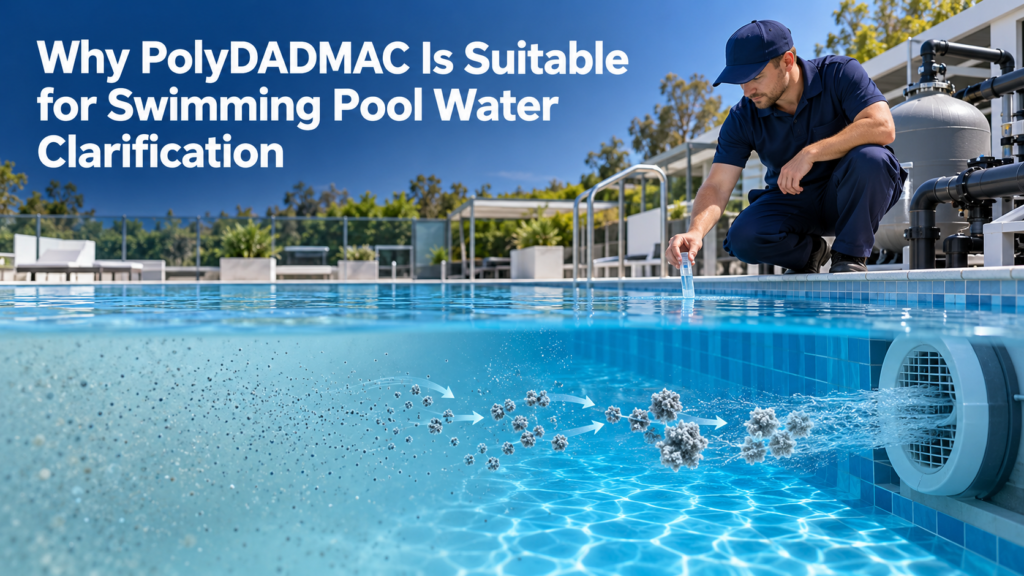
A swimming pool can have the right chlorine reading, a sensible pH, and a pump that seems to run perfectly—yet the water still looks dull. The floor is visible, but not sharp. Underwater lights reveal a faint haze. In a hotel or public pool, that small loss of clarity can quickly become a major operational concern.
Quite often, the problem is not a lack of disinfectant. It is a large population of very small suspended particles that the filter cannot catch efficiently.
This is where PolyDADMAC can help.
PolyDADMAC, short for poly(diallyldimethylammonium chloride), is a water-soluble cationic polymer used in many water-treatment applications. In a properly formulated swimming pool clarifier, it helps fine particles gather into larger, more filterable clusters. The filter can then remove material that might otherwise circulate for hours—or days.
That simple mechanism explains much of its appeal. Still, a good clarifier must do more than make water look brighter for a few hours. It should work with the circulation system, behave predictably at a low dose, suit liquid formulation, and avoid creating new maintenance problems when used as directed.
PolyDADMAC checks those boxes remarkably well.
Let’s look at why.
First, What Is PolyDADMAC?
PolyDADMAC is the common shortened name for poly(diallyldimethylammonium chloride). It is also known as PDADMAC or Polyquaternium-6, and its CAS number is 26062-79-3.
Chemically, it is a cationic polymer. “Cationic” means it carries positive electrical charges along its polymer chain. Unlike a small molecule with only one point of charge, a PolyDADMAC chain carries many charged sites. This gives it multiple opportunities to interact with suspended matter in water.
Why does that matter in a pool?
Many fine particles found in swimming pool water have a net negative surface charge. Examples may include tiny mineral particles, dust, clay, fragments of organic matter, some dead algae, and material introduced by swimmers. That surface charge helps particles repel one another, rather like two magnets held with matching poles together. They remain dispersed and can be too small for a filter to retain.
PolyDADMAC changes the situation. Its positive charge reduces the electrical repulsion between particles. Once that stabilizing force becomes weaker, the particles can collide, gather, and form larger clusters.
The chemistry sounds advanced. The practical result is not: small particles become easier for the pool filter to capture.
Why Tiny Particles Are Such a Stubborn Pool Problem?
Cloudy water is often described as if it were one condition. It is not. Cloudiness is a visible symptom with several possible causes, including poor water balance, active algae, weak circulation, damaged equipment, mineral precipitation, or suspended debris.
PolyDADMAC is most useful in that final category: fine suspended matter.
A normal filter removes particles only when they reach the media and are retained. Large debris is rarely a challenge. Leaves enter the skimmer basket. Hair collects in the strainer or filter. Larger dirt particles may settle or be vacuumed.
The troublesome fraction is much smaller. Individual particles can remain dispersed, follow the water through the circulation loop, and pass through filter pores. Even when each particle is nearly invisible, millions of them scatter incoming light. That scattering steals the clean, glass-like look of the water.
You may notice:
- A pale haze across the deep end
- Soft-looking lane markings or floor drains
- A beam of suspended matter in front of an underwater light
- Water that tests reasonably well but never looks polished
- Repeated cloudiness after busy weekends, storms, or nearby construction
Clear pool water matters for more than appearance. Operators need to see the pool bottom and submerged features. The CDC’s Model Aquatic Health Code states that pool water should be clear enough for the bottom to remain visible while the venue is open. Filtration and recirculation are therefore connected not only to presentation but also to operational safety.
For a fuller diagnosis before treatment, see Why Does Swimming Pool Water Become Cloudy?.
The Main Reason: Strong, Permanent Cationic Charge
The most important reason PolyDADMAC works as a clarifier is its positive charge.
PolyDADMAC contains quaternary ammonium groups in its polymer structure. These groups remain positively charged across the normal pH conditions found in a swimming pool. That feature is useful because the polymer does not need a narrow pH window merely to “switch on” its cationic character.
As the polymer disperses through the water, its charged sites are attracted to negatively charged surfaces. The polymer attaches to particles and reduces the forces keeping them apart. This process is often called charge neutralization, although real pool water can involve more than one interaction.
At a suitable dose, collisions during circulation allow destabilized particles to join into small aggregates. These clusters remain movable enough to travel toward the filtration system, yet they are larger and easier to retain than the original particles.
That is a very good match for routine pool clarification. The aim is usually not to create heavy floc that drops rapidly to the pool floor. It is to help the existing filter remove a fine haze while normal circulation continues.
One Polymer Chain Can Contact More Than One Particle
Charge neutralization is only part of the story. A long polymer chain may adsorb onto more than one particle. Part of the chain attaches to one surface, while another section reaches a second particle. Water-treatment professionals often call this polymer bridging.
Picture loose beads rolling across a table. Now imagine laying a slightly sticky thread among them. The thread can contact several beads and draw them into a group. PolyDADMAC does something broadly comparable at a microscopic scale—though pool water, naturally, is more chemically complicated than a tabletop.
The combined effect of charge reduction and polymer bridging can create particle clusters that a sand, cartridge, or diatomaceous earth filter can handle more effectively. Performance still depends on the filter condition and the finished formulation. A clarifier cannot repair torn cartridges, broken laterals, channelled sand, or a badly undersized circulation system.
In other words, PolyDADMAC gives the filter a fairer fight; it does not replace the filter.
Why Its Water Solubility Matters?
PolyDADMAC is highly soluble in water and is commonly supplied as an aqueous liquid. For pool-product formulators, distributors, and service professionals, that brings several practical benefits.
First, a liquid clarifier can disperse through the circulation system without leaving undissolved granules at the pool floor. Second, it can be diluted to a concentration that suits a retail or professional-use product. Third, liquid products are convenient to measure, dose, pump, and package.
This may sound like a small advantage. It is not. A raw material can perform well in a laboratory test and still be awkward in a finished product. Storage viscosity, pourability, mixing sequence, concentration, container compatibility, and low-temperature behavior all affect the real customer experience.
A well-designed PolyDADMAC formulation can be produced as a clear, easy-to-handle liquid. It may also be supplied in different active concentrations for further blending. For branded pool products, the finished clarifier can be left in its original appearance or given a suitable blue tint, subject to formulation and market requirements.
It Works at Low Treatment Levels
PolyDADMAC can be effective at relatively low use levels because each polymer chain contains many cationic sites. That supports economical treatment and compact packaging.
Yet there is an important catch: more is not always better.
A polymer dose has a useful working range. Too little may fail to destabilize enough particles. Too much may coat particle surfaces with excess positive charge, causing them to repel one another again. Excess polymer can also contribute to filter loading, sticky residue, or persistent haze, depending on the formulation and water conditions.
This “dose curve” is familiar in coagulation chemistry. Clarification may improve as the dose rises, reach a useful zone, and then worsen when the system becomes overdosed.
That is why a responsible product label matters. The user should follow the dose stated for the finished clarifier—not a generic number copied from a raw-material specification. Pool volume, active-polymer concentration, turbidity, particle type, filtration method, circulation time, and water chemistry all affect the required amount.
For suppliers developing a private-label product, small-scale testing with representative pool water is far more useful than assuming one dose will suit every market.
A Good Fit for Continuous Filtration
Pool clarifiers and pool flocculants are sometimes treated as identical. In practice, they are commonly used in different ways.
A clarifier is typically designed to form relatively small, filterable aggregates. The circulation system stays on, and the filter gradually removes the conditioned particles. This makes a clarifier suitable for mild cloudiness, routine polishing, recovery after heavy use, or maintenance between more intensive treatments.
A flocculant is generally intended to create larger, heavier floc that settles. The operator then vacuums the settled material to waste. That process can require downtime, extra water, and closer supervision.
PolyDADMAC’s cationic character, adjustable molecular properties, and liquid handling make it well suited to products designed around filtration rather than rapid settling. The precise behavior still depends on polymer grade, concentration, dose, and formulation.
If you need help choosing between the two treatment styles, read What Is the Difference Between a Pool Clarifier and a Flocculant?.
It Can Help with Several Common Sources of Haze
A PolyDADMAC-based clarifier can support the removal of many fine particles that enter normal pool operation, such as:
- Airborne dust, pollen, and fine soil
- Small organic residues introduced by swimmers
- Tiny fragments of leaves and landscaping debris
- Cosmetic, lotion, and body-oil residues after heavy use
- Fine particles washed into an outdoor pool by rain
- Dead algae remaining after the algae has been controlled
- Material stirred from surfaces during brushing or cleaning
- Fine debris that repeatedly passes through the filter
Notice the wording: it can help remove these particles. It does not correct every cause behind them.
If live algae is growing, the pool needs an algae-control and sanitation response. If calcium carbonate has precipitated because of high pH, high calcium hardness, or excessive water temperature, the balance problem must be corrected. If a filter is bypassing water, chemical treatment alone will not restore reliable clarity.
This is why diagnosis comes first. A clarifier is a precise tool, not a bottle of wishful thinking.
PolyDADMAC Is Not a Substitute for Chlorine or Bromine
This point deserves its own section because clear water can create false confidence.
PolyDADMAC is used here for clarification. It is not the primary disinfectant in a swimming pool. It does not replace a properly maintained chlorine, bromine, or other approved sanitation program.
CDC guidance treats disinfectant control, pH testing, circulation, and filtration as core parts of pool operation. For conventional pools, CDC recommends maintaining at least 1 ppm free chlorine and a pH of 7.0–7.8, while also following the product label and local rules. Requirements can differ by pool type and jurisdiction.
Think of the treatment system as a team:
- The sanitizer controls microorganisms.
- Water balance supports sanitizer performance, swimmer comfort, and equipment protection.
- Circulation moves treated water throughout the pool.
- Filtration physically removes captured contamination.
- The clarifier helps certain fine particles become easier to filter.
No single member should be asked to do every job.
Broad Practical Tolerance—But Not Complete Indifference
PolyDADMAC keeps its cationic charge across the normal pool pH range, which supports consistent clarification chemistry. It also generally has limited direct effect on pool pH when applied at the low level used in a properly formulated product.
Still, that does not mean pH can be ignored. Water outside its proper operating range can reduce sanitizer performance, promote scale or corrosion, irritate swimmers, and create cloudiness for reasons that a clarifier cannot solve. CDC notes that pH above 8.0 reduces chlorine’s germ-killing ability, while very low pH raises corrosion concerns.
The sensible order is straightforward:
- Test the water.
- Correct sanitation or major balance problems.
- Check circulation and filter condition.
- Use the clarifier when fine suspended particles remain the likely cause.
- Keep filtering and clean or backwash as required.
Simple? Yes. Frequently skipped? Also yes.
Non-Foaming Behavior Is Valuable in Pool Products
Many pool operators want a clarifier that improves sparkle without creating foam at returns, steps, waterfalls, or spa spillovers. A well-formulated PolyDADMAC clarifier can provide non-foaming performance, which makes it a practical choice for pools with visible water movement.
This benefit becomes especially relevant in hotels, resorts, clubs, and display pools. Foam looks like a maintenance failure even when the underlying water chemistry is acceptable. It can also be mistaken for detergent contamination.
Finished-product testing remains essential because foaming behavior can be influenced by surfactants, fragrances, dyes, contaminants, and other ingredients—not only by the active polymer. Still, PolyDADMAC provides a strong base for a clean, professional clarifier formula.
Compatible with Different Pool Filter Types—When Used Correctly
PolyDADMAC-based clarifiers may be used with common pool filtration systems, including sand, cartridge, and diatomaceous earth filters, provided the finished product label allows it.
The removal pattern can differ by filter type:
- Sand filters may benefit visibly because the clarifier helps create particle groups that the sand bed can retain more readily.
- Cartridge filters can capture conditioned particles effectively, but cartridges may need earlier rinsing after a dirty-water recovery.
- Diatomaceous earth filters already provide fine filtration and may show quicker pressure rise as captured material accumulates.
Watch filter pressure after treatment. A rising pressure reading can mean the clarifier is doing its job and the filter is collecting more material. It can also mean the system needs backwashing or cleaning. The correct response depends on the filter manufacturer’s instructions and the pool’s normal clean-filter pressure.
Do not keep adding clarifier because the water has not changed immediately. The polymer conditions particles; the circulation and filter need time to complete the removal.
Useful for Residential and Commercial Pools
The chemistry behind particle aggregation is not limited to one pool size. PolyDADMAC-based clarifiers can be formulated for residential pools, service-company routes, hotels, clubs, schools, wellness facilities, and other commercial venues.
The operating priorities, however, are different.
A homeowner may want an easy weekly product that keeps water bright after wind, rain, or a family gathering. A pool service company may value predictable dosing, non-foaming behavior, and a concentrated format that reduces storage space in the vehicle. A hotel operator may care most about rapid visual recovery, minimal downtime, and a polished appearance before guests arrive.
Commercial venues also need disciplined records, trained staff, frequent testing, and compliance with local health rules. A clarifier can support the water-quality program, but it should sit inside that program—not beside it as an informal extra.
The physical removal step matters. CDC notes that pool filters remove contaminants from treated recreational water and that contamination can accumulate in filter material. This is another reason filter cleaning and backwashing remain part of successful clarification.
Why Formulators Like PolyDADMAC?
From a product-development perspective, PolyDADMAC offers a useful combination of performance and flexibility.
Formulators can adjust:
- Active polymer concentration
- Raw-material viscosity and molecular-weight range
- Finished-product viscosity and pourability
- Original or dyed appearance
- Retail, professional, or bulk packaging
- Routine-maintenance or corrective-treatment positioning
- Label directions for local pool sizes and measuring habits
That flexibility is valuable for private-label brands. A one-litre retail bottle, a five-litre service pack, a 25-litre commercial container, and an IBC for local blending do not serve the same buyer. The underlying polymer technology may be related, but the concentration, instructions, packaging, and support should fit the market.
Eautrix offers a Polymer Pool Clarifier based on PolyDADMAC technology, with formulation, packaging, and private-label support for distributors and pool-chemical brands.
Buyers who need the raw cationic polymer for their own blending can also review the PolyDADMAC product page.
What Determines the Performance of a PolyDADMAC Clarifier?
The ingredient name alone does not guarantee identical performance. Two products can both contain PolyDADMAC and still behave differently.
Important variables include:
Polymer Concentration
A concentrated raw material and a ready-to-use pool clarifier are not interchangeable. The label dose must match the active content of the finished formulation.
Molecular Weight and Viscosity
Polymer chain length can affect particle interactions, bridging, solution viscosity, and handling. A very high-viscosity grade may not be the easiest choice for a retail product, even if it performs well in another water-treatment process.
Charge Density
Charge density affects how strongly and efficiently the polymer interacts with suspended particles. PolyDADMAC is valued for its strong cationic character, but grade selection still matters.
Water Conditions
Particle type, turbidity, pH, temperature, dissolved salts, organic load, and other pool chemicals can influence results. Real pool water is rarely as tidy as a laboratory beaker.
Mixing and Circulation
The product must disperse. Dead zones, short circulation times, blocked returns, or an underperforming pump can delay results.
Filter Condition
A dirty, damaged, channelled, or undersized filter limits the final removal step. Clarifier performance should be judged as part of the full circulation-and-filtration process.
Dose Accuracy
Underfeeding can produce little improvement; overfeeding may worsen haze. Clear measuring instructions are not decorative label text—they are part of product performance.
When PolyDADMAC Is a Good Choice—and When It Is Not?
A PolyDADMAC-based clarifier is a sensible choice when:
- The water has mild or moderate haze from fine suspended particles.
- Sanitizer and pH are within the required operating range.
- The circulation system works correctly.
- The filter is clean, intact, and appropriately sized.
- The operator wants gradual clarification during normal filtration.
- Water needs polishing after heavy use, rain, dust, or successful algae treatment.
It is not the correct first response when:
- The water is green and active algae is present.
- The sanitizer residual is inadequate.
- pH or calcium imbalance is causing mineral cloudiness.
- The pump is losing prime or circulation is poor.
- Filter media or internal parts are damaged.
- A major contamination incident requires a regulated response.
- The pool has already received repeated doses of clarifier.
For cloudy water after a crowded event, Cloudy Pool Water After Heavy Use: Causes and Solutions explains how swimmer residue, sanitizer demand, and filtration capacity interact.
How to Use a PolyDADMAC Pool Clarifier Responsibly?
Always follow the finished product label and local pool regulations. Do not calculate a dose from the raw-material CAS number or assume every PolyDADMAC product has the same strength.
A sound operating sequence usually includes these steps:
- Inspect the water and surfaces. Green color or slippery walls may point to algae rather than simple suspended haze.
- Test sanitizer and pH. Correct the primary water-care conditions first.
- Check circulation. Confirm the pump, skimmers, returns, and valves are working as expected.
- Inspect the filter. Record pressure and clean or backwash if required.
- Measure pool volume carefully. A wrong volume leads directly to a wrong dose.
- Add the labelled amount. Distribute it as the product instructions state.
- Keep the system circulating. Allow enough turnover and filtration time.
- Monitor filter pressure and clarity. Clean the filter when its normal pressure guidance indicates.
- Wait before considering another dose. Improvement may require several filtration cycles.
And yes, patience is part of the chemistry. Pouring again after one hour may feel productive, but it can move the water away from the useful dose range.
The Bottom Line
PolyDADMAC is suitable for swimming pool clarification because its permanent positive charge helps destabilize negatively charged fine particles. Its polymer chains can assist particle aggregation, making suspended matter easier for the pool filter to capture. Water solubility, low-dose efficiency, liquid-formulation flexibility, and non-foaming potential add practical value for both residential and commercial products.
Its role, however, should remain clear.
PolyDADMAC does not replace sanitation. It cannot fix broken equipment, correct severe water imbalance, or cure active algae by itself. The best results appear when the water has been properly diagnosed, the dose is controlled, circulation is sound, and the filter is ready to collect the conditioned particles.
Used in that setting, a PolyDADMAC clarifier does something both modest and valuable: it helps a good filtration system finish the job.
Frequently Asked Questions
1. Is PolyDADMAC safe for swimming pool water clarification?
A properly formulated PolyDADMAC pool clarifier can be suitable when it is used exactly as directed on the finished product label. Suitability depends on formulation quality, dose, local regulatory requirements, and correct pool operation. Never add an industrial raw material directly to a pool unless it has been formulated, labelled, and approved for that use.
2. How does a PolyDADMAC pool clarifier remove cloudy water?
The cationic polymer reduces the electrical repulsion that keeps many fine particles suspended. It helps the particles gather into larger clusters that the filtration system can capture more easily. The polymer does not make debris disappear; it supports physical removal by the filter.
3. Does PolyDADMAC replace chlorine in a swimming pool?
No. PolyDADMAC is used as a clarifying polymer, while chlorine or another approved disinfectant controls harmful microorganisms. Clear-looking water is not necessarily sanitized water, so disinfectant residual, pH, circulation, and filtration must still be maintained.
4. Can too much PolyDADMAC clarifier make pool water cloudy?
Yes. Overdosing may restabilize particles, leave excess polymer in the water, or load the filter too quickly. Use the dose on the finished product label, calculate pool volume carefully, and allow sufficient filtration time before adding more.
5. Is a PolyDADMAC clarifier suitable for sand and cartridge filters?
Many finished PolyDADMAC clarifiers are designed for use with sand, cartridge, or diatomaceous earth filters. The exact compatibility and instructions depend on the formulation. Monitor filter pressure and clean or backwash according to the filter manufacturer and clarifier label.