
GET IN TOUCH
Ask For Sample?
CAS 26062-79-3 in Pool Clarifiers: What Buyers Should Know
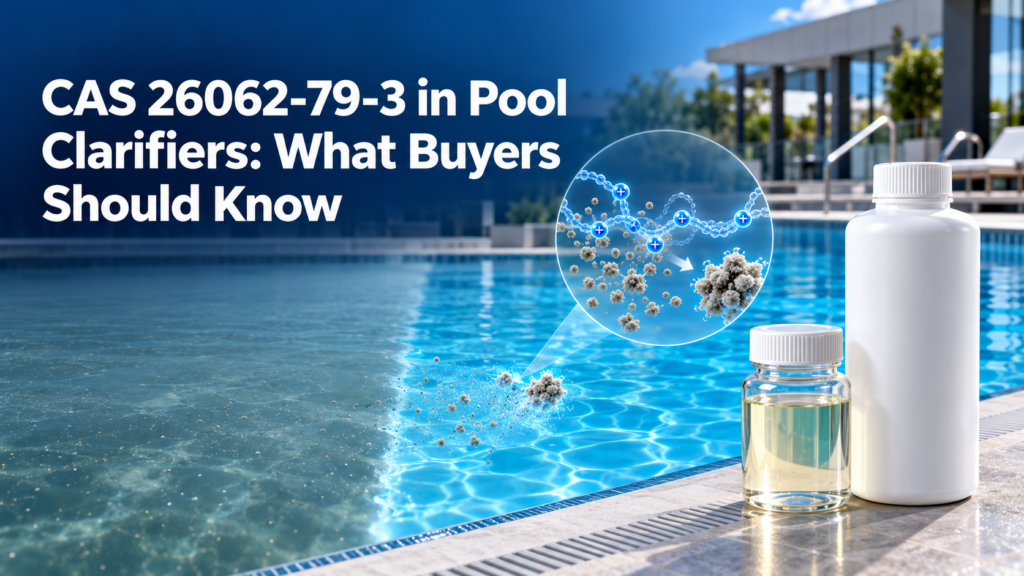
When a pool clarifier supplier lists CAS 26062-79-3, the number may look like a complete product identity. It is not.
It identifies poly(diallyldimethylammonium chloride), usually shortened to PolyDADMAC or PDADMAC—a water-soluble cationic polymer widely used for charge neutralization and water clarification. However, the same CAS number can appear on products with different active concentrations, viscosity grades, molecular-weight ranges, purity profiles, and intended applications.
Those differences matter.
For a buyer, the real question is not simply, “Does this clarifier contain CAS 26062-79-3?” It is:
“Which grade does it contain, at what concentration, and has the finished formula been tested in the pool systems I serve?”
That small change in the question can prevent a surprisingly large number of sourcing problems. It helps distributors compare quotations fairly, supports private-label development, and reduces the chance that an inexpensive material creates cloudy water, slow filtration, unstable appearance, or customer complaints later.
Here is what CAS 26062-79-3 tells you, what it does not tell you, and which details deserve attention before you approve a pool clarifier.
First Things First: What Is CAS 26062-79-3?
CAS 26062-79-3 refers to poly(diallyldimethylammonium chloride). Common commercial names and abbreviations include:
- PolyDADMAC
- PDADMAC
- PolyDDA
- Polyquaternium-6
- PQ-6
PolyDADMAC is a cationic polymer, meaning its polymer chain carries positive electrical charges. This characteristic gives it an affinity for many fine particles found in cloudy pool water, which often carry a negative surface charge.
It is normally supplied as an aqueous liquid and may range from colorless to pale yellow, depending on the product grade and manufacturing process.
The CAS number identifies the polymer family, not one universal formulation. The PubChem record connects CAS 26062-79-3 with poly(diallyldimethylammonium chloride), while distinguishing the related DADMAC monomer used to manufacture the polymer.
That distinction is worth pausing over. A polymer is not the same thing as its monomer. Buyers should therefore review the finished raw material specification and its residual monomer controls instead of treating the CAS entry as a complete quality certificate.
Why Is PolyDADMAC Used in Pool Clarifiers?
Cloudy pool water often contains particles that are too small for the filter to capture efficiently.
Dust, pollen, skin flakes, cosmetic residues, organic matter, dead algae, and mineral particles can remain suspended even when free chlorine and pH appear normal. Each particle may be tiny, but thousands of them scatter light. The water loses its sparkle and begins to look dull or milky.
PolyDADMAC helps by changing how those particles behave.
Because the polymer is positively charged, it can reduce the repulsion between negatively charged suspended particles. Once that electrical barrier weakens, the particles can gather into larger clusters.
Depending on the product grade, dose, water chemistry, and mixing conditions, polymer chains may also help link particles together. The pool filter then has a better chance of retaining them.
Think of it like trying to collect flour from the air. One speck is almost impossible to catch. Let the specks form soft clusters, though, and the job becomes much easier.
This is why PolyDADMAC can support clearer water without functioning as a sanitizer. It helps the physical removal process; it does not replace chlorine, bromine, filtration, circulation, brushing, or balanced water chemistry.
For a broader explanation of this mechanism, see How Cationic Polymers Help Remove Suspended Particles from Pool Water.
A CAS Number Is a Starting Point, Not a Full Specification
Two drums can show the same CAS number and still behave differently in a finished pool clarifier. This is one of the most important points for procurement teams.
Why? Polymer performance depends on more than chemical identity.
Chain length, charge density, solids content, solution viscosity, residuals, pH, and formulation conditions all influence handling and clarification behavior. A grade developed for industrial wastewater is not automatically the right choice for a retail pool product—even if both labels say CAS 26062-79-3.
Buyers should compare at least the following items.
1. Active Content
Commercial PolyDADMAC raw materials are available at different concentrations. A finished pool clarifier may contain a lower percentage of polymer than the raw material used to manufacture it.
For example, Eautrix offers a finished Polymer Pool Clarifier based on 10% PolyDADMAC technology, while raw PolyDADMAC grades may be supplied at higher concentrations. The finished clarifier is identified as a CAS 26062-79-3-based product, with its application and packaging options stated separately.
Never compare prices per kilogram without correcting for active content. A lower-priced product may simply contain more water.
A more useful comparison is the cost per kilogram of active polymer—followed by actual performance at the intended use dose.
2. Viscosity and Molecular-Weight Grade
Viscosity can offer a practical indication of polymer grade and chain length, although it is not a direct molecular-weight measurement unless the test method and conditions are carefully defined.
Different viscosity grades may disperse, pump, dilute, and clarify differently.
A very high-viscosity grade can sound “stronger,” but stronger is not always better. It may be harder to blend, slower to disperse, or more likely to create local overdosing if the finished formula is poorly designed.
A lower-viscosity grade may be easier to handle and more suitable for a ready-to-use retail liquid.
Ask the supplier to state:
- The viscosity range
- The test temperature
- The instrument or test method
- The spindle and speed, where relevant
- Whether the value applies to the raw material or finished clarifier
Without these details, two viscosity figures may not be comparable at all.
3. pH
PolyDADMAC products are often effective across a useful pH range, but the pH of the supplied liquid still matters for storage stability, packaging compatibility, blending, and finished-product quality control.
The pH on a certificate of analysis should include the test concentration if the sample is diluted before measurement.
For example, “pH 5.0” means little if one laboratory tests the product as supplied while another tests a 10% aqueous solution.
4. Appearance and Color
Raw PolyDADMAC is commonly a clear, colorless to pale-yellow liquid. A finished pool clarifier may be sold in its original appearance or dyed blue for familiar shelf appeal.
Color is mostly a market and branding choice; it is not proof of clarification strength.
A bright blue product can be weak, while a nearly colorless product can perform very well. Buyers should also assess color stability during shelf-life testing, especially when the product will be displayed in transparent bottles.
5. Residual Monomer and Impurity Control
PolyDADMAC is made from the monomer diallyldimethylammonium chloride, or DADMAC. Responsible sourcing therefore includes reviewing controls for residual monomer and other relevant manufacturing residues.
The acceptable limit depends on the grade, intended use, and regulations in the destination market.
Do not assume that a PolyDADMAC grade suitable for one water-treatment application automatically meets every requirement for a swimming pool product. Ask for evidence appropriate to your market and intended label claims.
Raw PolyDADMAC and Finished Pool Clarifier Are Not the Same Product
This sounds obvious, yet it causes real confusion in quotations.
Raw PolyDADMAC is an ingredient. A finished pool clarifier is a formulated product designed for application, storage, packaging, labeling, and consumer or professional use.
The finished product may include water, approved color, stabilizing components, or other formulation aids. Its concentration is selected to balance effectiveness, dosing convenience, packaging size, and price position.
Suppose Supplier A quotes a 40% raw PolyDADMAC and Supplier B quotes a 10% ready-to-use clarifier. The price per metric ton tells you almost nothing until you decide what you are actually buying.
Are you operating a blending facility and looking for concentrated feedstock? Or do you need a retail-ready liquid that can go directly into 1 L bottles?
The answer changes the appropriate specification, packaging, documentation, and quality tests.
For raw material options, review PolyDADMAC: Cationic Polymer Coagulant. For a ready-to-use product, review the Polymer Pool Clarifier page.
PolyDADMAC Clarifier Is Not Automatically an Algaecide
Here is another purchasing trap: the words “polyquat,” “quaternary ammonium,” and “cationic polymer” are sometimes treated as if they all describe the same function.
They do not.
PolyDADMAC is a polyquaternary ammonium polymer, but in a pool clarifier its primary role is particle aggregation and filtration support. A supplier should not market a PolyDADMAC clarifier as an algaecide merely because the molecule carries quaternary ammonium groups.
Algaecidal claims can trigger different performance, labeling, and registration requirements depending on the country.
If you want a combined algaecide-and-clarifier product, evaluate the complete formulation and its legally permitted claims. Do not infer biocidal efficacy from the CAS number alone.
This distinction also protects end users. A pool with active algae needs sanitation and algae-control measures. Adding more clarifier may gather some debris, but it will not correct the biological cause.
Clear-looking water and microbiologically safe water are related goals—not interchangeable ones.
More Polymer Does Not Always Mean Clearer Water
It is tempting to assume that a higher dose must work faster. Polymer chemistry is less forgiving than that.
At a suitable dose, the cationic polymer helps neutralize particle charge and form filterable clusters. At an excessive dose, the particle surfaces may become overtreated.
Charge reversal or polymer saturation can restabilize fine matter, leave the water hazy, create filter loading, or make the result inconsistent.
The practical dose depends on:
- Initial turbidity and particle type
- Pool volume and turnover rate
- Filter type and condition
- Active concentration of the clarifier
- Water pH, hardness, and temperature
- Bather load and organic contamination
- Presence of algae or recently killed algae
- Addition point and circulation time
This is why a supplier’s dose should be expressed for the finished product, not copied from a raw polymer data sheet.
Buyers should request both routine-maintenance guidance and corrective-treatment guidance, with clear units.
If your market includes residential and commercial pools, test each use pattern. A quiet backyard pool and a busy hotel pool can place very different loads on the same formula.
Filter Type Changes the Buying Conversation
A clarifier does not remove particles by magic. It prepares them for removal, while the filter and circulation system finish the job.
Sand filters, cartridge filters, and diatomaceous earth filters have different capture behavior, flow characteristics, and cleaning needs. A formula that gives excellent water polishing with a sand filter may require a different dose or operating procedure with a fine cartridge system.
During product validation, observe more than the visual result. Record:
- Time required for visible clarity improvement
- Filter pressure change
- Backwashing or cartridge-cleaning frequency
- Water appearance after 24 and 48 hours
- Any residue at the waterline or on pool surfaces
- Performance after repeated maintenance doses
One dramatic jar test is useful, but it is not a complete pool trial. Real circulation, shear, filtration, and contaminant loading can change the outcome.
To understand the partnership between chemical treatment and equipment, read How Swimming Pool Filtration and Clarification Work Together.
Compatibility Needs Evidence, Not a Blanket Promise
Pool water contains a moving mixture of chlorine products, pH adjusters, hardness ions, alkalinity, stabilizer, algaecides, scale-control agents, and contaminants introduced by swimmers or weather.
A good PolyDADMAC clarifier should be evaluated in the chemical environment where it will be used.
“Compatible with pool chemicals” is too broad unless the supplier defines normal application conditions.
Concentrated products should generally not be mixed together in the same container unless the formulation and procedure have been specifically validated. Products that coexist after proper dilution in a swimming pool may react when combined as concentrates.
Buyers developing private-label lines should request compatibility screening for the main products in their range. Look for:
- Separation
- Precipitation
- Viscosity drift
- Color change
- Odor development
- Gas formation
- Loss of clarification performance
These observations should be repeated after warm and cold storage.
A little patience here pays off. The cost of a stability trial is modest compared with recalling leaking, separated, or discolored bottles from distributors.
What Documents Should a Buyer Request?
A credible technical package should help you verify identity, consistency, safe handling, and commercial suitability.
Before placing a bulk order, request:
- Technical Data Sheet: Product description, intended use, typical properties, handling information, and dosage guidance
- Safety Data Sheet: Classification, hazard information, storage, transport, first aid, and disposal guidance for the supplied product
- Certificate of Analysis: Batch-specific results measured against agreed limits
- Product specification: Acceptance ranges for active content, pH, viscosity, appearance, and agreed impurity controls
- Sample label: Active ingredient statement, directions, warnings, net contents, batch coding, and local regulatory text
- Shelf-life statement: Supported by suitable stability data
- Packaging specification: Bottle or drum material, closure, seal, carton, pallet pattern, and net weight tolerance
- Export documents: Commercial invoice, packing list, and any destination-specific documentation agreed before shipment
Check that the product name, concentration, and CAS number match across the quotation, TDS, SDS, COA, label, and shipping documents.
Small inconsistencies can become large customs or customer-service problems.
How to Compare Supplier Quotations Fairly?
Start by putting every offer on the same basis. A simple comparison table can save hours of back-and-forth.
| Item | Supplier A | Supplier B | Why It Matters |
|---|---|---|---|
| Product type | Raw material or finished clarifier | Raw material or finished clarifier | Prevents an apples-to-oranges comparison |
| PolyDADMAC active content | Stated percentage | Stated percentage | Determines real polymer cost and dosing |
| Viscosity grade | Range plus method | Range plus method | Affects handling and performance |
| pH | Range plus test basis | Range plus test basis | Supports quality and stability review |
| Residual monomer control | Limit and method | Limit and method | Helps assess grade and market suitability |
| Packaging | IBC, drum, 25 L, 5 L, or 1 L | Same basis | Changes freight and filling costs |
| Private label | Included or extra | Included or extra | Influences landed project cost |
| Shelf life | Supported period | Supported period | Matters for distribution planning |
| Trial evidence | Pool and filter conditions | Pool and filter conditions | Shows relevance to your application |
| Incoterm | EXW, FOB, CFR, or CIF | Same basis | Makes freight comparison meaningful |
Then calculate the landed cost, not just the factory price. Include packaging, labeling, inland transport, ocean freight, duties, local compliance work, and the expected use dose.
A product that costs slightly more per bottle may deliver a lower treatment cost per pool if it works at a lower dose, stays stable on the shelf, and generates fewer complaints.
Cheap chemistry can become expensive rather quickly—usually after the container arrives.
A Practical Pre-Purchase Test Plan
Before approving a commercial batch, ask for a representative sample and test it against a written protocol. Keep the plan simple enough to repeat.
- Confirm basic properties. Check appearance, odor, pH, density where specified, viscosity, and active content using agreed methods.
- Test dilution behavior. Add the product to representative water and observe dispersion, clouding, strings, sediment, or gel formation.
- Run controlled jar tests. Compare several doses against an untreated control using the same water and mixing sequence.
- Conduct a circulation trial. Use a test pool or suitable pilot system with the filter types common in your market.
- Watch for overdosing. Test above the expected dose so the label can include sensible boundaries.
- Check packaging compatibility. Store the finished formula in the proposed bottle, cap, seal, drum, or IBC.
- Perform stability screening. Include ambient, elevated-temperature, and low-temperature conditions appropriate to the sales region.
- Retest after storage. Appearance alone is not enough; confirm that clarification performance remains acceptable.
Document the water conditions and filter setup.
Otherwise, a statement such as “cleared the pool in four hours” is not reproducible and has little purchasing value.
Private-Label Buyers Need a Finished-Product Mindset
If you are buying for your own brand, customers will judge the bottle, directions, and result—not the elegance of the raw-material specification.
The formula should pour cleanly, disperse easily, remain visually stable, and give repeatable performance at a dose that users can measure. The bottle must survive storage and transport. The label must explain what the product does without encouraging misuse.
Consider these commercial choices early:
- Original clear-to-pale appearance or blue-dyed formula
- Concentrated or ready-to-use positioning
- Residential, service-company, or commercial-pool audience
- 1 L, 5 L, 25 L, drum, or IBC packaging
- Induction seal or tamper-evident closure
- Metric-only or dual-unit dosing instructions
- Single-purpose clarifier or validated combination formula
- Climate and warehouse temperature in the destination market
Eautrix supports concentration adjustment, color options, customized formulations, retail-ready packaging, and bulk supply for PolyDADMAC-based pool clarifiers.
Still, the best project begins with a clear product brief. Tell the supplier where the product will be sold, who will dose it, which filter types are common, and what price position the brand is targeting.
Red Flags That Deserve a Second Look
Most sourcing problems leave clues. Watch for these warning signs:
- The supplier gives only a CAS number and price, with no grade specification.
- Active content is described as “high,” but no test result or range is provided.
- Viscosity is stated without a test temperature or method.
- The raw-material concentration and finished-product concentration are mixed up.
- One formula is claimed to suit every pool, dose, filter, and contamination level.
- The product is called an algaecide without suitable efficacy or regulatory support.
- The SDS, TDS, COA, label, and invoice use different product identities.
- A dyed sample looks attractive, but no color-stability data are available.
- The supplier will not discuss residual monomer or batch consistency.
- The commercial sample differs from the production specification.
None of these points automatically proves that a supplier is unreliable. They do mean that more questions are needed before money changes hands.
The Bottom Line for Pool Clarifier Buyers
CAS 26062-79-3 tells you that PolyDADMAC is present. It does not tell you the active concentration, polymer grade, residual profile, finished-product dose, shelf stability, packaging quality, or field performance.
Smart buying therefore moves through three stages:
- Confirm the chemical identity.
- Define the technical grade.
- Validate the finished clarifier under realistic pool conditions.
Do that, and the CAS number becomes useful rather than misleading.
For distributors and private-label brands, the strongest specification is not necessarily the one with the highest viscosity or concentration. It is the one that produces reliable clarity, works with the intended filter systems, remains stable through the supply chain, and arrives with consistent documentation.
That is what customers notice when they look across the pool and see the floor clearly. And, really, that clear view is the whole point.
Frequently Asked Questions
1. Is CAS 26062-79-3 the same as PolyDADMAC?
Yes. CAS 26062-79-3 identifies poly(diallyldimethylammonium chloride), commonly called PolyDADMAC or PDADMAC. It may also be listed as Polyquaternium-6. The CAS number does not define the product’s active content, viscosity grade, or finished formulation.
2. What concentration of PolyDADMAC is used in a pool clarifier?
There is no single concentration for every product. Raw PolyDADMAC and ready-to-use pool clarifiers may have very different active levels. Buyers should confirm whether the quoted percentage refers to the raw material, polymer solids, or finished clarifier, then validate the recommended dose.
3. Is a PolyDADMAC pool clarifier also an algaecide?
Not automatically. In a clarifier, PolyDADMAC mainly helps fine suspended particles form filterable clusters. Algaecidal performance and label claims require separate formulation, efficacy, and regulatory support. A clarifier should never replace proper sanitation.
4. What should be included in a CAS 26062-79-3 COA?
A useful PolyDADMAC certificate of analysis normally includes batch identity, appearance, active or solids content, pH, and viscosity tested by agreed methods. Buyers may also request density and relevant residual monomer or impurity controls based on the grade and destination market.
5. How can buyers test a PolyDADMAC clarifier before a bulk order?
Begin with identity and specification checks, then run jar tests at several doses. Follow with a circulation-and-filtration trial using representative pool water and the filter types common in your market. Packaging compatibility and warm/cold stability tests should be completed before approving a private-label production batch.