
GET IN TOUCH
Ask For Sample?
Pool Clarifier vs Pool Flocculant: Which One Does Your Pool Need?
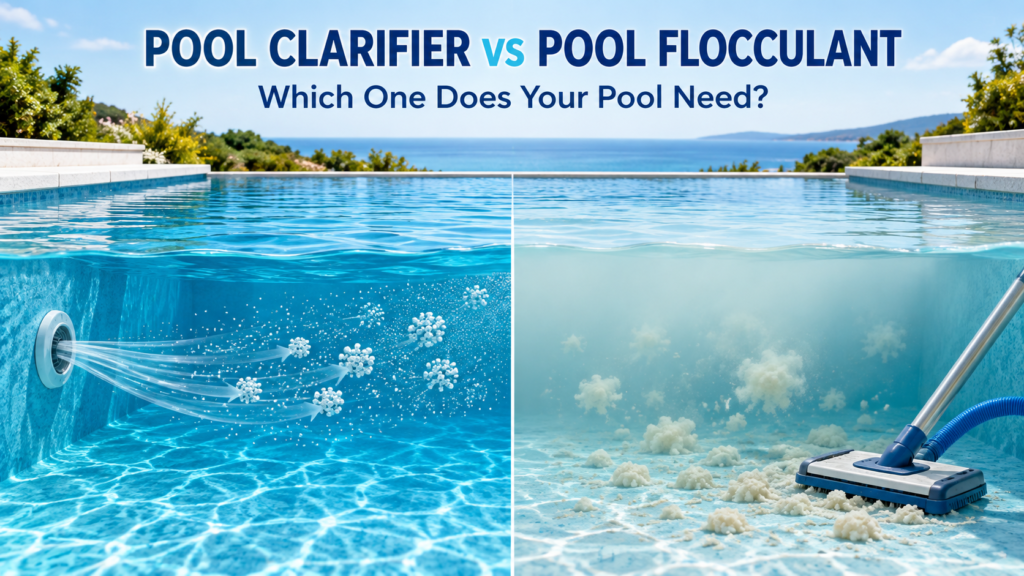
Cloudy pool water has a way of creating rushed decisions. The water looked fine yesterday. Today, the deep end seems hazy, the floor has lost its sharp outline, and guests may be arriving soon. You search for a quick fix and find two products that sound almost identical: pool clarifier and pool flocculant.
Both help remove fine suspended particles. Both can improve water clarity. Both may rely on coagulation or flocculation chemistry. Yet they are not used in the same way—and choosing the wrong one can leave you with an overloaded filter, a floor covered in unsettled debris, or water that looks worse than it did before.
Here is the short answer: use a pool clarifier for mild cloudiness when your filtration system is working well; use a pool flocculant for heavier cloudiness when you can let the debris settle and vacuum it directly to waste.
That simple rule handles many cases. Still, pools are rarely quite that polite. Water balance, algae, filter condition, mineral precipitation, swimmer load, and even the type of vacuum connection can change the answer. So, let’s work through the choice carefully.
First, Why Is the Pool Cloudy?
Before choosing between a clarifier and a flocculant, identify what you are trying to remove. Cloudiness is a symptom, not a single problem.
A swimming pool may turn hazy because of:
- Fine dust, soil, or construction debris
- Pollen and airborne organic matter
- Sunscreen, body oils, cosmetics, and heavy swimmer use
- Dead algae left after successful algae treatment
- Early live algae growth
- Poor circulation or insufficient filter run time
- A dirty, damaged, or incorrectly operated filter
- High pH, high calcium hardness, or mineral precipitation
- Incorrect sanitizer control
- Too much clarifier, flocculant, or another treatment chemical
This distinction matters. Neither a clarifier nor a flocculant corrects low sanitizer, kills an established algae bloom by itself, repairs damaged filter media, or restores badly unbalanced water. These products help gather suspended particles so those particles can be physically removed. They do not erase the cause that created the particles.
If you are still diagnosing the haze, What Causes Fine Suspended Particles in Swimming Pool Water? explains how tiny contaminants remain dispersed and why a pool can look cloudy even when no large debris is visible.
Start with a reliable water test. Check the primary sanitizer, pH, total alkalinity, calcium hardness, and any other parameters required for your treatment system. Empty the baskets, inspect the filter, confirm good return flow, and brush the walls and floor. If colored dust reappears, surfaces feel slippery, or sanitizer disappears unusually fast, algae may still be active.
And one safety point cannot be softened: if the floor or main drain is not clearly visible, keep swimmers out. Water clarity is not just about appearance. It affects supervision and emergency response.
What Is a Pool Clarifier?
A pool clarifier is a treatment that helps the filtration system capture particles that are otherwise too small to remove efficiently.
Many liquid clarifiers use water-soluble polymers. Fine particles in pool water often carry surface charges that help them remain separated. A properly selected and correctly dosed polymer can reduce those repulsive forces or bridge several particles together. The individual specks then form small clusters.
The clusters generally remain suspended in the circulating water. They travel through the skimmer and plumbing to the filter, where sand, cartridge media, or diatomaceous earth has a better chance of retaining them.
So the clarifier does not perform the final removal. The filter does.
Think of a clarifier as giving your filter larger parcels to catch instead of asking it to collect a cloud of microscopic confetti. The water may improve gradually over several hours or a day or two, depending on the product, particle load, circulation, and filter condition.
That makes clarifier well suited to:
- Slightly dull or mildly cloudy water
- Routine water polishing
- Fine dust or pollen after windy weather
- Residual dead algae after the algae has been controlled
- Cloudiness following a busy swimming period
- Pools that can remain under normal circulation and filtration
- Situations where avoiding unnecessary water loss matters
For a closer look at this mechanism, see Pool Clarifier Explained: A Beginner’s Guide to Clearer Pool Water.
What Is a Pool Flocculant?
A pool flocculant—often called pool floc—is intended to create larger, heavier aggregates that settle on the pool floor. Instead of sending those particles through the filter, you allow them to drop out of suspension and then remove them with a manual vacuum set to waste.
That last phrase, set to waste, is crucial.
During waste vacuuming, dirty water bypasses the filter and leaves the pool through the waste line. The settled material is removed from the system instead of being pushed into the filter bed or returned to the pool. Because water is discharged, the pool usually needs to be topped up afterward.
Flocculant may be considered when:
- Cloudiness is heavy and caused by a large suspended-particle load
- A faster, more aggressive cleanup is needed
- The pool can remain unused while circulation stops and solids settle
- The system has a true waste-vacuum function
- The operator can vacuum very slowly without disturbing the settled layer
- Water loss and refilling are acceptable
Floc is not merely a “stronger clarifier.” It changes the removal route. Clarifier sends conditioned particles toward the filter; flocculant sends them toward the floor.
Pool Clarifier vs Pool Flocculant: The Practical Difference
| Question | Pool Clarifier | Pool Flocculant |
|---|---|---|
| Best suited to | Mild haze and routine polishing | Heavy particle cloudiness requiring corrective cleanup |
| Particle behavior | Forms smaller clusters that remain in circulation | Forms larger, heavier aggregates that settle |
| Removal method | Captured by the pool filter | Vacuumed slowly to waste |
| Pump operation | Usually runs for circulation and filtration | Often runs for mixing, then stops for settling; follow the label |
| Labor required | Relatively low | Higher; careful manual vacuuming is needed |
| Water loss | Usually minimal | Significant water may be discharged during vacuuming |
| Filter demand | Increases filter loading | Should bypass the filter during final removal |
| Speed | Usually gradual | Can provide a faster reset if the process works correctly |
| Pool downtime | Often limited, subject to label and visibility | Usually longer because settling and vacuuming take time |
| Main risk | Overdosing may cause haze or coat filter media | Disturbing settled floc can cloud the pool again |
The chemistry can overlap. The operating process does not. That is why the product label, pool plumbing, and available equipment matter as much as the name printed on the bottle.
Which One Does Your Pool Need? Use This Simple Test
Ask these questions in order.
1. Is the Pool Only Slightly Cloudy?
If you can see the floor clearly but the water lacks sparkle, a clarifier is usually the more sensible starting point—after testing the water and confirming that the filtration system works properly.
Clarifier is gentler from an operational viewpoint. You measure the labeled dose, distribute it as directed, and let circulation carry the conditioned particles to the filter. You then monitor filter pressure and clean or backwash when required.
2. Is the Water Very Cloudy Because of Suspended Debris?
If the pool contains a large quantity of dead algae, fine soil, or another known particle load, flocculant may remove that material more quickly. This is especially relevant when normal filtration would take too long or would load the filter repeatedly.
But severe cloudiness alone does not automatically mean “add floc.” First rule out active algae, poor sanitation, mineral imbalance, and equipment failure. Floccing a pool without correcting the underlying problem may produce a brief improvement followed by another cloudy episode.
3. Can Your Pool Vacuum to Waste?
If the answer is no, conventional pool flocculant may be the wrong choice.
Many multiport sand-filter systems have a waste setting, but not every pool does. Some cartridge-filter installations do not have a straightforward waste line. Robotic cleaners are also generally not substitutes for vacuuming floc to waste: they may stir the material, clog quickly, or pass fine debris back into the water, depending on the unit.
Do not improvise around the plumbing. Check the equipment manual or ask a qualified pool technician.
4. Can the Pool Stay Closed During Treatment?
Flocculation requires patience and stillness. The product must disperse according to its label, particles must form larger aggregates, circulation is commonly stopped for a settling period, and nobody should enter the pool and kick the debris back into suspension.
If the pool must remain in service—particularly a hotel, school, fitness club, or community facility—a compatible clarifier and controlled filtration plan may be easier to manage. Commercial operators must also follow local health rules and facility procedures.
5. Do You Want to Avoid Water Loss?
Clarification normally keeps water in the pool. Floc cleanup sends water to waste. In areas with water restrictions, expensive water, limited drainage, or difficult refill chemistry, that difference can decide the matter.
A Quick Decision Guide
Choose a pool clarifier when:
- The water has a light haze rather than severe opacity.
- Chemistry has been checked and major problems have been corrected.
- The filter and circulation system are operating normally.
- You want the filter to perform the final particle removal.
- You prefer a lower-labor treatment with little water loss.
- You can allow time for gradual filtration.
Consider a pool flocculant when:
- The water holds a heavy load of suspended particles.
- The cause is known and has already been addressed.
- The product is suitable for the pool and equipment.
- You can close the pool for settling and cleanup.
- You have a manual vacuum and a verified waste-discharge route.
- You accept the water loss involved in vacuuming to waste.
Choose neither one yet when:
- Sanitizer is low or algae is still alive.
- pH, alkalinity, or calcium balance may be causing precipitation.
- The pump, filter, valves, or return system is not working correctly.
- The cloudiness appeared after an overdose of another chemical.
- You do not know what is causing the problem.
- The product label is incompatible with your filter or treatment system.
Sometimes the least exciting answer is the right one: test again, clean the filter, and fix circulation before adding another chemical.
How to Use a Pool Clarifier Without Making the Haze Worse?
Clarifier is easy to apply, but easy does not mean careless. Polymer treatments work within a useful dose range. More is not necessarily better.
Test and Correct the Basics
Measure the pool chemistry first. Correct sanitizer and balance problems according to the relevant product directions. A clarifier cannot compensate for weak disinfection or ongoing mineral precipitation.
Calculate the Pool Volume
Do not estimate by eye. Use the pool dimensions, average depth, and the correct unit conversion. Irregular pools may need to be divided into sections for a more accurate calculation.
Read the Finished-Product Label
Clarifier formulas vary in active polymer, concentration, and dose. A dosage copied from another product may be far too high or too low. Raw polymer ingredients intended for professional formulation must not be treated like ready-to-use retail products.
Prepare the Filter
Empty baskets and confirm good flow. Clean or backwash if the filter already needs attention, but do not automatically backwash immediately after dosing. The treatment needs time to circulate and bring particles to the filter.
Add the Measured Dose and Keep Filtering
Distribute the product exactly as directed. Run the pump for the stated period. Check pressure and water clarity as the filter collects more material. Clean the cartridge or backwash the filter when equipment guidance indicates it is needed.
Wait Before Redosing
This is where many treatments go sideways. The pool does not clear within an hour, so another dose goes in. Then another. Excess polymer can stabilize particles again, contribute its own haze, leave sticky residue, or load the filter rapidly.
Give the first application the full time stated on the label. If the water does not improve, reconsider the diagnosis instead of blindly adding more.
For buyers seeking a polymer-based finished product, Eautrix offers a Polymer Pool Clarifier based on PolyDADMAC technology, with formulation, packaging, and private-label support for different markets. Final dosage and label directions should always match the supplied concentration, target market, and intended pool system.
How to Use Pool Flocculant Correctly
Exact instructions differ, so the label remains the authority. A typical flocculation process, however, follows this general logic.
Fix the Underlying Water Problem
If algae caused the cloudiness, complete the approved algae-control and sanitation treatment first. If mineral precipitation is involved, correct the relevant balance issue. Flocculant removes suspended material; it does not prevent the same problem from forming again.
Confirm the Waste Setting Before You Start
Know which valve position bypasses the filter, where discharged water will go, and whether local rules permit that discharge. Confirm that the pool has enough water for vacuuming and that more water is available for refilling.
Apply the Exact Label Dose
Some products require dilution; others do not. Some call for brief circulation to disperse the treatment, followed by pump shutdown. Follow the instructions for the specific formula. Never combine concentrated chemicals in the same container.
Let the Water Become Still
Settling can take several hours or overnight. Keep swimmers, automatic cleaners, return jets, and anything else that disturbs the water out of the process. You want a quiet pool and a visible layer of material on the floor.
Vacuum Slowly to Waste
Move the manual vacuum head with almost comical slowness. Seriously. A quick pass can lift the fragile floc back into suspension. Watch the water level during discharge and avoid allowing the pump to run dry.
If the sediment becomes disturbed, stop and let it settle again rather than chasing a moving cloud around the pool.
Refill, Rebalance, and Restore Filtration
After the floor is clean, return the valves to the correct operating position, refill the pool, test the water, and adjust chemistry as needed. Inspect the system before reopening.
What About Sand, Cartridge, and DE Filters?
Filter type influences the choice, though it does not replace product-specific instructions.
Sand Filters
Sand filters are commonly paired with clarifiers because particle conditioning can help the bed retain finer material. Many sand-filter systems also have multiport valves with a waste setting, which can make a floc procedure possible. Still, confirm the actual plumbing—never assume that every valve marked similarly is connected the same way.
Cartridge Filters
Cartridge filters can capture fine particles well, but they may load quickly after clarifier treatment. Too much polymer may coat the cartridge and make cleaning harder. Conventional flocculant is often inconvenient where no waste-vacuum route exists. Check the pool design and both the filter and chemical instructions.
Diatomaceous Earth Filters
DE filters already provide fine filtration. A large conditioned-particle load may raise pressure quickly, so close monitoring matters. Some flocculant labels may restrict use with certain systems. Follow the equipment manufacturer’s directions for cleaning and restoring the DE layer.
Whatever the filter type, chemicals cannot repair cracked laterals, torn cartridges, damaged grids, channeling media, incorrect valve positions, or poor circulation. If debris blows back through the returns, inspect the system.
Can You Use Clarifier and Flocculant Together?
Usually, there is no good reason to use them together unless a qualified treatment program and the product labels specifically direct it.
Both affect particle behavior. Combining them casually can create unpredictable aggregation, excessive polymer loading, rapid filter blockage, stubborn residue, or a new haze. It also makes troubleshooting harder because you no longer know which treatment caused the result.
Choose one removal strategy: either condition the particles for filtration or settle them for vacuuming to waste. If one treatment fails, diagnose the failure before adding the other.
And never mix concentrates in a bucket, dosing vessel, feeder, or storage container. Chemical compatibility in diluted pool water does not mean concentrated products can be safely mixed.
Common Mistakes That Waste Time and Water
Treating Live Algae as Ordinary Cloudiness
Clarifier and flocculant may help remove dead algae after control, but they are not substitutes for a proper sanitizer and algae-control program. If the pool is green, slippery, or consuming sanitizer rapidly, address biological growth first.
Assuming Flocculant Is Always Faster
Floc can produce a dramatic cleanup, but only when the particles settle well and the operator removes them without disturbance. Add settling time, careful vacuuming, refilling, and rebalancing, and the “quick fix” may take longer than expected.
Overdosing the Clarifier
The instinct is understandable: if one measured dose works, two must work faster. Polymer chemistry does not behave that way. Excess product may reduce performance and prolong the haze.
Sending Settled Floc Through the Filter
This can clog or burden the filter and may return fine material to the pool. The normal goal of a floc procedure is to bypass the filter and remove the settled material to waste.
Using an Automatic Cleaner for Floc
An automatic or robotic cleaner may disturb the fluffy layer, clog, or return fine particles. Unless the cleaner and flocculant instructions explicitly support that use, choose a manual vacuum-to-waste method.
Forgetting the Refill Water
Fresh water can change pH, alkalinity, hardness, stabilizer concentration, salt level, and temperature. After waste vacuuming and refilling, test the pool again. Clear water can still be chemically unbalanced.
The Bottom Line: Choose the Removal Path, Not the Strongest-Sounding Product
Pool clarifier and pool flocculant are related tools, but they solve particle problems through different operating paths.
A clarifier creates filterable clusters and keeps them moving through the circulation system. It is generally the better fit for mild haze, routine polishing, lower labor, and minimal water loss.
A flocculant creates larger aggregates that settle. It can be useful for severe particle cloudiness when the pool can be closed, the water can remain still, and the settled material can be vacuumed directly to waste.
The choice is not really “weak product versus strong product.” It is filter versus floor.
Before adding either one, test the water, correct the underlying cause, inspect the equipment, calculate the pool volume, and read the complete label. When the diagnosis is right, the treatment often feels straightforward. When the diagnosis is wrong, another bottle rarely brings clarity.
Frequently Asked Questions
1. Is Pool Clarifier or Pool Flocculant Better for Slightly Cloudy Water?
Pool clarifier is usually better for slightly cloudy water when chemistry is balanced and the filter works correctly. It forms small particle clusters that the filter can capture, with less labor and water loss than a conventional floc treatment.
2. Can I Use Pool Flocculant Without a Waste Setting?
Conventional pool flocculant generally needs a method for vacuuming settled debris directly to waste. If your system lacks that function, check the equipment and product instructions or consult a pool professional. Sending floc through the filter may cause blockage or poor results.
3. How Long Does Pool Clarifier Take to Clear Cloudy Water?
Visible improvement may take several hours to one or two days, depending on the clarifier formula, particle load, circulation, turnover, and filter condition. Follow the label and allow the first dose time to work before considering another treatment.
4. Will Pool Flocculant Kill Algae in a Green Pool?
Pool flocculant is not a primary sanitizer or algae-control treatment. It may help settle suspended debris after the algae has been controlled, but active algae must first be treated with an approved sanitation and algae-control program.
5. Can Too Much Pool Clarifier Make Water Cloudier?
Yes. Overdosing a polymer pool clarifier may interfere with particle aggregation, leave excess polymer in the water, coat filter media, or cause rapid filter loading. Measure the pool volume carefully and use only the dose stated on the finished-product label.