
GET IN TOUCH
Ask For Sample?
What Makes a Good Swimming Pool Clarifier?
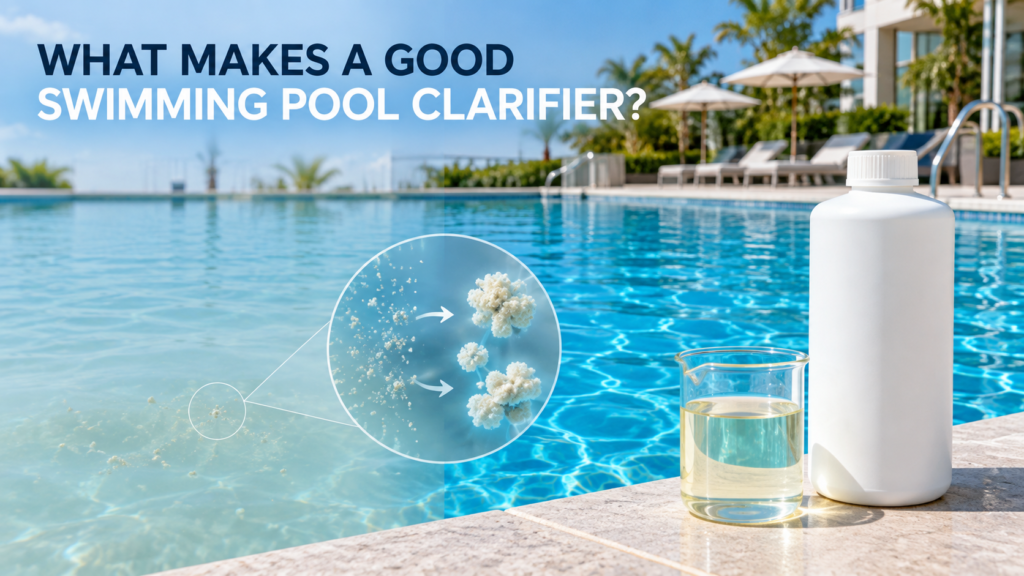
A swimming pool can have the right pH, a normal sanitizer reading, and a filter that runs every day—yet still look dull or slightly cloudy. That is frustrating. The water may be safe enough to treat, but it does not have the clean sparkle that swimmers, homeowners, and commercial pool operators expect.
This is where a swimming pool clarifier can help.
A good pool clarifier does not simply “make water clear.” It helps tiny suspended particles join together so the pool filter can capture them more easily. The chemistry sounds simple, but product performance depends on much more than a bold claim on the front label. Polymer type, charge density, molecular structure, concentration, dose, water compatibility, stability, and even packaging quality can all affect the final result.
So, what separates a dependable clarifier from an ordinary bottle of liquid? Let’s look beyond the marketing language.
First, What Does a Swimming Pool Clarifier Actually Do?
Cloudy pool water often contains particles too small for the filter to catch efficiently. These may include fine dust, pollen, dead algae, sunscreen residue, body oils, organic debris, mineral particles, or fragments left after a heavy swimmer load.
Individually, many of these particles remain dispersed in the water. Some carry similar electrical charges, so they repel one another instead of settling or joining together. They can pass through the filter again and again, leaving the pool with a pale haze.
A polymer clarifier changes this behavior.
Many effective clarifiers contain water-soluble cationic polymers. “Cationic” means the polymer carries a positive charge. Because many suspended particles in pool water have negatively charged surfaces, the polymer is attracted to them. It can neutralize part of their surface charge and form bridges between separate particles.
The tiny particles then gather into larger clusters, often called flocs or aggregates. These clusters remain small enough to circulate but large enough for the filter to retain more effectively.
Think of the filter as a kitchen strainer and the suspended particles as fine flour. Flour passes through easily. If those particles gather into soft crumbs, the strainer has a much better chance of catching them. The clarifier does not replace the strainer—it makes the material easier to strain.
That distinction matters. A clarifier supports filtration; it is not a substitute for filtration, sanitation, circulation, or balanced water.
Good Clarification Starts with the Right Polymer
The active polymer is the heart of the formulation.
PolyDADMAC, also known as poly(diallyldimethylammonium chloride), is one polymer commonly used in water clarification applications. It is a water-soluble cationic polymer that can help destabilize and gather fine suspended particles. A properly formulated Polymer Pool Clarifier may use PolyDADMAC technology at a concentration selected for the intended finished product.
Yet the chemical name alone does not guarantee good performance.
Two clarifiers based on the same general polymer family can behave differently because of differences in:
- Active concentration
- Molecular-weight distribution
- Charge density
- Solution viscosity
- Residual raw materials
- pH range
- Dilution quality
- Added color, fragrance, or formulation aids
- Batch consistency
A supplier should understand these variables rather than treating every cationic polymer as interchangeable. The goal is not to use the most aggressive polymer available. The goal is to use a polymer grade that disperses well, interacts effectively with the target particles, and works with the intended pool filtration system.
More chemistry is not automatically better chemistry.
It Should Work at a Practical, Forgiving Dose
A good clarifier should give useful results at a sensible dose. It should also offer a reasonable operating window.
Why does that matter? Real pools are rarely treated under perfect laboratory conditions. Pool volume may be estimated rather than measured. Operators may use a cap, cup, or dosing pump. Swimmer load changes. Rain introduces new debris. A commercial facility may treat several pools with different circulation rates.
If a product works only within a very narrow dose range, small application errors can lead to inconsistent results.
An effective formulation should disperse throughout the water and support particle capture without requiring excessive product. The label must still provide exact directions because the correct dose depends on formulation strength. A 10% finished clarifier, for example, cannot be dosed by copying instructions written for a different concentration.
Overdosing also deserves attention. Adding extra clarifier may seem like a quick way to clear severe haze, but too much polymer can coat filter media, increase filter pressure, create sticky deposits, or restabilize particles under some conditions. The water may become no clearer—and sometimes looks worse.
A strong product makes correct dosing easy. A responsible label makes overdosing less likely.
Fast Dispersion Matters More Than a Dramatic Pour
A clarifier has to reach the suspended particles before it can help the filter remove them.
Good formulations disperse evenly when added according to label instructions. They should not form rubbery lumps, stringy masses, or stubborn gel pockets in normal use. A product that looks impressive because it is extremely thick may actually be harder to measure, dilute, and distribute.
Viscosity can be useful as a quality-control parameter, but it should not be mistaken for performance by itself. A thicker liquid is not automatically a stronger clarifier. Likewise, a thin liquid is not automatically weak. Concentration, polymer structure, temperature, and formulation design all influence viscosity.
For commercial buyers, this is worth checking during sample evaluation. Observe how the liquid pours at normal warehouse temperature. Mix it into water under controlled conditions. Look for even dispersion, not just a visually dramatic reaction in a small jar.
Pool water is the real stage. The bottle is only backstage.
A Good Clarifier Works with the Filter, Not Against It
Clarification and filtration are a team.
Sand filters, cartridge filters, and diatomaceous earth filters do not all retain particles in the same way. Their operating procedures also differ. A clarifier suitable for one system may require a different dose or cleaning schedule in another.
A good clarifier should help form aggregates that the intended filter can capture without producing an excessive pressure rise or creating a difficult-to-remove coating. Clear use directions should explain whether the pump should remain running, how long circulation may be needed, and when the filter should be checked or cleaned.
Filter condition is just as important as product quality. Even an excellent polymer will struggle if:
- The sand bed is channeling
- The cartridge is saturated with oils or scale
- The filter is too small for the pool
- The pump run time is too short
- Return jets leave large dead zones
- Backwashing occurs before the aggregates are captured
- Water bypasses damaged filter components
This is why a trustworthy clarifier never promises to repair a mechanical problem. It improves the capture of fine particles. It cannot mend a cracked lateral or revive a worn-out cartridge.
It Should Be Compatible with Normal Pool Water Conditions
Pool water changes from day to day. A useful clarifier needs to tolerate the normal range of conditions found in a maintained swimming pool.
Compatibility should be considered with:
- The pool’s sanitizer program
- Expected pH range
- Water hardness and alkalinity
- Saltwater chlorination systems
- Filter type
- Other maintenance chemicals
- Pool surfaces and equipment
That does not mean every chemical can be poured into the same bucket. Concentrated products should not be mixed unless the label and qualified technical guidance clearly permit it. Chemical compatibility in the pool after proper, separate addition is different from compatibility between concentrates.
Anionic products deserve special care because anionic and cationic materials may interact strongly. Direct contact can cause precipitation, loss of performance, or deposits. Suppliers should be able to discuss such limitations honestly.
“Compatible with common pool programs” is helpful. “Compatible with everything” is a warning sign.
It Should Clear Haze Without Creating a New Problem
The purpose of a clarifier is straightforward: improve visual clarity by helping the filter remove fine suspended material. A good product should not trade one problem for another.
Depending on the formulation and correct use, buyers may look for characteristics such as:
- Low-foaming or non-foaming behavior
- No unwanted color change in the water
- No strong or objectionable odor
- No oily surface film
- No sticky residue around the waterline
- No unnecessary effect on pool pH
- No excessive filter loading at the labeled dose
Color is a formulation choice, not proof of cleaning power. Some markets prefer a blue finished liquid because consumers associate blue with pool care. Other buyers want the polymer in its original color. Either approach can be reasonable if the dye is suitable for the intended application and remains stable.
What matters is that color does not hide inconsistency. A heavily dyed product can make it harder to notice batch-to-batch changes in the base liquid. Commercial buyers should evaluate both appearance and analytical data.
Concentration Must Be Clear—Not Merely High
People often ask, “What percentage is the clarifier?” It is a fair question, but concentration needs context.
A concentrated raw polymer and a ready-to-use retail clarifier serve different purposes. The raw material may be designed for professional formulation, while the finished product may be diluted to a practical use strength and packaged for direct application.
A higher percentage may reduce freight per unit of active polymer and give formulators more flexibility. It may also require better mixing equipment, more careful dosing, and stricter handling controls. A lower-concentration finished product may be easier for pool owners or service teams to measure accurately.
Therefore, a good product is not simply the one with the highest number on its specification. It is the one whose concentration matches the buyer’s use case.
Ask the supplier to state clearly:
- The active ingredient
- The CAS number, where applicable
- The active or solids content and test method
- Whether the product is a raw material or finished formulation
- Recommended dilution or use instructions
- Available packaging sizes
- Storage and shelf-life conditions
If these answers remain vague, the price comparison is not yet meaningful.
Batch Consistency Is Quietly Essential
A clarifier may perform well in a single sample and still disappoint in regular supply. That is why batch consistency matters.
For pool chemical distributors and private-label brands, inconsistent viscosity or concentration can create several problems. Filling equipment may need adjustment. Labels may no longer match actual performance. Customers may use last season’s dose and get a different result. Complaints then land on the brand owner, not on the anonymous liquid inside the bottle.
A professional manufacturer should control defined parameters for each batch. Depending on the product, these may include:
- Appearance
- Active or solids content
- pH
- Viscosity
- Density
- Solubility or dilution behavior
The certificate of analysis should correspond to the supplied batch. A specification sheet describes the target range; a certificate of analysis records the result for a particular lot. Buyers need both.
Small differences are normal within an approved specification. Unexplained swings are not.
Stability in Storage Is Part of Performance
A clarifier can leave the factory in good condition and arrive months later after hot containers, cold warehouses, repeated handling, and long sea transit. The formulation must remain stable through the expected supply chain.
A well-designed product should resist separation, sedimentation, unexpected thickening, and loss of uniformity under its stated storage conditions. The packaging must also protect the liquid from contamination and leakage.
Buyers should ask practical questions:
- What is the recommended storage temperature?
- Should the product be protected from freezing or direct sunlight?
- What is the stated shelf life in unopened packaging?
- Is gentle mixing needed after long storage?
- Has packaging compatibility been checked?
- Are retain samples kept for batch investigation?
These questions may sound less exciting than “How fast does it clear a pool?” Still, they decide whether the product performs consistently after a three-month journey and another six months on a distributor’s shelf.
Clear Instructions Are a Quality Feature
The liquid inside the bottle is only half of the product. The directions are the other half.
A good label or technical data sheet should explain the intended use, dose, method of addition, circulation requirement, filter care, storage conditions, and key precautions. Directions should use units familiar to the target market and should distinguish routine clarification from treatment of unusually cloudy water.
It should also state what the product cannot fix.
Cloudiness may come from poor water balance, early algae growth, calcium precipitation, filter failure, excessive dissolved material, or a sanitation problem. A clarifier is most useful when fine suspended particles are the main issue. If the pool is green and algae are actively growing, an appropriate algae-control and sanitation program is needed first.
For algae prevention, buyers can review Polyquat 60 Algaecide. For off-season care, a purpose-designed Winter Algaecide may be more suitable. These products serve different primary functions from a dedicated clarifier, even though polymer chemistry may appear in more than one category.
Honest instructions protect the end user and the brand.
How Should Buyers Test a Pool Clarifier?
Start with documents, but do not stop there.
Review the technical data sheet, safety data sheet, certificate of analysis, product label, and packaging details. Confirm chemical identity and concentration. Then request a representative sample.
A simple comparative test can provide useful early information. Use the same pool water or prepared test water in identical containers. Add each clarifier at an equivalent active dose, mix in the same way, and observe the samples over the same period. Record particle aggregation, water clarity, sediment behavior, and ease of filtration.
Be careful with jar-test theater. A dramatic clump that drops to the bottom in seconds may look convincing, but it may represent flocculant-style behavior rather than the gentle filter-aid action expected from a routine clarifier. The best result depends on the intended application.
Pilot testing in an actual pool or controlled filtration loop is more meaningful. Track:
- Initial turbidity or visual haze
- Dose per unit of pool volume
- Circulation time
- Filter pressure before and after treatment
- Time required for visible improvement
- Need for backwashing or cartridge cleaning
- Water appearance after 24 and 48 hours
Change only one major variable at a time. Otherwise, no one can tell whether the result came from the clarifier, longer filtration, a sanitizer adjustment, or simple settling.
What Makes a Good Clarifier Supplier?
A reliable product needs reliable support behind it.
For distributors, pool chemical brands, and service companies, a good supplier should be able to discuss formulation strength, packaging, labeling, quality control, and shipping—not merely quote a price per kilogram.
Useful supplier capabilities may include:
- Stable polymer sourcing and controlled production
- Batch-specific quality documents
- Sample support and application discussion
- 1 L, 5 L, and 25 L packaging options
- Original-color or blue-color formulation choices
- Private-label packaging
- Export documentation
- Clear response procedures for quality complaints
Custom packaging also needs discipline. Bottle resin, cap seal, label adhesive, carton strength, pallet pattern, and storage temperature all matter. A beautiful label on a leaking bottle is not a market-ready product.
Ask how changes are approved. If the supplier changes raw-material grade, concentration, dye, or packaging component, will the buyer be informed? Good change control protects both sides.
The Best Clarifier Is the One That Fits the Real Problem
There is no single bottle that solves every case of cloudy pool water.
A good swimming pool clarifier contains suitable polymer chemistry, disperses evenly, works at a practical dose, cooperates with the filter, and remains stable through storage. It comes with clear specifications, honest directions, and consistent quality records. Just as important, it is used for the right reason.
If the haze consists of fine suspended particles, clarification can make a visible difference. If the real cause is poor sanitation, scale formation, active algae, or broken filtration equipment, another corrective step must come first.
That may sound less glamorous than promising instant crystal-clear water. It is also far more useful.
For commercial buyers, the smartest evaluation combines paperwork, sample testing, filtration trials, and supplier review. Do not judge the product by color, thickness, or concentration alone. Judge it by how reliably it helps the whole pool system do its job.
Clear water is not created by one chemical acting alone. It is the result of balanced water, steady sanitation, effective circulation, sound filtration—and, when fine particles refuse to cooperate, the right clarifier at the right dose.
Image Alt Text: Good swimming pool clarifier helping fine suspended particles form larger clusters for filtration beside a clear commercial pool.
Frequently Asked Questions About Swimming Pool Clarifiers
1. What is the best active ingredient for a swimming pool clarifier?
There is no universal best ingredient for every pool, but water-soluble cationic polymers such as PolyDADMAC are widely used to help fine, negatively charged particles gather into filterable clusters. The polymer grade, concentration, dose, and filter compatibility matter as much as the chemical name.
2. How can I tell whether a pool clarifier is good quality?
Check the active ingredient, concentration, pH, viscosity, appearance, batch certificate, storage stability, and use directions. Then compare samples at equivalent active doses and confirm performance with the intended filter system. A good-quality pool clarifier should deliver repeatable results without creating foam, residue, or excessive filter pressure at the labeled dose.
3. Can too much polymer pool clarifier make water cloudy?
Yes. Excess polymer can overload the filter, coat filter media, leave sticky material, or interfere with normal particle aggregation. Follow the finished product label rather than assuming that a larger dose will clear the pool faster.
4. Does a swimming pool clarifier kill algae?
A dedicated clarifier is mainly designed to gather fine suspended particles so the filter can capture them. It should not be treated as a replacement for sanitizer or algaecide. If active algae are causing cloudy or green water, correct the sanitation and algae problem before relying on clarification.
5. How long does a pool clarifier take to clear cloudy water?
Visible improvement may occur within several hours, but the full result often depends on circulation time, filter condition, particle load, product dose, and the cause of cloudiness. Check the product label, run the filtration system as directed, and inspect or clean the filter when needed.