GET IN TOUCH
Ask For Sample?
Why Commercial Swimming Pools Need Professional Water Clarification?
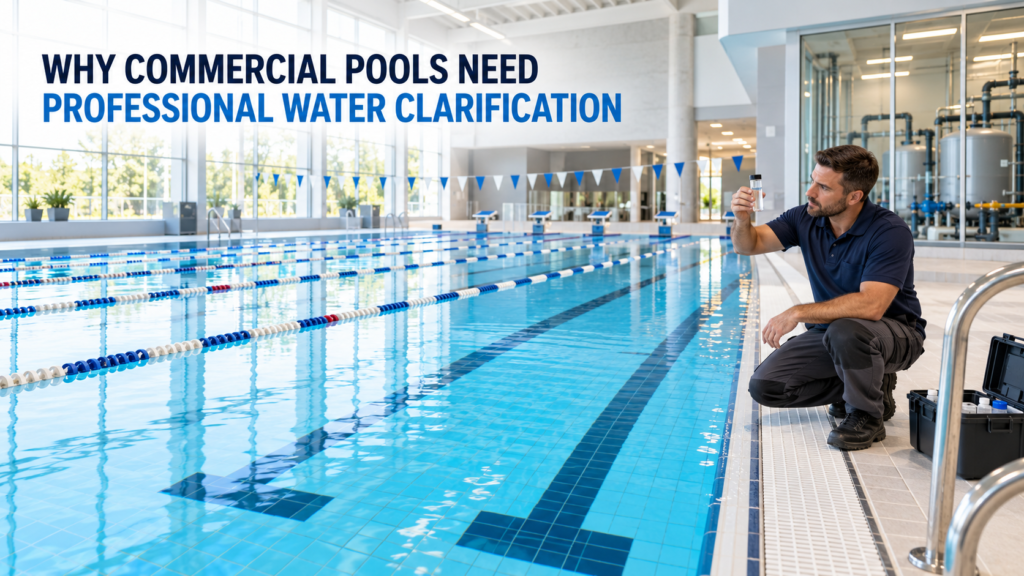
A commercial swimming pool can pass its basic water tests and still look disappointing.
The free chlorine may be within the operating range. The pH may be steady. The circulation pump may be running without an alarm. Yet the water has a faint haze, the lane markings look softer than they should, and underwater lights reveal a stream of tiny particles. Nothing seems dramatically wrong—but the pool does not look truly clean.
For a backyard pool, that may be an annoyance. For a hotel, fitness club, aquatic center, school, resort, or water park, it is an operational problem.
Commercial pools carry heavier swimmer loads, longer operating hours, more organic contamination, and far greater expectations than most residential pools. Their water must not merely meet chemical targets. It must also remain clear, inviting, easy to monitor, and compatible with the filtration system throughout the day.
That is why professional water clarification matters. It supports the removal of fine suspended particles that ordinary filtration may struggle to capture on its own. Used as part of a controlled treatment program—not as a shortcut—it can help operators maintain dependable visual clarity under demanding conditions.
Clear Water Is More Than a Cosmetic Detail
Guests judge a pool long before they see a water-test record.
They notice whether the water sparkles in the morning. They notice whether the deep end looks crisp or slightly milky. They notice floating debris, dull surfaces, and hazy underwater lights. Most swimmers cannot explain the chemistry behind those details, but they quickly form an opinion: this pool feels clean, or it does not.
That reaction has commercial value. A bright, transparent pool supports confidence in a hotel, health club, or leisure facility. Cloudy water does the opposite. Even when the cause is harmless fine debris rather than a serious sanitation failure, guests do not make that distinction. Why would they? They can only respond to what they see.
Clarity also supports pool supervision. Lifeguards and operators need a clear view through the water, especially toward the floor and deeper zones. Requirements vary by location, pool type, and local health authority, so every facility must follow its applicable rules. Still, the practical principle is universal: poor visibility makes inspection and supervision harder.
Professional clarification therefore sits at the intersection of appearance, swimmer confidence, operational control, and safety support. It does not replace disinfection. It does not correct bad water balance. It does not repair a failed filter. What it can do is help the existing treatment system remove particles that would otherwise remain suspended and scatter light.
Why Commercial Pools Become Cloudy So Quickly?
Every swimmer brings something into the water.
Body oils, perspiration, cosmetics, sunscreen, hair products, textile fibers, dust, and tiny flakes of skin all enter the pool during normal use. Outdoor facilities also receive pollen, soil, insects, smoke particles, and windblown organic matter. Add occasional algae remnants, mineral precipitates, and treatment by-products, and the particle load can rise surprisingly fast.
Now multiply that input by hundreds—or thousands—of bathers each week.
A residential pool may have long quiet periods in which filtration gradually catches up. A commercial pool often has only a short overnight window before another busy day begins. In a teaching pool, water-aerobics class, or hotel pool during holiday season, contamination arrives continuously. Turbulence from swimmers and water features keeps fine matter moving rather than allowing it to settle.
Several common factors make clarification more difficult:
- High bather load during peak hours
- Fine organic particles from skin, oils, and personal-care products
- Dust and pollen in outdoor or semi-open facilities
- Dead algae remaining after successful algae treatment
- Calcium or other mineral precipitation caused by poor balance
- Inadequate circulation in corners, steps, or shallow play areas
- Short filter cycles or insufficient backwashing
- Filters that are poorly sized, damaged, overloaded, or incorrectly operated
- Chemical overdosing that creates new cloudiness instead of solving it
The result is often not a pool full of visible dirt. It is something subtler: countless particles too small to see individually but large enough, together, to bend and scatter light. The water loses its polished appearance. It may look blue from one angle and gray from another. Under bright commercial lighting, the haze can be painfully obvious.
Why Filtration Alone May Not Be Enough?
Pool filters are designed to remove suspended material, but every filter has practical limits.
Sand filters, cartridge filters, and diatomaceous earth systems work in different ways and have different particle-capture characteristics. Their real performance also depends on flow rate, media condition, maintenance, hydraulic design, and how heavily the pool is used. A filter that performs well under normal conditions may struggle after a crowded weekend or an algae cleanup.
Very fine particles present a special problem. They may pass through the filter media, circulate repeatedly, or remain suspended because their surface properties keep them apart. Imagine trying to collect flour with a kitchen colander. Water moves through, the larger material stays behind, but the finest powder escapes. The comparison is not chemically exact, of course, yet it captures the operational frustration.
Running the pump longer may help, but only if the filter can retain the particles. Increasing filtration time cannot fully solve a particle-size problem. Nor will adding more sanitizer automatically make the haze disappear. Chlorine controls many microorganisms and oxidizes contaminants; it is not a universal particle-removal tool.
This is the gap that professional clarification is designed to address.
What Professional Water Clarification Actually Does?
Many fine particles found in pool water carry a negative surface charge. That electrical charge encourages them to repel one another, so they remain dispersed rather than joining into larger groups. They are small, stable, and annoyingly good at slipping through the treatment loop.
A cationic polymer carries positive charges along its molecular chain. When correctly selected and dosed, it can interact with negatively charged suspended particles. Charge neutralization reduces the repulsion between them. Long polymer chains may also connect—or bridge—several particles at once.
The resulting clusters are larger than the original particles. A pool filter can generally capture these larger aggregates more readily.
That is the heart of clarification: the product does not magically erase dirt. It changes how difficult particles behave so the filtration system can remove them more effectively.
For commercial operators and pool-product businesses, a purpose-designed Polymer Pool Clarifier may be used as one component of a broader water-care program. Product chemistry, concentration, label directions, filter type, and local operating requirements all matter. A treatment that works well at the correct dose may perform poorly when poured in casually.
Clarification, Coagulation, and Flocculation—Are They the Same?
These terms are related, but they should not be treated as interchangeable.
Clarification usually refers to improving water clarity by helping fine particles become easier for the filter to capture. The pool generally remains in normal circulation while the treatment works, subject to the product instructions.
Coagulation describes the destabilization of dispersed particles, often through charge neutralization. It is one of the chemical steps that can occur during clarification.
Flocculation encourages small destabilized particles to form much larger flocs. In some pool procedures, those flocs are intentionally allowed to settle so they can be vacuumed to waste. That method may require circulation changes, downtime, careful vacuuming, and water replacement.
The distinction is important in a commercial facility. A routine clarifier may support filtration without closing the pool for an extended settling process. A strong flocculation treatment may be useful in certain severe cases, yet it can interrupt operations and place a heavy load on staff.
So, is one always better? No. The appropriate method depends on the cause and severity of the problem, the filter design, the product label, and the facility’s operating plan.
The Commercial Benefits Go Beyond Sparkling Water
Better-looking water is the most visible benefit, but it is not the only one.
First, controlled clarification can help filtration work more effectively. When small particles form filterable aggregates, more of the unwanted material can leave the circulating water instead of returning to the pool.
Second, dependable clarity can reduce reactive maintenance. Staff spend less time chasing a vague haze with repeated, unplanned chemical additions. That matters because random treatment often becomes expensive treatment. One employee adds extra sanitizer. Another adds clarifier. A third changes the pH. By the next shift, nobody is sure which action helped—or which one caused a new problem.
Third, clear water makes routine inspection easier. Operators can see surfaces, drains, fittings, and debris more readily. That visual access supports better housekeeping and faster identification of developing issues.
Fourth, clarity protects the guest experience. A resort pool may be chemically compliant, yet a dull appearance can still lead to complaints, refund requests, poor photographs, and negative reviews. Commercial water care has a psychological side. People want the water to look as carefully maintained as it actually is.
Finally, a stable clarification program can support consistent operations across sites. For a hotel group, fitness chain, or pool-service company, repeatability is precious. Staff need a written process they can follow—not a collection of improvised fixes passed from one technician to another.
Why “Just Add More” Is a Costly Mistake
Clarifiers have a useful operating range. More product does not always mean clearer water.
An excessive dose may leave the water dull, create sticky deposits, load the filter too quickly, or interfere with efficient particle capture. In some cases, overdosing can restabilize particles rather than helping them aggregate. The exact response depends on the polymer, formulation, water conditions, and filtration system.
Commercial pools are especially vulnerable to dosing errors because of their size. A small calculation mistake can become several liters of unnecessary product. Pool-volume records may be inaccurate, balance tanks may be overlooked, and operators may confuse the concentration of a raw material with that of a finished-use formulation.
This is why a professional program starts with four simple habits:
- Confirm the true system volume, including balance or surge tanks where applicable.
- Identify the likely cause of the cloudiness before treating it.
- Follow the finished product label and technical instructions.
- Record the dose, time, water conditions, filter pressure, and observed result.
Those notes turn water care into a controlled process. Without them, every cloudy-water event feels like the first one.
Clarifier Is Not a Substitute for Sanitizer or Good Hydraulics
This point deserves emphasis: clear water is not necessarily sanitary water.
A clarifier helps remove suspended particles. It does not replace the approved disinfectant residual, routine microbial control, pH management, or required water testing. A pool can look brilliant and still be unsafe if its sanitation program fails.
The reverse is also true. A pool can have an acceptable sanitizer reading and still appear cloudy because of fine debris, precipitation, dead algae, poor circulation, or filtration trouble.
Professional treatment separates these functions rather than asking one chemical to do everything. Sanitizer controls susceptible microorganisms. Oxidation helps break down certain contaminants. Algaecide helps prevent or control algae when used as directed. Clarifier improves fine-particle removal. Filtration physically takes material out of circulation.
For facilities that also need non-foaming polymeric algae control, Polyquat 60 Algaecide belongs to a different treatment category from a dedicated clarifier. Some polymer chemistries may contribute secondary clarification effects, but buyers should not assume that every algaecide is a direct replacement for a pool clarifier. The product’s intended function and label must guide use.
Hydraulics matter just as much. If return jets do not distribute treatment throughout the pool, dead zones will remain. If the turnover rate is inadequate, water will not reach the filter often enough. If the filter media is channeled or the cartridges are damaged, aggregated particles may pass straight back into the basin.
Chemistry can support equipment. It cannot pretend broken equipment is healthy.
When Does a Commercial Pool Need Clarification?
Clarification may be appropriate when testing and inspection indicate that fine suspended particles are the main cause of reduced clarity.
Common situations include:
- Haze after a period of heavy swimmer use
- Fine debris after storms, wind, or nearby construction
- Dull water after algae have been controlled and dead cells remain
- Cloudiness that persists despite acceptable balance and properly functioning filtration
- Fine particles passing through a correctly maintained filter
- Water that looks clear from above but hazy under underwater lighting
Clarifier should not be the first reflex when there is an unexplained sanitation failure, severe algae bloom, major balance problem, equipment fault, or unsafe visibility. In those cases, the operator needs to diagnose and correct the primary cause, follow local closure rules where applicable, and use the treatment method specified for the situation.
Seasonal operation brings another set of challenges. Outdoor facilities may face pollen in spring, heavy bather loads in summer, and organic debris during closing. A planned clarification step can support seasonal maintenance, while a separate Winter Algaecide may be considered when the treatment goal includes off-season algae prevention. Again, these products perform related but distinct jobs.
How to Build a Reliable Clarification Program?
A professional program is less dramatic than emergency treatment—and that is precisely the point. It aims for steady water, predictable filter behavior, and fewer surprises.
Start with diagnosis. Review sanitizer residual, combined chlorine or the relevant disinfectant indicators, pH, alkalinity, calcium hardness, temperature, and any other parameters required for the facility. Inspect circulation, pump strainers, return flow, filter condition, and pressure. Ask what changed: Was there a swim meet? A storm? A sudden increase in bathers? Recent algae treatment? A chemical delivery from a new batch?
Next, establish a small, controlled dose based on the product label and actual pool volume. Distribute the product as directed, maintain the required circulation, and allow enough filtration time before deciding whether it worked. Clarification is not always instant. Fine particles need time to interact, aggregate, travel through the hydraulic system, and reach the filter.
Then watch the filter. As particle capture improves, filter pressure may rise more quickly. Backwash or clean the filter according to the equipment manufacturer’s instructions and the facility’s operating procedure. A clarifier that moves contamination from the water to the filter is doing useful work—but the captured material still has to be removed from the system.
Finally, document the outcome. Record visual clarity, pressure change, chemical dose, timing, bather load, and any maintenance performed. Over several treatment cycles, the facility can refine a dosage window and response plan suited to its own water, filter, and usage pattern.
That local experience is valuable. A large competition pool with sand filtration does not behave exactly like a warm hotel spa, and neither behaves like a shallow children’s play pool with spray features.
What Professional Buyers Should Ask a Clarifier Supplier?
For distributors, private-label brands, pool-service companies, and multi-site operators, product selection should go further than color and price.
Ask for a clear technical specification. Confirm the active chemistry, concentration, appearance, pH, viscosity where relevant, recommended storage conditions, shelf life, and compatible packaging. Request a current Safety Data Sheet and batch-specific Certificate of Analysis. Make sure the intended application is clearly stated.
It is also sensible to discuss:
- Compatibility with the target filter types
- Recommended dilution and dosing procedure
- Performance across the expected pool-water pH range
- Potential interaction with anionic products or other treatment chemicals
- Original, blue, or other permitted color options
- 1 L, 5 L, 25 L, or bulk packaging requirements
- Private-label artwork and label-compliance responsibilities
- Batch traceability and retained-sample procedures
- Trial quantities for laboratory or pool-side evaluation
A sample should be tested under representative conditions before a large commercial order is approved. Water chemistry differs by region. Source water, hardness, temperature, treatment history, and filter design can all influence the result.
The cheapest drum is not always the lowest-cost treatment. Consistent concentration, manageable viscosity, reliable documentation, and predictable performance often matter more than a small difference in unit price.
A Clearer Pool Starts with a Clearer Process
Commercial pools are dynamic systems. People enter. Contaminants accumulate. Weather changes. Filters load. Chemical demand rises and falls. Expecting water to remain polished without an organized particle-removal strategy is a bit like expecting a busy hotel lobby to stay spotless without regular cleaning.
Professional water clarification helps close the gap between acceptable chemistry and visibly excellent water. It supports filtration by gathering fine suspended particles into forms the system can more readily capture. When applied correctly, it can improve appearance, strengthen guest confidence, support visual inspection, and reduce the temptation to make costly chemical guesses.
The key phrase is “applied correctly.” Clarification works best when operators diagnose the cause, calculate the real system volume, use a product designed for the task, respect the dose, monitor the filter, and keep accurate records.
Commercial pool water should not merely avoid looking bad. It should look controlled—clear, calm, and ready for the next swimmer. That result rarely comes from one bottle alone. It comes from a treatment program in which chemistry, circulation, filtration, and trained people all do their part.
Frequently Asked Questions
1. Why does a commercial pool stay cloudy even when chlorine and pH are correct?
Correct chlorine and pH do not remove every fine suspended particle. Body oils, dead algae, cosmetics, dust, mineral precipitates, and other tiny contaminants may remain in circulation or pass through the filter. A professional pool clarifier can help these particles form larger aggregates that are easier to capture, provided the filtration system is working correctly.
2. How often should a commercial swimming pool use a clarifier?
There is no universal schedule. Frequency depends on bather load, filter type, source water, weather, operating hours, and the product label. Some facilities use a controlled maintenance dose, while others treat only after verified clarity problems. Routine testing, visual checks, and treatment records should guide the program.
3. Can a polymer pool clarifier replace chlorine or another sanitizer?
No. A polymer pool clarifier supports suspended-particle removal; it does not replace an approved sanitizer or required disinfection program. Commercial pools must maintain the disinfectant residual and other water-quality parameters required by local regulations and the facility’s operating plan.
4. Can too much clarifier make commercial pool water cloudy?
Yes. Overdosing may create dull water, sticky deposits, rapid filter loading, or poor particle aggregation. Operators should calculate the true system volume, follow the finished product instructions, measure accurately, and allow sufficient circulation and filtration time before adding more.
5. What should buyers check when sourcing a commercial pool clarifier?
Buyers should review the active chemistry, concentration, technical specification, Safety Data Sheet, Certificate of Analysis, packaging, shelf life, dosing guidance, filter compatibility, and batch consistency. A representative sample trial is wise before approving bulk or private-label supply.