GET IN TOUCH
Ask For Sample?
Get Your Custom Polyquat 60 Pool Chemical Solution Today
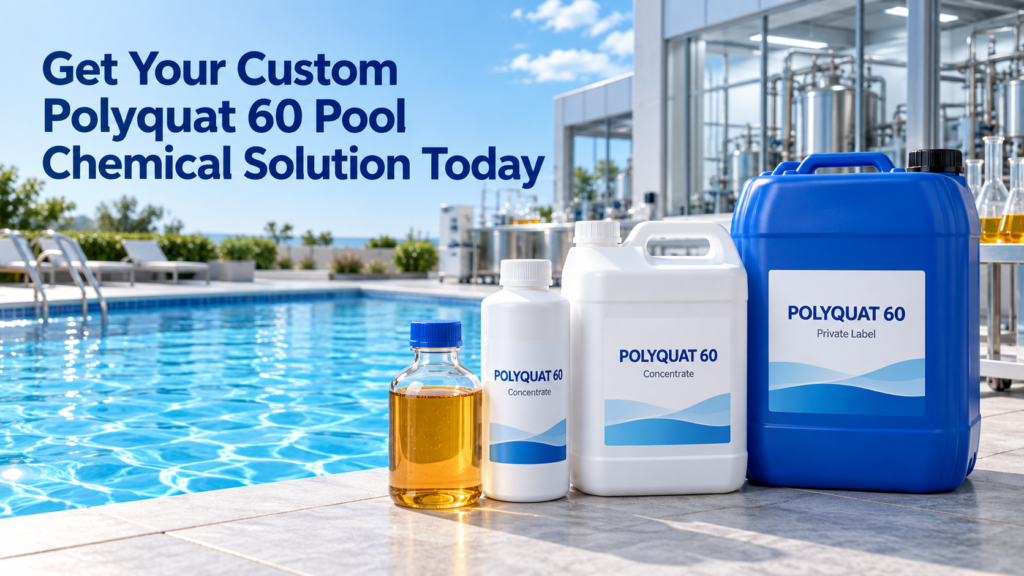
A good pool chemical does more than work in water. It must also fit the way your customers buy, store, carry, dose, and understand the product.
That is why a standard drum of Polyquat 60 is not always the complete answer.
A formulator may need concentrated raw material with a tight specification. A distributor may want a finished algaecide in 5 L jerry cans. A retail brand may need 1 L bottles, a dyed formulation, multilingual labels, and cartons ready for local stores. A pool service company may care most about simple dosing and consistent performance from one batch to the next.
The chemistry may begin in the same place, but the commercial solution does not.
At Eautrix, we help buyers develop a custom Polyquat 60 pool chemical solution around their real market needs. That can include active concentration, product color, package size, private-label presentation, documentation, sample approval, and bulk supply planning.
If you are trying to build or improve a pool chemical line, the question is not merely, “Can I buy Polyquat 60?” The better question is, “What form of Polyquat 60 will work for my customers and my business?”
Let’s work through that question.
Start with Your Market, Not the Bottle
Customization sometimes gets reduced to label design. Change the logo, select a cap color, and the job is done. It sounds convenient—but it misses the hard part.
The right solution begins with the product’s route to market.
Who will buy it? Will it be used by professional pool technicians, regional distributors, private-label brands, or homeowners? Is it sold as a concentrated formulation ingredient or as a ready-to-use pool treatment? Will customers measure the dose with professional equipment, a small cap, or a marked chamber?
These questions influence almost every later decision.
For example, a professional maintenance company may prefer a larger container and a concentrated product because its team treats many pools each week. A retail customer may value a smaller bottle, simple directions, and a label that makes the product’s role easy to understand. An importer supplying several countries may need neutral export cartons and market-specific labels added after arrival.
Same polymer. Very different job.
Before we discuss packaging or price, it helps to define five commercial basics:
- Target country or region
- Buyer type and sales channel
- Intended product position
- Expected annual or seasonal volume
- Local label, registration, and transport requirements
That short brief gives a custom project a firm starting point. Without it, buyers often compare quotations for products that look similar on paper but are not commercially equivalent.
What Can Be Customized in a Polyquat 60 Solution?
A custom program can be simple or detailed. Some buyers need only a different package size. Others need a finished private-label product prepared for a new pool-care range.
The usual customization areas include:
- Active ingredient concentration
- Original amber appearance or an approved finished-product color
- Package volume and container style
- Cap, induction seal, tamper-evident feature, or dosing accessory
- Label artwork and language
- Outer carton and shipping marks
- Pallet configuration
- COA, SDS, TDS, and export documents
- Batch specification and testing requirements
- Order quantity and repeat-supply schedule
Not every possible change is technically sensible. That is worth saying plainly. A custom product still has to remain stable, practical to manufacture, compatible with its container, and suitable for its intended application.
Good customization is controlled customization. It gives the buyer a meaningful market difference without creating avoidable quality problems.
First Decision: Concentrated or Ready to Use?
Polyquat 60 commonly refers to a concentrated, water-soluble polymeric algaecide based on Polixetonium Chloride, CAS No. 31512-74-0. The “60” usually refers to an active level around 60%, subject to the supplier’s stated specification and test method.
For technical details and the current product overview, visit Polyquat 60 Algaecide.
Yet not every buyer needs a 60% concentrate in the final retail bottle. This is where the project usually splits into two paths.
Concentrated Polyquat 60 for Formulators and Bulk Buyers
Concentrated material may suit buyers who already have blending, filling, quality-control, and labeling capability. They can use the concentrate as a formulation base and prepare market-specific strengths locally.
This route can offer several commercial benefits:
- More active ingredient is shipped per unit of freight
- One concentrate can support several finished formulations
- Local filling allows faster label changes
- Packaging can be sourced closer to the target market
- Product strength can be adapted to different sales channels
However, concentrate also transfers more responsibility to the buyer. Accurate dilution, compatible processing water, clean equipment, safe handling, batch traceability, and final-product testing all matter.
Buying concentrate is not simply buying “less water.” It means taking control of part of the manufacturing process.
Finished or Diluted Products for Direct Distribution
A finished product can suit importers, wholesalers, pool service brands, and retailers that do not want to run a local blending operation. The product can be supplied at an agreed concentration, filled into the chosen container, and prepared with the required label format.
This approach may reduce operational work after arrival. It can also make product costing easier because the buyer receives a defined saleable unit rather than a formulation ingredient.
The trade-off? Freight carries more water, and each finished version needs its own packaging and inventory plan.
Neither route is automatically better. The right choice depends on your facilities, order volume, freight conditions, working capital, and local compliance duties. A small distributor may gain more from a finished product, while an established blender may prefer concentrated supply.
A Custom Formula Should Have a Clear Purpose
“Can you make it stronger?” is a common request. So is, “Can you make it blue?” Those questions are valid, but they need context.
A concentration should be selected around the product’s intended dose, label claim, price position, package size, and local regulatory framework. Color should also serve a purpose. Some markets associate blue liquids with pool care, while others prefer the natural appearance of the active material. The concentrated Polixetonium Chloride solution itself is typically a clear amber to light amber viscous liquid; it should not be mistaken for a naturally blue chemical.
If a buyer wants a dyed finished formulation, color compatibility and stability should be checked before commercial production. The same principle applies to fragrance, mixed actives, or extra functional claims. Each added feature makes the formulation more complex and may change testing or registration needs.
Sometimes the smartest custom formula is the simplest one: a controlled active concentration, stable appearance, clear directions, and reliable packaging.
That may not sound flashy. It does, however, reduce complaints—and repeat orders tend to appreciate boring consistency.
Packaging Is Part of Product Performance
Packaging is not decoration placed around the chemistry. It protects the product, affects handling, influences freight, and shapes the customer’s first impression.
1 L Bottles for Retail and Trial Sales
A 1 L bottle can work well for residential pool-care shelves, online sales, market trials, and starter product lines. It is easy to display and easier for a homeowner to handle than a large jerry can.
Small packaging also gives a new brand a lower-risk way to test demand. The unit packaging cost may be higher, but the retail presentation can support a stronger price per liter.
5 L Jerry Cans for Professional and Semi-Professional Use
The 5 L format sits in a useful middle ground. It can serve pool service technicians, small commercial pools, dealers, and experienced residential users. It offers more product without becoming awkward to carry.
For many private-label programs, 5 L is the practical workhorse.
25 L Jerry Cans for Distribution and Service Operations
A 25 L jerry can is better suited to professional users, regional repacking, institutional pool maintenance, and buyers who consume product regularly. It reduces the number of individual packages compared with small retail bottles and can simplify handling at service depots.
The container must still be selected carefully. Wall thickness, cap fit, seal quality, stacking strength, label adhesion, and leakage resistance are not minor details when a shipment crosses oceans and passes through several warehouses.
Bulk Packaging for Industrial Handling
Drums or IBC totes may be considered for larger formulation operations where the buyer has suitable unloading, storage, and transfer equipment. Bulk supply can improve packaging efficiency, but it is not appropriate for every warehouse.
Before choosing it, confirm forklift access, storage conditions, discharge method, local rules, and the buyer’s realistic consumption rate. A package that is cheap per kilogram can become expensive if it sits half-used for too long.
Private Label Is More Than Putting a Logo on a Container
A private-label Polyquat 60 project brings chemistry, branding, and compliance into the same room. They do not always agree immediately.
Your front label may focus on clear water and easy maintenance. The technical file must still identify the product correctly. Directions should be readable. Batch coding should remain traceable. Required warnings, net contents, responsible-party details, and market-specific statements must be handled according to the destination’s rules.
The brand owner or importer normally remains responsible for checking local registration and label requirements. A manufacturer can provide product data and production support, but it should not casually promise that one label is legal in every country.
A sound private-label workflow usually covers:
- Product identity and concentration
- Intended use and target market
- Container and closure
- Draft label dimensions
- Buyer-supplied or jointly reviewed artwork
- Required languages and variable data
- Batch code and production-date format
- Carton marks and pallet requirements
- Pre-production sample or digital proof
- Final approval before filling
That last step matters. A five-minute artwork check can prevent thousands of labels from carrying the wrong volume, spelling, barcode, or address.
Documentation: The Quiet Part That Keeps Orders Moving
A strong custom product can still face delays if its documents tell different stories.
The commercial name, chemical identity, active concentration, package information, and batch number should remain consistent across the relevant records. Depending on the order and destination, a documentation package may include:
- Certificate of Analysis (COA)
- Safety Data Sheet (SDS)
- Technical Data Sheet (TDS)
- Commercial invoice
- Packing list
- Certificate of origin, when requested and applicable
- Transport documents
- Label files or approved artwork records
- Additional test reports agreed before the order
Requirements vary by country and product status. Pool chemicals may also fall under local biocide, pesticide, chemical inventory, labeling, or product-registration rules. Buyers should confirm these obligations before approving a formula or printing labels.
Why so early? Because a last-minute compliance change can affect the formula name, claim language, concentration, pack size, and even the importer shown on the container.
Paperwork is not the glamorous part of launching a pool product. Still, when a container is waiting at port, nobody thinks paperwork is boring.
Samples Turn a Sales Idea into a Testable Product
A custom project should move from discussion to evidence.
For concentrated material, a representative sample lets the buyer review appearance, odor, viscosity, pH, active content, and handling behavior using suitable methods. For a finished formulation, sample evaluation may also cover dilution, color, storage behavior, packaging compatibility, and performance under the buyer’s planned use conditions.
The buyer should define what “approved” means before testing begins. A vague response such as “the sample looks fine” is hard to convert into a production standard.
A better approval record may include:
- Sample or batch reference
- Product name and concentration
- Test methods used
- Measured results
- Package type
- Storage observations
- Application notes
- Approved specification limits
- Approval date and responsible person
Keep the approved reference when possible. It gives both parties something concrete to compare if a question appears later.
Quality Control Should Follow the Agreed Specification
Consistency is one of the strongest reasons to build a long-term supply relationship. Your customer expects the second order to behave like the first. The fifth should behave like the fourth. That sounds obvious, yet it requires discipline.
For Polyquat 60 concentrate, common control items may include:
- Appearance
- Active content
- pH at a stated dilution
- Density
- Viscosity under stated test conditions
- Packaging condition
- Net weight
- Batch identification
The exact limits and methods should appear in the approved specification. Test conditions matter, especially for viscosity, because temperature and method can change the reported result.
Finished private-label products may require additional checks, such as color comparison, fill volume, cap torque, seal integrity, label position, barcode readability, carton count, and drop or leakage testing where appropriate.
A COA is useful, but it works best as part of a broader quality system. It reports results for a batch; it does not replace sample approval, written specifications, incoming inspection, or clear complaint procedures.
Need Clarification or Winter Performance? Build a Product Line, Not a Lonely SKU
Polyquat 60 can be the anchor of a pool chemical range, but it does not have to stand alone.
After algae treatment, fine suspended debris may remain in the water. Where the product labels and treatment plan permit, a separate Polymer Pool Clarifier can support filtration by helping fine particles become easier to capture. An algaecide and a clarifier serve different primary jobs, so the product line should explain that difference rather than blur it.
Seasonal markets may also benefit from a dedicated Winter Algaecide designed for pool closing and off-season maintenance.
This creates a clearer commercial structure:
- Polyquat 60 for concentrated, non-foaming algae control
- Maintenance algaecide for regular preventive programs
- Pool clarifier for fine suspended particles and filtration support
- Winter product for seasonal closing
For a distributor, that structure can increase basket size and give sales teams a more complete story. For the end user, it reduces the temptation to expect one bottle to solve every water problem.
From Idea to Shipment: A Practical Customization Process
Custom manufacturing should not feel mysterious. A clear sequence helps both sides make decisions faster.
Step 1: Tell Us About Your Market
Share the destination country, customer type, planned sales channel, preferred product position, and expected volume. If you already sell pool chemicals, tell us which pack sizes move fastest.
Step 2: Define the Product
Confirm whether you need Polyquat 60 concentrate, a diluted finished formulation, or a broader private-label product line. State the required active concentration and any important physical or performance requirements.
Step 3: Select Packaging
Choose the container size, material, color, cap, seal, label type, carton, and pallet arrangement. If you have not made these decisions, share your intended sales channel and shipping method so practical options can be discussed.
Step 4: Review Technical and Regulatory Needs
List required documents, label languages, destination rules, registration status, test methods, and any customer-specific specification. Resolve uncertain compliance points before commercial printing.
Step 5: Request and Evaluate a Sample
Test the proposed material or finished product against agreed criteria. Record the results and confirm any changes in writing.
Step 6: Approve the Quotation and Artwork
The quotation should state the product, concentration, package, quantity, commercial terms, and included services. Artwork approval should be separate and unmistakable.
Step 7: Produce, Inspect, and Ship
Production follows the approved specification. The batch is checked, packaging is inspected, and agreed shipment documents are prepared.
Step 8: Review the First Order
After arrival, review package condition, customer feedback, sales speed, and any dosing questions. The first shipment often reveals small improvements for the next run—perhaps a stronger carton, a clearer direction panel, or a different mix of 1 L and 5 L packs.
That is normal. A custom program becomes sharper through real market feedback.
Common Mistakes That Make Custom Projects Harder
Most delays do not come from dramatic technical failures. They come from small decisions left unresolved.
Comparing Only the Price per Kilogram
A lower unit price may exclude labels, cartons, seals, pallets, tests, or documentation. Compare the delivered commercial solution, not just the liquid.
Using “Polyquat 60” Without a Full Specification
The commercial name alone does not confirm the chemical identity, CAS number, active concentration, appearance, viscosity, or test method. Put the agreed details in writing.
Printing Labels Before Compliance Review
Premature printing can create expensive waste. Confirm mandatory wording, claims, language, importer details, and net contents first.
Ordering Too Many Package Variants at Launch
Five sizes and three label designs may look ambitious, but they split inventory and raise setup costs. A focused first launch often works better. Add variants after sales data shows what customers actually want.
Skipping Package Compatibility Tests
A container can look suitable and still leak, deform, discolor, or lose label adhesion during storage and transport. Check the complete pack, not only the bottle body.
Treating Algaecide as a Replacement for Pool Balance and Filtration
Polyquat 60 supports algae control. It does not replace sanitizer management, circulation, brushing, filtration, or balanced water. Clear application guidance protects both users and the brand.
What Information Should You Send for a Fast, Useful Quote?
“Please quote Polyquat 60” is enough to begin a conversation, but not enough for an accurate custom proposal.
For a faster response, include:
- Destination country and port
- Concentrated raw material or finished product
- Required active concentration
- Estimated order quantity
- Preferred package size
- Private label or neutral packaging
- Label language
- Required documents or tests
- Target delivery schedule
- Whether a sample is needed first
If you do not know every answer, that is fine. State what is fixed and what remains open. A useful supplier should help turn those open points into practical decisions.
Your Pool Chemical Brand Deserves a Solution That Fits
There is no prize for forcing the wrong product into the wrong package.
The better route is to build from the market backward: understand the customer, choose the product strength, select sensible packaging, confirm documentation, test a sample, and then move into controlled production.
Eautrix can support custom Polyquat 60 projects for formulators, importers, distributors, pool service companies, and private-label brands. Whether you need 60% concentrate, a finished formulation, 1 L retail bottles, 5 L professional packs, 25 L jerry cans, or a broader seasonal pool-care range, the conversation can begin with your actual commercial goal.
Tell us where the product will be sold, who will use it, and what you want it to achieve. We will help you assess a practical route from sample to shipment.
Ready to begin? Request your custom Polyquat 60 pool chemical solution today and include your destination, concentration, package size, and estimated quantity. The more we know, the more useful the first proposal will be.
Frequently Asked Questions
1. Can I order a custom concentration of Polyquat 60 pool algaecide?
Yes, custom diluted formulations may be discussed based on your target market, order volume, intended dose, packaging, and applicable local requirements. Clearly distinguish a finished diluted algaecide from approximately 60% Polyquat concentrate on specifications and labels.
2. What packaging is available for private-label Polyquat 60?
Common options can include 1 L bottles, 5 L jerry cans, 25 L jerry cans, and bulk packaging for qualified operations. Availability, minimum quantity, closure type, carton design, and pallet plan should be confirmed for each project.
3. Can Polyquat 60 be supplied as a blue liquid?
Concentrated Polixetonium Chloride is normally a clear amber to light amber viscous liquid. A compatible dye may be considered for some finished formulations if color stability, packaging, application, and local rules are reviewed before production.
4. What documents can a custom Polyquat 60 supplier provide?
A typical order may include a COA, SDS, TDS, commercial invoice, and packing list, with other export or test documents agreed as needed. Buyers should confirm destination-country registration and label duties before ordering.
5. How do I request a custom Polyquat 60 sample and quotation?
Send the destination country, required concentration, package size, estimated quantity, private-label needs, documentation requirements, and target schedule. A sample can then be discussed against a clear specification before the commercial order.