GET IN TOUCH
Ask For Sample?
Why OEM Pool Chemical Manufacturing Is Growing Globally?
Walk through a pool supply store in Florida, Dubai, Spain, or Australia, and you may notice something interesting. The bottles carry different logos, use different colors, and make slightly different claims. Yet many of those products were not manufactured in facilities owned by the brands printed on their labels.
They were produced by OEM pool chemical manufacturers.
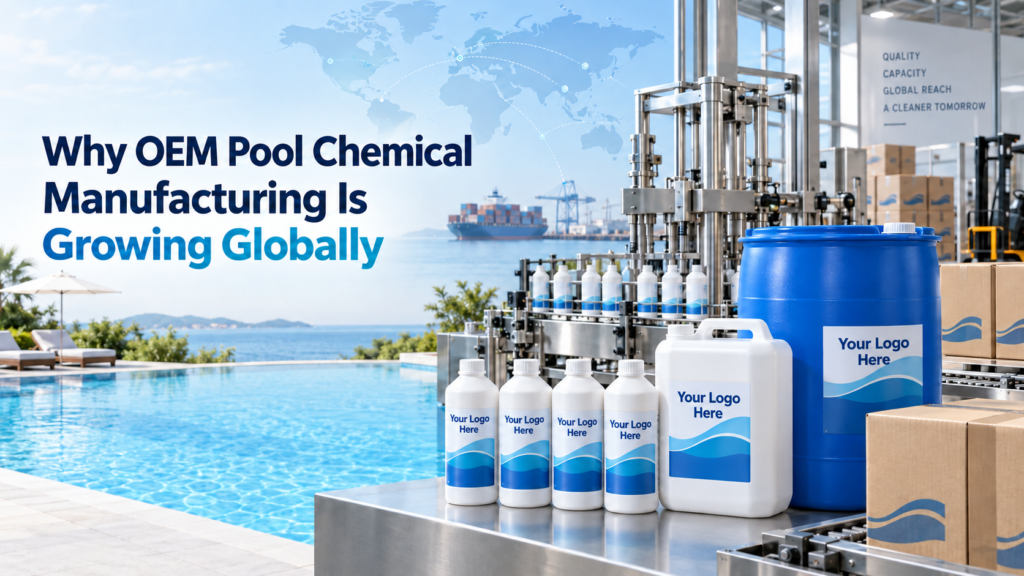
OEM stands for Original Equipment Manufacturer. Within the pool chemical industry, an OEM manufacturer may formulate, blend, fill, package, label, and prepare products for another company to sell under its own brand. Depending on the agreement, the service may range from basic bulk supply to a complete private-label program.
This business model is not new. What is changing is its reach.
Pool equipment distributors are launching chemical lines. Regional chemical suppliers are developing private-label products. Pool service companies are putting their names on maintenance chemicals, while online sellers are creating compact ranges aimed at specific types of pool owners.
Why is this happening?
The short answer is that building a brand has become easier than building a chemical plant. The longer answer involves changing customer habits, regional market differences, tighter regulations, rising production costs, and the commercial value of owning the relationship with the end customer.
Let’s take a closer look.
The Global Pool Market Is Still Creating Chemical Demand
Every new swimming pool creates an ongoing maintenance requirement.
A pool may be built once, but it must be sanitized, balanced, cleaned, clarified, and protected from algae throughout its operating life. This makes pool chemicals a recurring-consumption category rather than a one-time purchase.
Market forecasts differ because research companies define the swimming pool sector in different ways. Still, they generally point in the same direction: steady global expansion. One recent estimate placed the swimming pool construction market at approximately USD 7.49 billion in 2025 and forecast continued growth through 2030, supported by residential development, hospitality projects, renovation, and demand for automated pool systems. The Business Research Company
The chemical opportunity extends beyond newly built pools. Existing pools require years—or decades—of treatment.
Demand comes from several segments:
- Residential swimming pools
- Hotels and holiday resorts
- Public aquatic centers
- Fitness clubs and schools
- Water parks
- Pool maintenance companies
- Commercial property managers
- Spa and wellness facilities
Climate also matters. Warmer regions may operate pools throughout the year, while temperate markets create intense spring-opening, summer-maintenance, and winter-closing seasons.
That seasonal cycle encourages distributors to build product families rather than sell a single chemical. A company that begins with an algaecide may later add a clarifier, winter treatment, surface cleaner, or specialty maintenance product.
OEM manufacturing gives that company a practical way to expand.
Brands Want Product Lines Without Owning Factories
Building a pool chemical production facility requires more than tanks and filling machines.
A producer may need raw-material storage, blending equipment, calibrated testing instruments, packaging lines, batch traceability systems, trained operators, safety procedures, environmental controls, and suitable warehousing. Every additional package size can bring new molds, labels, cartons, caps, and filling adjustments.
For a new pool brand, that is a heavy starting point.
An OEM partnership separates brand ownership from physical production. The brand can concentrate on market research, sales channels, customer service, and promotion while the manufacturer manages production.
This can reduce the initial commitment in several areas:
- Manufacturing equipment
- Factory space
- Technical staffing
- Production permits
- Packaging machinery
- Raw-material inventory
- Quality-control facilities
- Maintenance and equipment downtime
It does not make the business effortless. The brand still has to understand its customers, verify compliance, forecast stock, and support its claims. However, it removes one of the largest barriers to entering the market.
That difference is especially important for small and medium-sized distributors. They may already have customers and technical knowledge, but they do not have enough volume to justify their own factory.
OEM manufacturing fills that gap.
Private Labels Give Distributors More Commercial Control
A distributor selling another company’s established brand often competes mainly through price, availability, and service. The product name belongs to someone else. So does much of the long-term brand value.
Private labeling changes that relationship.
When customers repeatedly buy a pool algaecide carrying the distributor’s own name, the distributor becomes more difficult to replace. It can build recognition around its formulation, packaging, instructions, and service program.
The product is no longer just another item in a catalog. It becomes part of the company’s identity.
This can produce several commercial advantages:
- Greater control over retail or wholesale positioning
- Less direct price comparison with identical branded products
- Stronger customer retention
- More freedom to create product bundles
- Better connection between chemical sales and technical service
- The chance to develop exclusive package sizes or concentrations
Imagine two distributors offering similar non-foaming algaecides. One sells a product available from six other local suppliers. The other sells a private-label version supported by its own dosage guide, seasonal maintenance plan, and customer training.
Which one has a stronger reason for buyers to return?
The chemistry matters, of course. Yet presentation, availability, instructions, and trust shape the purchase too. A reliable formulation wrapped in a clear brand story is often more commercially useful than an anonymous drum of chemical.
Faster Product Launches Matter More Than They Used To
Pool care markets are becoming more segmented.
Some buyers want concentrated products that reduce transport and storage costs. Others want ready-to-use treatments with simple instructions. Premium residential customers may care about non-foaming performance and stain prevention, while commercial operators may focus on predictable dosage and compatibility with their existing maintenance systems.
Seasonality adds pressure. If a brand misses the spring-opening period, it may lose much of that year’s sales opportunity.
An experienced OEM pool chemical manufacturer can shorten development time by offering established product platforms, packaging formats, and quality procedures. The customer does not always need to begin with a blank formula.
A typical development path might start with an existing formulation and then adjust:
- Active concentration
- Color
- Fragrance, where technically appropriate
- Package volume
- Label language
- Dosage directions
- Carton configuration
- Product name and visual identity
This approach can be much faster than constructing a production system from scratch. It also lets the brand test demand with a focused range before making larger commitments.
Speed should never mean skipping stability testing, packaging compatibility, or regulatory review. Still, when the technical foundation already exists, many avoidable delays disappear.
Local Markets Rarely Want Exactly the Same Product
A product that sells well in one country may need changes before it makes sense elsewhere.
Pool size, climate, water hardness, rainfall, filtration systems, treatment habits, price expectations, and retail packaging all vary by region. Even the familiar units printed on the bottle may change—from gallons and fluid ounces to liters and milliliters.
Consider algaecides.
A market with many spas, fountains, or high-agitation pool systems may place greater value on low-foaming formulations. Areas with hard water or concerns about surface discoloration may show stronger interest in metal-free algae control. Cold-climate markets may need dedicated closing products, while tropical regions may focus more heavily on year-round preventive treatment.
Packaging preferences can be just as local:
- A one-liter bottle may suit residential retail.
- A five-liter jerrycan may work better for pool service companies.
- A 20- or 25-liter container may appeal to commercial operators.
- Bulk drums may suit regional blenders or large distributors.
- Multilingual labels may be essential in cross-border markets.
OEM production allows brands to respond to these differences without developing separate factories in every region.
For example, a supplier could build a compact specialty range around Polyquat 60 Algaecide, a preventive algae-control product valued for non-foaming and metal-free performance. It could then add a Polymer Pool Clarifier for cloudy-water treatment and a Winter Algaecide for seasonal pool closing.
Together, those products tell a more complete market story than a single generic chemical.
Online Sales Are Encouraging Smaller, More Focused Brands
E-commerce has changed how pool chemicals reach customers.
A new brand no longer needs a national chain of physical stores before it can test a product. It may begin through its own website, a regional dealer network, a marketplace, or direct sales to pool service professionals.
Digital channels also make narrow positioning more practical.
Instead of presenting a huge catalog, a company can focus on a clear promise:
- Non-foaming pool care
- Metal-free algae prevention
- Products for saltwater pools
- Professional treatments for service companies
- Seasonal pool-opening and closing kits
- Compact maintenance programs for residential users
This does not mean every online pool chemical brand will succeed. Chemical products require accurate instructions, careful shipping, responsible claims, and responsive customer support. A nice label cannot rescue an unreliable formula.
However, online selling has reduced the cost of finding a specific audience. OEM manufacturing reduces the cost of producing for that audience. Those two changes reinforce each other.
Pool Service Companies Are Becoming Product Brands
Pool service companies have something many new consumer brands would love to possess: direct contact with pool owners.
A service technician sees real water conditions every week. The company learns which problems appear repeatedly, which instructions confuse homeowners, and which package sizes technicians actually use.
That experience can support a practical private-label range.
A service company might introduce its own weekly algaecide, clarifier, or winter-closing treatment. The products can be sold during service visits, included in maintenance plans, or offered to customers who want to handle part of the routine themselves.
There is also a trust advantage. A homeowner who already relies on a technician to maintain the pool may feel comfortable buying a product recommended—and branded—by the same company.
For the service provider, this creates revenue beyond labor. It may also improve treatment consistency because technicians work with a familiar formulation and dosage system.
OEM manufacturers make such programs possible without asking the service company to become a full chemical producer. The service business contributes field knowledge and customer access; the manufacturer contributes formulation, production, testing, and packaging.
That is a sensible division of labor.
Retailers Want Products Customers Cannot Compare in Seconds
Price transparency has become a headache for many retailers.
If five websites sell the exact same product with the same barcode, buyers can compare prices almost instantly. The lowest offer gains attention, and the retailer’s margin becomes increasingly fragile.
A private-label product reduces direct one-to-one comparison.
Customers can still compare active ingredients, concentration, performance claims, and package volume. They should. But they cannot simply search for an identical branded bottle from dozens of sellers.
This gives the retailer more room to build value around:
- Technical guidance
- Delivery speed
- Local service
- Maintenance programs
- Product bundles
- Training materials
- Warranty or support policies
The goal is not to hide information. A responsible pool chemical label should be clear about the product’s purpose, directions, precautions, and legal status.
The real goal is differentiation. The retailer is selling a product-and-service package, not merely passing along someone else’s bottle.
Seasonal Demand Makes Flexible Production Valuable
Pool chemical demand can rise sharply before and during swimming season.
For a brand owner, the difficult question is not only how much product will sell. It is when the stock must arrive.
Too little inventory can mean missed sales during the most valuable weeks of the year. Too much may leave cash sitting in a warehouse until the following season. Packaging materials make the calculation harder because bottles, caps, labels, and cartons all require planning.
OEM suppliers can support more flexible purchasing when they offer sensible minimum order quantities, multiple package formats, and staged production schedules.
The exact arrangement depends on the manufacturer. Some facilities are designed for long, efficient production runs. Others can handle smaller branded batches. Neither model is automatically better.
A buyer should match the manufacturer to the sales plan.
For an established national distributor, a large production run may reduce unit cost. For a new regional brand, a smaller first order may be worth a higher unit cost because it limits unsold stock.
That is one reason OEM demand is spreading across different company sizes. The model can support both large-volume programs and careful market tests—provided the supplier’s production system fits the customer’s needs.
Supply-Chain Diversification Is Becoming a Strategic Priority
Recent supply-chain disruptions taught pool chemical brands a costly lesson: relying on one production route can leave a business exposed.
A shortage of raw materials, delayed shipping schedules, port congestion, packaging shortages, or unexpected plant maintenance can interrupt product availability at exactly the wrong time. In a seasonal industry, a six-week delay is not always a small inconvenience. It may mean missing a large part of the summer selling period.
This has encouraged brands to examine where their products come from and how quickly supply can recover after a disruption.
OEM manufacturing can support a more diversified sourcing plan. A distributor may work with one primary manufacturer while qualifying another producer for selected products or regions. Larger brands may also source bulk concentrate from one location and arrange local filling closer to the target market.
The aim is not simply to collect more suppliers. Too many unqualified sources can create inconsistent formulas, confusing documentation, and quality complaints. The real aim is to build dependable alternatives.
A useful diversification plan may consider:
- Raw-material availability
- Production capacity during peak season
- Access to bottles, caps, labels, and cartons
- Distance from major ports
- Typical manufacturing lead time
- Export documentation experience
- Backup arrangements for essential equipment
- Batch testing and traceability
- Communication during shipping disruptions
Price still matters, naturally. But a slightly lower price offers little comfort when the product arrives after the season has ended.
Reliable supply has become part of product value.
OEM Is No Longer Just About Putting a Logo on a Bottle
The phrase “private label” sometimes creates a misleading picture. It sounds as though a manufacturer fills a standard liquid, applies a customer’s label, and ships the order.
That may be the simplest version of the service. Yet a serious OEM pool chemical program usually involves far more.
Before production begins, the manufacturer and brand owner may need to confirm:
- Target application
- Active ingredient and concentration
- Finished-product specifications
- Suitable packaging material
- Label dimensions and printing method
- Batch coding requirements
- Storage conditions
- Shelf-life expectations
- Safety Data Sheet requirements
- Transport classification
- Local language needs
- Regulatory status in the destination market
Packaging compatibility deserves special attention. A bottle that looks attractive in a sample photograph may not perform well after months of contact with a concentrated chemical. Caps can leak. Labels can wrinkle. Printed ink can fade or rub away. Cartons can weaken in humid warehouses.
These details are not glamorous, but they shape the customer’s experience.
Imagine opening a shipment and finding stained cartons or loose caps. Even if the chemistry inside still meets specification, confidence drops immediately. The product suddenly feels unreliable.
Good OEM manufacturing connects the formulation, container, closure, label, and shipping carton as one complete system.
Quality Control Protects Both Names on the Product
In an OEM relationship, a quality problem affects two companies.
The customer sees the brand printed on the bottle, not the blending tank used to make it. If the liquid separates, the concentration varies, or the package leaks, the brand owner receives the complaint. At the same time, repeated complaints can damage the manufacturer’s reputation and future business.
That shared risk makes quality control central to the relationship.
A dependable OEM manufacturer should define the finished-product specification before commercial production. The exact testing program will vary by formulation, but it may include:
- Appearance
- Active concentration
- pH
- Density
- Viscosity
- Odor or color, where relevant
- Packaging weight or fill volume
- Closure integrity
- Batch identification
A Certificate of Analysis, or COA, should correspond to the batch being shipped. It should not be treated as a generic marketing sheet.
Traceability matters too. If a distributor reports a problem several months later, the manufacturer should be able to identify when the batch was produced, which raw materials were used, what test results were recorded, and how the product was packed.
This becomes even more important when one manufacturer produces similar formulations for several private-label customers. Labels and cartons must be controlled carefully so that the wrong brand, language, or dosage instructions do not end up on the product.
Simple checks prevent expensive mistakes.
Regulatory Requirements Are Raising the Value of Experienced Manufacturers
Pool chemicals do not all fall into the same regulatory category.
A pH adjustment product, clarifier, cleaner, sanitizer, and algaecide may face different rules depending on its ingredients, claims, and country of sale. A product described as controlling or preventing algae may be regulated as a pesticide or biocidal product in some markets.
This is where inexperienced brands can get into trouble.
Changing the label does not remove the legal obligations attached to the product. Neither does importing the material in bulk. The permitted claims, active ingredients, manufacturing facility, label format, safety information, and product registration route may all require review.
In the United States, for example, the Environmental Protection Agency allows certain registered pesticide products to be sold under another company’s name through supplemental distribution. However, the distributor product remains connected to the primary registered product, and both the registrant and distributor may be held liable for violations. It is not an unrestricted relabeling arrangement.
The European Union also requires companies placing biocidal products on the market to demonstrate that the product is effective and does not present unacceptable risks to people, animals, or the environment. Authorisation must be considered alongside active-substance status and national or Union-level requirements.
Other countries have their own systems.
For that reason, a responsible OEM manufacturer should never promise that one label or registration automatically covers every destination. The brand owner, importer, local consultant, and manufacturer need to confirm the requirements for the actual market.
Regulation may slow a launch, but ignoring it can stop sales completely.
Documentation Has Become Part of the Product
Buyers once judged chemical suppliers mainly through price, specification, and delivery time. Those points still matter, but documentation now carries much more weight.
Distributors, shipping companies, warehouses, customs brokers, marketplaces, insurers, and regulators may all request product information. A manufacturer that cannot provide consistent documents creates work—and risk—for everyone else.
An OEM buyer may need:
- Product specification
- Certificate of Analysis
- Safety Data Sheet
- Technical Data Sheet
- Ingredient or composition information where permitted
- Batch records
- Packaging details
- Transport information
- Country-of-origin documents
- Regulatory statements
- Label files and approved artwork
- Stability or compatibility information
Not every document is needed for every shipment. Still, the manufacturer should understand what the documents mean and keep the information consistent.
Conflicting data can be a warning sign. If the product name, concentration, physical properties, or transport classification changes from one document to another, the buyer has good reason to ask questions.
Clear paperwork does more than satisfy an administrative request. It shows that the product is controlled.
Smaller Minimum Orders Are Opening the Market to New Brands
Traditional chemical manufacturing tends to favor large batches. Longer runs reduce cleaning, setup, label changes, and production interruptions. That helps lower the unit cost.
Yet many new pool brands do not need a full container of every product on their first order.
They want to test demand.
This has created interest in OEM suppliers that can support smaller commercial batches, mixed product ranges, or a gradual increase in volume. A brand might begin with one or two products, collect customer feedback, and then add complementary treatments.
A smaller minimum order usually comes with trade-offs. The packaging cost per unit may be higher. Custom bottle colors may not be available. Label printing may be less economical. Production scheduling may also require more flexibility from the buyer.
Still, paying a little more per bottle can make sense if it prevents thousands of units from sitting unsold.
The lowest unit price is not always the lowest business risk.
For a first launch, a focused range is often easier to explain and manage. A brand could begin with:
- One preventive algaecide
- One cloudy-water treatment
- One seasonal or winter product
That is enough to create a recognizable specialty program without turning the warehouse into a maze of slow-moving stock.
Custom Packaging Helps Brands Serve Specific Customers
Packaging is not merely decoration. It influences who can use the product, how it is stored, and where it can be sold.
A homeowner may prefer a compact bottle with clear dosage instructions. A pool technician may need a sturdy handle, a reliable measuring system, and packaging that survives daily transport in a service vehicle. A commercial facility may prefer larger containers that reduce packaging waste and purchasing frequency.
OEM manufacturing lets the brand match packaging to the user.
Customisation may include:
- Bottle or jerrycan size
- Cap style
- Tamper-evident seal
- Induction seal
- Measuring chamber
- Label material
- Front-and-back label layout
- Multilingual instructions
- Outer-carton quantity
- Pallet configuration
There is a temptation to make a new package look dramatic. Bright colors, bold claims, and crowded icons may attract attention, but clarity should come first.
Pool owners need to know what the product does, how much to add, when to use it, and what precautions to follow. If the label makes those answers hard to find, the design is working against the product.
The strongest packaging often feels simple because difficult decisions were settled before printing.
How Should a Brand Choose an OEM Pool Chemical Manufacturer?
A glossy website and a competitive quotation are not enough.
The buyer needs to understand how the manufacturer works when something goes wrong. Can it investigate a complaint? Can it reproduce the same specification across batches? Will it communicate early if a raw material is delayed?
Start with the technical fit.
Ask whether the manufacturer already works with the relevant product type. A factory experienced in water-treatment polymers may understand concentrated cationic formulations, but that does not automatically mean it can manufacture every oxidizer, sanitizer, or acid product. Different chemicals need different equipment, storage conditions, and safety controls.
Then examine the commercial fit.
Questions worth asking include:
- What is the minimum order for each package size?
- Can several products be combined in one shipment?
- Who purchases the bottles, caps, and labels?
- Who owns unused custom packaging?
- How long does label approval take?
- What tests are completed for each batch?
- How are samples retained?
- What happens if a batch falls outside specification?
- Can the manufacturer support future volume growth?
- Which export markets has it served before?
Samples are useful, but a sample alone does not prove that future batches will be consistent. The buyer should review specifications, test methods, production controls, and commercial terms as a connected package.
A trial order can reveal things that meetings cannot. It shows how the supplier handles artwork, deadlines, documents, packing, and unexpected questions.
The Cheapest OEM Quote Can Become the Most Expensive Choice
Two quotations may look similar while covering very different services.
One price may include a tested finished formula, printed labels, batch coding, export cartons, pallets, and documentation. Another may cover only liquid and a basic container.
Concentration differences can also distort comparisons. A lower-priced product may contain less active ingredient or require a larger dosage. Freight cost per treatment may then be higher even though the price per bottle looks attractive.
Before comparing quotes, buyers should confirm:
- Active concentration
- Recommended dosage
- Package volume and net weight
- Bottle and cap specifications
- Label printing
- Carton strength
- Pallet or non-pallet loading
- Testing included
- Documentation included
- Production lead time
- Payment terms
- Incoterm
- Expected shelf life
Quality failures create costs that rarely appear in the quotation. These may include returned goods, relabeling, lost selling time, customer refunds, disposal, regulatory delays, and damage to the brand.
A fair price is important. A complete price is better.
Strong OEM Relationships Depend on Clear Responsibilities
OEM manufacturing works well when each party knows what it owns.
The manufacturer usually controls production, batch testing, filling, and agreed packaging operations. The brand owner generally controls market positioning, sales forecasts, artwork approval, local distribution, and customer communication.
Regulatory responsibility may be shared or divided differently depending on the country and agreement. It should never be assumed.
Before launch, both sides should clarify:
- Who approves the formula?
- Who confirms local legal requirements?
- Who reviews label claims?
- Who owns the artwork?
- Who keeps retained samples?
- Who handles customer complaints?
- Who pays for obsolete labels?
- What happens when packaging specifications change?
- How are confidential formulas and customer information protected?
- Under what conditions may the price be adjusted?
Written specifications reduce later disagreement. So do approved samples, signed artwork, and documented change procedures.
Trust is important, of course. But trust grows faster when the details are clear.
Where Is Global OEM Pool Chemical Manufacturing Heading?
The market is likely to become more specialized.
Large general-purpose product ranges will remain important, but smaller brands will continue building offers around specific customer problems. Metal-free pool care, non-foaming maintenance, saltwater-pool compatibility, easy-dose packaging, professional service products, and seasonal treatment kits all provide room for focused positioning.
Buyers are also asking more questions about concentrated products, packaging waste, shipment efficiency, and traceable raw materials. Not every environmental claim will survive close examination, so brands must be careful. A concentrated product may reduce packaging and transport per treatment, but the full impact still depends on dosage, materials, shipping distance, and product life.
Digital tools will influence OEM projects as well. Online artwork approval, batch records, inventory forecasts, and order tracking can make cross-border cooperation easier. Yet the core work remains physical: stable chemistry, accurate filling, secure packaging, and dependable delivery.
That part cannot be replaced by clever software.
The most successful OEM manufacturers will probably be those that combine chemical production with practical support. They will understand not only how to blend a product, but also how packaging, documents, shipping, regulation, and seasonal planning affect the buyer’s business.
OEM Growth Is Really About Specialization
So, why is OEM pool chemical manufacturing growing globally?
It is growing because more companies want to own their brands without owning every part of production. Distributors want stronger margins and customer loyalty. Service companies want products that support their maintenance programs. Online sellers want focused ranges. Established brands want regional packaging and additional supply options.
Meanwhile, manufacturing is becoming more demanding. Quality systems, chemical handling, documentation, packaging compatibility, and regulatory requirements require real experience.
OEM manufacturing connects these two sides.
The model lets one company concentrate on customers while another concentrates on production. When both parties understand their responsibilities, the result can be much more than a bottle with a new logo. It can become a stable product range, a stronger market position, and a long-term source of repeat business.
That is the key point: OEM is not growing because manufacturing has become unimportant.
It is growing because professional manufacturing has become too important to improvise.
Frequently Asked Questions About OEM Pool Chemical Manufacturing
What does OEM mean in the pool chemical industry?
OEM pool chemical manufacturing means that a qualified producer formulates, blends, fills, or packages pool treatments for another company to sell under its own brand. The exact service can range from bulk chemical supply to a complete private-label product program.
Can a small distributor launch a private-label pool chemical brand?
Yes. Some manufacturers support smaller initial orders and standard packaging formats. A focused launch with one to three products can help a distributor test demand before expanding its private-label pool chemical range.
What information does an OEM pool chemical manufacturer need from a buyer?
The manufacturer normally needs the target product type, concentration, package size, expected order quantity, destination country, label language, performance requirements, and sales claims. Regulatory requirements should also be reviewed before production.
Are private-label pool algaecides automatically approved for sale in every country?
No. Registration and labeling rules vary by market. Products making algae-control claims may be regulated as pesticides or biocides. The manufacturer, brand owner, and local importer should confirm the applicable requirements before sale.
How long does it take to launch an OEM pool chemical product?
Timing depends on formula selection, testing, packaging availability, artwork approval, order size, and regulatory work. A product based on an established formulation and standard bottle can usually move faster than a fully custom formula with new packaging.