
GET IN TOUCH
Ask For Sample?
The Commercial Advantages of Selling Polyquat 60 Algaecide
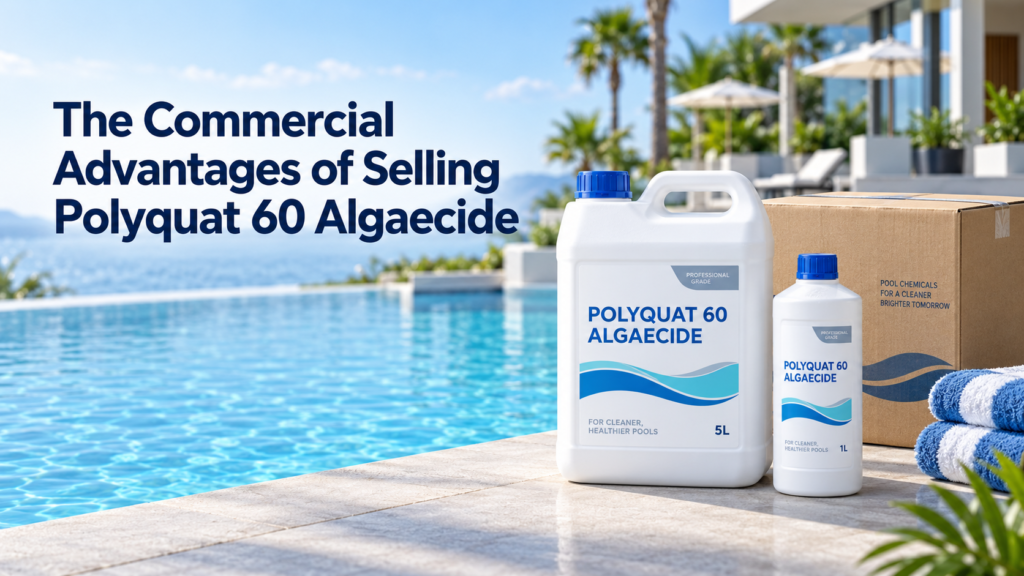
Selling pool chemicals can look simple from the outside. Buy a drum, fill smaller bottles, add a label, and offer the product to pool owners. Yet anyone who has worked in this market knows the truth: a chemical that merely “works” is not always a good commercial product.
A commercially attractive algaecide must do several jobs at once. It should deliver reliable performance, fit easily into existing pool-care routines, create few customer complaints, support repeat orders, and leave enough room for distributors to build a healthy margin.
That is where Polyquat 60 Algaecide becomes interesting.
Polyquat 60 is a concentrated, polymer-based algaecide commonly supplied as a liquid containing approximately 60% active ingredient. It is valued for non-foaming algae control and its suitability for preventive, corrective, and seasonal pool-maintenance programs.
Those technical qualities matter. But the commercial story is even broader.
For distributors, pool chemical brands, service companies, and OEM buyers, Polyquat 60 can support a premium product line without relying on flashy claims or short-lived trends. It solves recognizable problems, serves several market segments, and can be sold in multiple package sizes and concentrations.
In plain terms, it gives sellers more than one way to make money.
Polyquat 60 Competes on Value, Not Just Price
Commodity products often pull sellers into price competition. When several suppliers offer what appears to be the same basic chemical, buyers compare quotations line by line. A small price difference can decide the order.
Polyquat 60 allows a different conversation.
Instead of presenting it as “another pool algaecide,” a seller can build the offer around specific performance and customer-experience benefits:
- Non-foaming application
- Polymer-based algae control
- Suitability for routine prevention
- Compatibility with common pool-maintenance programs when used as directed
- No intentional addition of copper or other staining metals
- Availability in concentrated and diluted formulas
- Support for seasonal closing products
- Private-label and custom-packaging possibilities
This gives sales teams something meaningful to discuss beyond the cost per bottle.
A premium hotel, for example, may care more about calm, attractive water than saving a small amount on each treatment. A pool service company may value predictable application and fewer callbacks. A retailer may want a product that is easy to explain and less likely to generate complaints about foam or staining.
The product’s value changes according to the customer—but there is usually a relevant value story to tell.
Non-Foaming Performance Supports Premium Market Positioning
Foam is not merely a technical inconvenience. It is visible.
That makes it commercially important.
When foam appears on the surface of a decorative pool, spa, hotel pool, or residential pool, customers often assume the water has been treated incorrectly. The chemistry may still be functioning, but the pool no longer looks clean and inviting.
That visual problem can become a reputational problem for the retailer or service company that supplied the chemical.
Polyquat 60 is generally marketed as a non-foaming algaecide. This gives sellers a strong point of distinction in markets where water appearance matters almost as much as algae control.
Consider the difference between two sales messages:
“Here is an economical algaecide.”
“This concentrated, non-foaming algaecide helps control algae without covering the pool surface in bubbles.”
The second message speaks to an experience the customer can picture. It explains why the product may deserve a higher price.
This is especially useful when selling to:
- Hotels and resorts
- Health clubs
- Residential pool professionals
- Water parks
- Property-management companies
- Premium pool retailers
- Spa and leisure facilities
- High-end villa projects
Customers in these segments are often buying presentation, reliability, and peace of mind—not just a liter of liquid.
A Metal-Free Formula Can Address a Familiar Customer Concern
Copper-based algaecides have an established place in pool maintenance. Still, dissolved metals can become part of the conversation when pool operators are concerned about surface discoloration, scale deposits, or changes in hair color under certain water conditions.
Polyquat 60 offers brands a polymer-based option that does not depend on copper as the active algae-control component.
That does not mean every staining problem disappears. Pool staining can have several causes, including source-water metals, corroding equipment, poor pH control, and incompatible chemical additions. Sellers should never promise more than the formulation and approved label can support.
Even so, the absence of intentionally added copper gives sales teams a clear and responsible message:
Polyquat 60 can be positioned for customers who want algae control without adding another metal-based treatment to the pool.
That is a useful advantage in premium residential markets, commercial pools with expensive finishes, and service programs where operators want tighter control over total metal levels.
It also helps brands create a more organized product range. Instead of claiming that one chemistry is right for every situation, they can offer different algaecide technologies for different customer priorities.
That feels more professional—and customers notice.
Concentration Creates More Commercial Flexibility
A 60% active product is not limited to a single route to market.
Some buyers want the concentrated raw material because they operate local blending or filling facilities. Others want a finished retail formulation that can go directly to distributors. Some prefer a lower concentration for easier consumer dosing or a more accessible retail price.
One starting material can therefore support several commercial models:
- Bulk Polyquat 60 for regional formulators
- Concentrated professional-grade algaecide
- Diluted maintenance algaecide
- Retail-ready private-label products
- Commercial pool service packs
- Seasonal pool-closing formulas
- Combined treatment kits containing complementary products
This flexibility can be valuable when a supplier serves markets with different price levels.
A 1-liter concentrated product may suit a specialist pool shop. A 5-liter jerrycan may work better for a service company. A 25-liter container can serve commercial operators, while drums or IBC totes may suit local blenders.
The product remains chemically related, but the commercial offer changes.
That is much more efficient than building a separate supply chain for every customer group.
Private Labeling Turns Chemistry into a Brand Asset
When distributors resell another company’s finished brand, they may receive a margin, but they do not fully own the customer relationship. The manufacturer’s name remains on the bottle. Customers can search for the same product elsewhere, compare prices, and change suppliers.
Private labeling changes that equation.
With a private-label Polyquat 60 product, the distributor can control:
- Brand name
- Label design
- Package format
- Market positioning
- Product instructions, subject to local approval
- Sales channels
- Dealer structure
- Recommended retail price
- Supporting educational content
This does not make manufacturing or compliance disappear. Far from it. It does, however, give the local seller an asset that becomes more valuable with each successful order.
A well-designed private-label product can sit naturally beside chlorine, pH control products, clarifiers, test kits, and seasonal chemicals. Over time, customers begin asking for the brand rather than a generic algaecide.
That is the quiet power of private labeling. The bottle may contain a pool chemical, but the repeat purchase belongs to the brand.
Companies planning a branded range can source a retail-ready Polyquat 60 Algaecide in different container sizes, or discuss concentration and packaging adjustments for their local channels.
Healthy Margins Depend on More Than the Raw Material Cost
It is tempting to calculate profitability by subtracting the chemical cost from the selling price. That gives a number, but it does not give the full answer.
The real margin is affected by many connected costs:
- Packaging
- Label printing
- Cartons and pallets
- Filling losses
- Quality testing
- Warehousing
- Freight
- Customs duties
- Registration
- Distributor discounts
- Product returns
- Customer complaints
- Technical support
- Marketing
A cheap raw material can become an expensive product if it creates instability, inconsistent appearance, leaking packages, or repeated after-sales problems.
Polyquat 60 may support a stronger commercial margin because it can be positioned as a specialist product rather than a generic commodity. Its concentrated form may also reduce the amount of packaging needed per unit of active ingredient, although the actual freight advantage depends on the finished concentration, package type, shipment method, and local regulations.
More importantly, a dependable product protects the margin after the sale.
If customers apply a product as directed and receive consistent results, they are less likely to demand replacements or switch brands after one season. Avoiding one serious commercial-pool complaint can be worth far more than saving a few cents per kilogram at the purchasing stage.
The cheapest purchase is not always the most profitable sale. Pool chemical businesses learn that lesson sooner or later.
Repeat Sales Fit the Natural Pool-Maintenance Cycle
A product becomes commercially powerful when customers have a reason to buy it again.
Polyquat 60 fits naturally into recurring pool-care programs. It may be used for preventive maintenance, algae treatment, pool opening, or seasonal closing, depending on the finished formulation and approved directions.
That creates several repeat-purchase moments:
- Initial pool opening
- Early-season algae prevention
- Routine summer maintenance
- Treatment after heavy rain or high bathing loads
- Recovery following circulation or sanitation problems
- Pool closing and winterization
- Spring inspection and restocking
For a distributor, this means Polyquat 60 does not need to depend on a one-time project. It can become part of the customer’s annual purchasing routine.
Pool service companies have an even greater opportunity. They can include the treatment within monthly or seasonal service packages rather than selling it as an isolated bottle. The chemical then supports recurring service revenue.
A product with predictable repeat demand also makes inventory planning easier. Sellers can examine the previous season’s consumption, identify demand peaks, and place bulk orders before the busiest months.
Of course, weather still matters. A wet, hot season may change algae pressure and demand. Yet the underlying maintenance cycle remains relatively easy to understand.
Polyquat 60 Can Help Reduce Costly Service Callbacks
For pool service companies, profitability is often won or lost between scheduled visits.
A technician may complete a treatment correctly, leave the property, and move to the next customer. If visible algae returns quickly—or if foam develops—the customer calls. The company must send someone back, often without charging for the extra trip.
Fuel, labor, scheduling disruption, and customer frustration all eat into the original service margin.
A well-designed Polyquat 60 maintenance program may help service businesses improve consistency and reduce algae-related surprises. It should not replace proper sanitizer control, circulation, filtration, brushing, or water testing. Instead, it serves as one part of a complete maintenance system.
That distinction matters.
Customers should not be told that an algaecide can fix poor pool management. It cannot. But when used correctly within a balanced program, it can add another layer of algae control.
For service companies, that extra layer can mean fewer awkward calls on Friday evening—right before the customer’s weekend pool party.
One Product Can Serve Several Customer Groups
Some specialty chemicals have a narrow audience. Polyquat 60 has a broader commercial reach.
Potential buyers may include:
- Pool chemical formulators
- Importers and national distributors
- Private-label brands
- Regional wholesalers
- Pool retail chains
- Independent pool shops
- Commercial pool operators
- Pool maintenance contractors
- Hotel and resort suppliers
- Seasonal pool-closing specialists
Each group buys differently.
A formulator may focus on active content, viscosity, stability, technical documents, and bulk price. A retailer wants attractive packaging and clear consumer instructions. A service company may prefer 5-liter or 25-liter containers. A hotel supplier cares about dependable deliveries and professional presentation.
The same technical product can address these different needs when concentration, packaging, documentation, and support are planned properly.
This broad addressable market reduces dependence on a single sales channel. If retail demand slows, the supplier may still pursue service companies or formulators. If a country has a limited private-pool market, commercial facilities may offer another entry point.
That does not guarantee sales, of course. Nothing does. But it gives the seller room to test several routes without abandoning the product category.
Polyquat 60 Opens the Door to Portfolio Selling
Selling one bottle is useful. Selling a complete maintenance program is better.
Polyquat 60 can act as the lead product in a wider pool-care range. Once a buyer trusts the algaecide, the supplier can introduce related products for water clarity, winter maintenance, or other treatment stages.
For example, a distributor might offer:
- A concentrated Polyquat 60 product for algae control
- A lower-strength maintenance formula
- A polymer clarifier for cloudy water
- A winter product for pool closing
- Test strips or dosing accessories
- A seasonal opening or closing kit
The commercial advantage is not merely a larger order. A coordinated range makes the distributor more useful to the customer. Instead of sourcing each product from a different company, the buyer can consolidate purchasing and receive more consistent packaging, documents, and technical communication.
A Polymer Pool Clarifier, for instance, can sit beside the algaecide as a separate product for suspended particles and water clarity. The two products should not be presented as interchangeable. One addresses algae control, while the other supports filtration and clearer-looking water.
For colder markets, a dedicated Winter Algaecide can extend the selling season beyond the summer peak.
This portfolio approach can raise the average order value and deepen the buyer relationship without forcing the seller into an unrelated chemical category.
Seasonal Products Can Smooth the Sales Calendar
Pool chemical sales are seasonal in many countries. Demand climbs as pools open, remains active through the warm months, and falls after the swimming season.
Polyquat 60 gives sellers several ways to work with that cycle.
Before the season, distributors can sell stock to pool shops and service companies. During summer, they can promote routine maintenance and algae-response products. As temperatures fall, the message can shift toward closing and off-season protection.
This creates three connected campaigns from the same chemistry:
- Pool opening
- In-season maintenance
- Pool closing
The packaging and formulation may differ, but the supply chain can remain related.
In warm regions where pools operate all year, the opportunity changes rather than disappears. Sellers can focus on continuous maintenance, heavy bathing loads, warm-water algae pressure, and commercial facilities that cannot tolerate downtime.
A thoughtful product range therefore follows the local climate. It does not force a northern-European seasonal message onto a tropical market—or the other way around.
Flexible Packaging Helps Sellers Reach Different Price Points
Packaging is not just a container. It determines where the product can be sold, who can lift it, how it is displayed, and how much cash the buyer must spend per purchase.
Common commercial formats may include:
- 1-liter bottles for residential retail
- 5-liter jerrycans for frequent users and service companies
- 25-liter containers for commercial applications
- IBC totes for local blending and high-volume industrial customers
- Custom retail packs for private-label programs
Smaller packs can deliver a higher selling price per liter, but they also increase packaging and filling costs. Bulk supply lowers packaging cost per kilogram but normally brings a lower unit margin.
A sensible seller does not automatically chase the format with the largest percentage margin. The right choice depends on order frequency, filling capability, warehousing, freight, local handling practices, and customer expectations.
For a new brand, one retail size and one professional size may be enough at the beginning. Too many stock-keeping units can trap cash in slow-moving packaging.
Start narrow. Learn what customers actually buy. Then expand.
Consistent Specifications Protect the Brand Behind the Bottle
Private-label customers may never see the factory, but they will notice variation.
If one batch pours easily and the next feels unusually thick, they notice. If the color changes sharply, they notice. If the active content or pH moves outside the agreed range, the finished product may behave differently during blending, filling, or storage.
Commercial success therefore depends on more than obtaining a low quotation. Buyers should agree on a clear specification that may include:
- Active ingredient content
- Appearance and color
- pH
- Density
- Viscosity
- Packaging material
- Net weight
- Batch identification
- Certificate of Analysis
- Shelf-life and storage conditions
The seller should also test the finished formulation, not only the concentrated raw material. Dilution water, dyes, fragrances, additional ingredients, container materials, and storage temperature can all affect the final product.
A reliable specification protects both sides. The supplier knows what must be delivered, and the brand owner has an objective basis for accepting each batch.
Trust is built through repeated consistency. A beautiful label may win the first order; consistent quality wins the fourth.
Documentation Makes International Sales Easier
Chemical buyers rarely purchase on appearance alone. They may need a Technical Data Sheet, Safety Data Sheet, Certificate of Analysis, composition information, transport classification, product label, and supporting quality records.
The exact document package depends on the country, application, formulation, and route to market.
For distributors, complete documentation has direct commercial value. It can speed up supplier approval, reduce repeated questions, and help technical teams compare products. It also signals that the supplier understands international business.
However, documents must match the actual material being supplied. A Safety Data Sheet for a 60% concentrate should not automatically be used for a diluted retail formulation. Likewise, the product name, active ingredient, concentration, batch details, and packaging should remain consistent across commercial and technical paperwork.
Small inconsistencies can delay customs clearance or make a serious buyer uncomfortable. In chemical sales, paperwork is part of the product.
Regulatory Preparation Can Become a Competitive Barrier
Algaecides are regulated products in many markets because their intended purpose is to control algae. Registration, labeling, approved claims, language, packaging, and reporting obligations vary by jurisdiction.
In the United States, for example, pesticide products generally must be registered with the Environmental Protection Agency and carry EPA-approved labeling before they are sold or distributed for pesticidal use. Companies should verify federal and applicable state requirements before launching a pool algaecide.
This may initially look like a disadvantage. Registration costs money and takes time.
Yet once a company has completed the required work, compliance can become a commercial barrier against poorly prepared sellers. Buyers often prefer suppliers that can provide stable specifications, accurate technical files, traceable batches, and labels suited to the destination market.
The responsible approach is simple:
- Identify the intended country before confirming the label
- Verify how the finished product is classified
- Confirm which company will hold or support the registration
- Use only permitted product claims
- Match directions and precautions to the approved label
- Review local language and packaging requirements
- Keep batch and production records
Calling a product “raw material” does not automatically remove every regulatory obligation. Classification may depend on composition, claims, packaging, intended use, and local law. Professional regulatory advice should be obtained for each target market.
Careful compliance may slow the first launch, but it protects the business later.
Technical Education Makes the Product Easier to Sell
Polyquat 60 is easier to sell when customers understand what it can and cannot do.
Good marketing content should explain that the product supports algae control but does not replace filtration, circulation, sanitizer management, brushing, or balanced water chemistry.
That honest message may seem less dramatic than promising a miracle. It is also more credible.
Distributors can create useful content around questions such as:
- When should Polyquat 60 be added?
- Can it be used before or after pool shock?
- How does pool volume affect dosage?
- Why is a non-foaming algaecide useful?
- How should the product be stored?
- How does it differ from copper-based algaecides?
- Can it be included in a winterization program?
Every good answer can attract search traffic, help a salesperson respond faster, and reduce incorrect application.
This is particularly valuable for private-label brands. Large competitors may have bigger advertising budgets, but a focused brand can still earn attention by explaining one product exceptionally well.
Expertise has a compounding effect. One helpful article supports the next one, and over time the brand becomes associated with the category.
What Should a Distributor Check Before Adding Polyquat 60?
Before committing to a large order, the distributor should examine the complete business case.
Ask the following questions:
- Which customer segment will buy the product?
- Will it be sold as a concentrate or finished formulation?
- Which package sizes match the local channel?
- What claims are legally permitted?
- Is product registration required?
- What specification will appear in the purchase contract?
- Can the supplier provide batch-specific COAs?
- Has packaging compatibility been tested?
- What is the minimum order for custom labels?
- How long will the launch inventory take to sell?
- What gross margin remains after freight, duties, warehousing, and distributor discounts?
- Can the product lead to sales of clarifiers or seasonal chemicals?
- What technical support will customers receive?
These questions prevent a common mistake: buying a commercially attractive product without building a route to market.
Polyquat 60 has real selling advantages, but chemistry alone does not create a successful brand. The offer must connect product performance with packaging, compliance, education, and dependable supply.
The Strongest Advantage Is Commercial Versatility
Polyquat 60 is not attractive because of one dramatic claim. Its strength comes from a collection of practical advantages that reinforce one another.
It is concentrated. It is polymer-based. It supports non-foaming formulations. It can serve residential and commercial pools. It fits preventive, corrective, and seasonal programs. It can be supplied in bulk or developed into a private-label retail product.
That versatility gives sellers room to adjust.
A regional distributor can begin with one professional pack. A retail brand can launch a premium bottle under its own name. A service company can incorporate the product into recurring maintenance. A formulator can purchase bulk material and produce concentrations suited to local demand.
Few products can rescue a weak business model. Polyquat 60 cannot do that either. But when the product is supported by consistent quality, responsible claims, suitable packaging, and a clear sales channel, it can become a dependable part of a profitable pool chemical portfolio.
And that is the real commercial advantage: not merely selling an algaecide, but building repeatable business around it.
Frequently Asked Questions
1. Is selling Polyquat 60 Algaecide profitable for distributors?
It can be profitable when positioned as a concentrated, non-foaming, polymer-based product rather than a generic low-cost algaecide. Actual profit depends on purchase volume, packaging, freight, registration costs, sales channel, and local selling price.
2. Can Polyquat 60 be sold as a private-label pool algaecide?
Yes. Polyquat 60 can support private-label programs with custom bottles, labels, cartons, concentrations, and pack sizes. The finished product and label must meet the regulatory rules of the destination market.
3. Which customers are most likely to buy Polyquat 60 Algaecide?
Potential customers include pool chemical distributors, specialist retailers, maintenance contractors, hotels, resorts, commercial pool operators, local formulators, and companies developing their own pool-care brands.
4. What packaging is suitable for wholesale Polyquat 60 Algaecide?
Retail brands often use 1-liter or 5-liter packs, while service companies may prefer 5-liter or 25-liter containers. Drums and IBC totes are more suitable for formulators and high-volume buyers. The package material should be tested with the actual formulation.
5. Does Polyquat 60 replace chlorine in a swimming pool?
No. Polyquat 60 is used for algae control and should be treated as part of a complete pool-maintenance program. It does not replace an approved sanitizer, proper filtration, circulation, brushing, or routine water testing.