
GET IN TOUCH
Ask For Sample?
Why Distributors Prefer Polyquat 60 Over Metal-Based Algaecides?
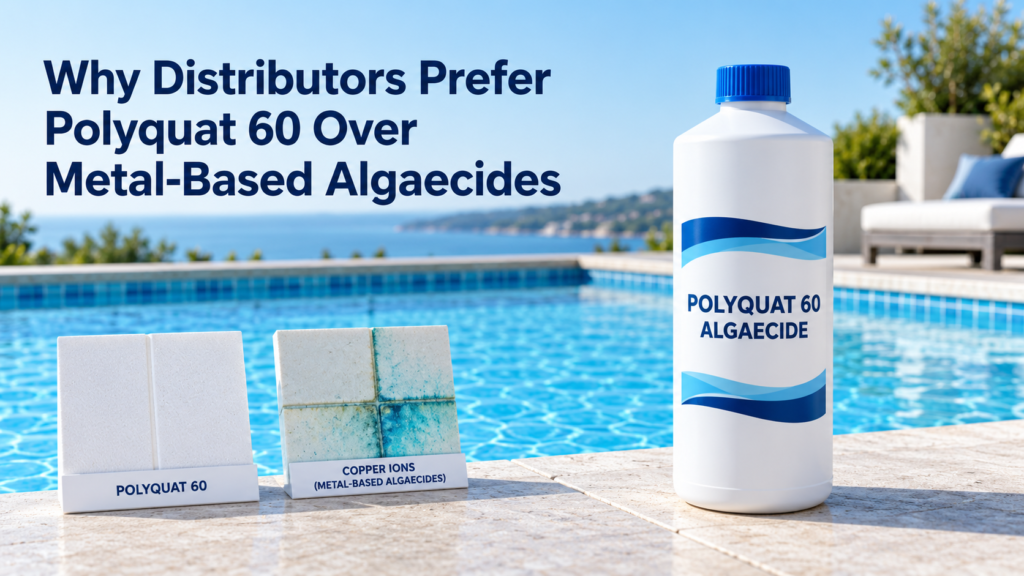
A pool chemical distributor does not judge an algaecide by one question alone: “Does it kill algae?”
That matters, of course. Yet a commercially successful product must do much more. It should be easy to explain, suitable for many pool types, simple to package, and unlikely to generate avoidable complaints. It also needs to fit into the customer’s wider pool maintenance program without creating a new problem three weeks later.
This is where Polyquat 60 often has an advantage over metal-based algaecides.
Polyquat 60 is a concentrated, polymeric quaternary ammonium algaecide. Unlike products based on copper or silver compounds, it does not depend on dissolved metal ions to control algae. This basic chemical difference affects nearly every stage of the product’s commercial life—from formulation and labeling to customer support and repeat sales.
Metal-based algaecides still have legitimate applications. They can provide strong algae control when selected and applied correctly. However, distributors frequently prefer Polyquat 60 for general pool maintenance, professional service programs, winter products, and private-label product lines because it offers a cleaner and more flexible commercial proposition.
Let’s look at why.
Distributors Sell Confidence, Not Just a Bottle
Imagine two products sitting on the same warehouse shelf.
Both can help control algae. Both have technical data sheets, labels, and dosage instructions. One, however, may contribute metal ions to the water. If water balance shifts, those metals can become associated with discoloration, deposits, or staining. The other does not add copper or silver to the pool.
Which product is easier for a distributor to recommend across thousands of pools with different surfaces, water sources, pH levels, and maintenance habits?
For many distributors, the answer is Polyquat 60.
The distributor rarely controls what happens after a bottle leaves the warehouse. One homeowner may carefully test the water before every treatment. Another may pour in an estimated amount, skip the pH test, and add shock ten minutes later. Commercial operators may follow written procedures, while seasonal pool owners may only think about water chemistry when the pool starts turning green.
A forgiving product therefore has real commercial value.
Polyquat 60 is commonly selected because it gives distributors a way to offer preventive algae control without adding another metal variable to the customer’s water. That makes the sales message easier and helps reduce the gap between laboratory performance and real-world use.
No Added Metals Means a Simpler Water-Care Story
Copper compounds work because copper ions interfere with important cellular processes in algae. That biological effect can be useful, but the copper remains part of the water chemistry after treatment.
Its behavior can change with:
- Pool pH
- Total alkalinity
- Water hardness
- Oxidizer concentration
- Existing metal content
- Sequestering agents
- Pool surface condition
- Local fill-water quality
If dissolved copper comes out of solution, it may create blue, green, gray, or dark deposits on pool surfaces and equipment. It can also contribute to greenish discoloration of light-colored hair. Not every copper treatment causes these effects, and balanced water greatly reduces the risk. Still, the possibility becomes part of the distributor’s support burden.
Polyquat 60 follows a different route. Its positively charged polymer chains interact with negatively charged algae cells and cell surfaces. It does not introduce copper or silver into the pool.
That distinction allows a distributor to make a clear, responsible statement: this polymer-based algaecide does not cause metal staining because it does not add metal ions.
Notice the wording. It does not mean that Polyquat 60 can remove metals already present in the water. Nor does it guarantee that staining from another source will never occur. It simply removes the algaecide itself as a source of added metal.
For customers dealing with high-metal fill water, light-colored surfaces, fiberglass pools, decorative features, or expensive finishes, that can be a persuasive advantage.
Distributors developing a broad maintenance range can use a concentrated Polyquat 60 Algaecide as the foundation for full-strength, diluted, seasonal, or private-label formulations.
Fewer Staining Concerns Can Mean Fewer Costly Complaints
A staining complaint is rarely a small conversation.
The customer may blame the newest chemical added to the pool, even if the real cause involves old plumbing, source-water metals, excessive pH, or an earlier treatment. The distributor must then investigate product history, dosage, pool volume, water balance, surface type, and the order in which chemicals were added.
Sometimes the issue can be corrected with a metal treatment or surface-cleaning procedure. Sometimes it cannot be solved quickly. Either way, the complaint consumes time and can weaken trust.
For a distributor, therefore, staining risk is not just a chemistry issue. It is a customer-service cost.
Polyquat 60 reduces one part of that risk because it is metal-free. This can be especially helpful when supplying:
- Pool service companies managing many different properties
- Retailers serving homeowners with limited testing equipment
- Resorts and hotels with visible decorative pool surfaces
- Operators of white plaster or light fiberglass pools
- Private-label brands sold across several regions
- Customers whose source water already contains iron, manganese, or copper
The wider the market, the more valuable this flexibility becomes. A regional distributor may know the local water quite well. An export distributor selling to several countries often does not have that luxury.
A metal-free algaecide creates fewer assumptions about the customer’s water source. That makes technical recommendations more portable from one market to another.
Polyquat 60 Fits Preventive Maintenance Programs Well
Distributors usually earn stronger repeat business from routine maintenance than from emergency rescue treatments.
Emergency products may sell quickly during a severe algae outbreak, but a planned maintenance product can create stable weekly or monthly demand. Polyquat 60 is well suited to this preventive position because it is non-oxidizing and is generally used alongside, rather than in place of, a primary sanitizer.
That last point matters.
Polyquat 60 is an algaecide. It should not be presented as a substitute for chlorine, bromine, or another approved pool sanitizer. A good maintenance program still requires appropriate sanitizer residual, circulation, filtration, brushing, debris removal, and balanced water.
The algaecide acts as an added layer of control. Think of it like a seat belt rather than the steering wheel. It provides useful protection, but it does not run the whole system.
For distributors, this complementary role opens several merchandising possibilities:
- Weekly algae-prevention products
- Spring pool-opening kits
- Summer maintenance programs
- Products for periods of heavy rain or high temperatures
- Pool-closing and winterization treatments
- Professional service-size packages
- Concentrates for local dilution and repacking
The product can therefore sit within a range rather than compete with every other water-care chemical on the shelf.
Non-Foaming Performance Makes the Product Easier to Place
Conventional low-molecular-weight quaternary ammonium algaecides can produce noticeable foam, particularly in spas, fountains, pools with water features, or systems with strong circulation.
Foam does not always mean the treatment has failed. Even so, customers usually dislike it. A layer of bubbles can make clean water look chemically overloaded, and few pool owners enjoy explaining foam to their guests.
Polyquat 60 is valued for its non-foaming or very-low-foaming behavior under normal use conditions. Its polymeric structure distinguishes it from many traditional quaternary ammonium compounds.
This gives distributors access to applications where visible foam would be commercially awkward:
- Pools with waterfalls or deck jets
- Spas connected to swimming pools
- Hotel and resort pools
- Public or semi-public facilities
- Decorative water systems
- Premium residential pools
Once again, the advantage goes beyond chemistry. It affects how the water looks and how the customer feels.
Clear water that stays visually calm supports confidence in the product. A foamy pool may trigger a support call even when the water is technically under control. Distributors know that perception matters—perhaps more than technical people like to admit.
It Works Alongside Standard Pool Treatment Programs
Pool chemical shelves are crowded for a reason. No single treatment handles every water problem.
Customers may use chlorine products, pH adjusters, alkalinity increasers, calcium hardness products, shock treatments, clarifiers, enzymes, phosphate removers, and stain-control chemicals. An algaecide must fit into this crowded routine without causing unnecessary confusion.
Polyquat 60 is commonly incorporated into chlorine- and bromine-based maintenance programs. Because it is non-oxidizing, it provides a different mode of algae control from the sanitizer.
However, compatibility should never be interpreted as permission to mix concentrated chemicals together. Products should be added separately, with the circulation system operating, and according to the registered end-use label. The exact order and waiting period can vary with the treatment program.
Strong oxidizer treatments may also reduce the polymer over time. This does not make the two products incompatible in a properly managed pool; it means application timing and maintenance dosage matter.
Distributors that explain this clearly gain something valuable: credibility.
A responsible product page should say what Polyquat 60 can do, while also reminding customers to keep their sanitizer residual within the required range. Overpromising may create a quick sale. Accurate guidance creates repeat customers.
Easier Positioning Across Different Pool Surfaces
A distributor may supply concrete, plaster, vinyl-lined, fiberglass, tiled, painted, and saltwater pools—sometimes through the same catalog.
Metal-based products require added attention because metal behavior can be affected by water chemistry and surface conditions. Rough, aged, porous, or previously stained surfaces can further complicate the picture.
Since Polyquat 60 does not add metal ions, distributors can position it across a broad range of pool surfaces without building the sales message around metal management.
This does not remove the need for correct dosing. Excess chemical use is still poor practice, and every finished formulation must be evaluated for its intended market. Yet the core product offers a straightforward surface-related benefit: no copper or silver is being introduced by the algaecide.
Saltwater pools are another useful example. A salt chlorine generator produces chlorine, so the pool still needs balanced water, circulation, and algae prevention. Polyquat 60 can be used as a supporting algaecide when the finished product label permits it.
It does not replace the salt system. It simply gives the maintenance program another tool—one that does not deliberately increase the pool’s metal content.
Private-Label Development Becomes More Flexible
Private-label customers rarely want only a chemical. They want a product concept.
They may request a particular concentration, container size, label position, carton design, market message, or seasonal use. Some want a professional concentrate. Others need a homeowner-friendly maintenance product in a smaller bottle.
A 60% Polyquat concentrate gives formulators room to develop several finished-product strengths, provided that stability, performance, legal classification, packaging compatibility, and local registration requirements are properly addressed.
This flexibility can support:
- Full-strength professional products
- Lower-concentration retail algaecides
- Maintenance-focused formulations
- Winter pool-closing products
- Multi-product pool-care kits
- Different package sizes for retail and service channels
The same raw-material platform may therefore support several stock-keeping units.
This can simplify supplier qualification and technical communication. Rather than sourcing unrelated active ingredients for every market tier, a distributor may build a more coherent product family around one familiar polymer chemistry.
For colder markets, a dedicated Winter Algaecide can extend that product family into pool closing and off-season maintenance.
Naturally, a concentrated ingredient cannot simply be diluted and sold everywhere without review. The finished product needs suitable preservatives where required, verified stability, clear directions, compliant claims, and packaging that remains sound throughout its shelf life.
In the United States, for example, algaecidal claims generally bring a finished product within pesticide-registration requirements. EPA labeling also makes clear that pesticide products must be used according to their approved directions. Distributors should confirm the rules in every target country before selling or relabeling a finished formulation.
A Concentrated Liquid Can Improve Supply-Chain Efficiency
Shipping water around the world is rarely an exciting business strategy.
Polyquat 60 is typically supplied as a concentrated aqueous liquid. Importers with suitable facilities may use the concentrate to formulate lower-strength finished products closer to their market. This can reduce the amount of packaging associated with shipping multiple ready-to-use retail units from the original manufacturing location.
The actual economic benefit depends on several factors:
- Freight rates
- Import duties
- Local labor costs
- Packaging availability
- Minimum order quantity
- Warehouse conditions
- Formulation equipment
- Registration status
- Quality-control capability
A concentrate is not automatically cheaper in every case. Small distributors without blending or filling facilities may gain more from importing finished private-label packs.
Still, the choice itself is commercially useful. Polyquat 60 can support bulk supply, local formulation, or factory-packed retail products. Distributors can select the model that matches their sales volume and operational capacity.
Inventory Can Serve More Than One Season
Some pool products have a narrow sales window. They arrive, sell for six weeks, and then occupy warehouse space until the following year.
Polyquat 60 can be positioned for several points in the pool-care calendar. It may be included in spring opening, routine summer prevention, problem-recovery support, and winter closing programs.
This does not mean the same dosage or label instruction applies to every use. It means the chemistry can support several clearly defined finished-product concepts.
For distributors, broader seasonal relevance can improve inventory planning. A product that serves only one urgent problem may experience sharp demand spikes. A maintenance-oriented Polyquat range can support steadier ordering patterns.
There is also an educational benefit. Once service professionals understand how the product behaves, they can use that knowledge across several maintenance situations. Familiarity lowers the barrier to repeat purchases.
Polyquat 60 Can Support Water Clarity—but It Is Not a Universal Clarifier
Because Polyquat 60 is a cationic polymer, it may interact with negatively charged algae cells and fine suspended matter. Customers sometimes notice improved visual clarity following treatment.
Still, distributors should be careful with this message.
Polyquat 60 is primarily sold for algae control. It should not automatically be treated as a replacement for a dedicated clarifier, especially when turbidity comes from silt, dead algae, organic debris, calcium precipitation, or poor filtration.
When the main problem is suspended fine material rather than active algae, a dedicated Polymer Pool Clarifier may be the more appropriate recommendation.
This distinction helps a distributor build a logical product range:
- Sanitizer for microbial control
- Algaecide for algae prevention and control
- Clarifier for fine suspended particles
- Shock treatment for oxidation
- Water-balancing products for chemical stability
Products should support each other, not blur into one vague “all-in-one” promise.
Customer Education Is Usually More Straightforward
Metal-based algaecides can require a longer explanation.
The distributor may need to discuss existing metal levels, sequestering agents, pH control, surface staining, hair discoloration, and possible interactions with oxidation treatments. A trained service professional can manage these issues, but a first-time pool owner may find the instructions rather daunting.
Polyquat 60 still requires responsible guidance, yet its central message is relatively easy to understand:
- Balance the pool water.
- Maintain the approved sanitizer level.
- Measure the correct algaecide dose.
- Add it separately while the water circulates.
- Brush and filter as required.
- Follow the finished-product label.
Clear instructions reduce misuse. They also make employee training easier for distributors operating several branches or serving dealer networks.
A product that can be explained accurately in a short conversation has an advantage at the retail counter. Simple does not mean simplistic; it means the main risks and responsibilities can be communicated without turning every sale into a chemistry seminar.
Lower Complaint Risk Supports the Distributor’s Brand
Private-label products carry the distributor’s own name. That changes the calculation.
When a national manufacturer’s product causes a complaint, the retailer may be able to pass the case to the brand owner. When the label carries the distributor’s brand, the customer comes directly back to the distributor.
A metal-free, non-foaming product can reduce several common sources of dissatisfaction. It cannot prevent every problem—poor circulation, extreme algae growth, under-dosing, high chlorine demand, and unbalanced water can still defeat a maintenance program.
Yet Polyquat 60 helps the distributor avoid adding two visible concerns: metal staining and foam.
That matters because customers judge pool products with their eyes. They expect blue water, clean surfaces, and no strange bubbles. Technical performance and visible experience are tied together.
If a product repeatedly delivers a calm, predictable experience, customers remember the label. That is exactly what a private-label distributor wants.
Where Metal-Based Algaecides May Still Make Sense
Polyquat 60 is not automatically the right choice for every pool or every outbreak.
Copper-based products may offer strong, persistent algae control in certain applications. A trained operator who tests water, manages copper concentration, controls pH, and understands the pool surface may use them successfully.
Metal-based formulations may remain appropriate when:
- The target algae and approved label support their use
- Water chemistry is monitored carefully
- Existing metal levels are known
- Surface-staining risk is controlled
- The operator understands sequestration
- Local regulations permit the intended application
The important commercial distinction is not “Polyquat good, copper bad.” That would be inaccurate.
The real distinction is that Polyquat 60 often suits a broader, lower-complication maintenance position. Metal-based products can be effective, but their responsible use may require closer control of water chemistry.
A distributor should choose according to the application, customer skill level, product claim, and regional regulations—not according to one fashionable ingredient story.
What Distributors Should Check Before Buying Polyquat 60
Not every container described as Polyquat 60 will offer identical quality. Concentration is important, but it is not the only purchasing specification.
Before approving a supplier, distributors should review:
- Active-content test method and specification
- Appearance and color
- pH
- Density
- Viscosity
- Batch-to-batch consistency
- Shelf-life information
- Storage recommendations
- Packaging compatibility
- Certificate of Analysis availability
- Safety Data Sheet quality
- Sample-testing support
- Private-label packaging options
- Export and transport documentation
The active-content method deserves particular attention. Suppliers may report “solids,” “active content,” or another analytical value, and these figures are not always interchangeable. A specification should state what is measured and how it is measured.
Distributors should also test the material in the intended finished formulation. Water source, fragrance, dye, supporting ingredients, container material, and storage temperature can influence the final product.
A sample is helpful. A controlled formulation trial is better.
The Commercial Preference Comes Down to Predictability
So, why do many distributors prefer Polyquat 60 over metal-based algaecides?
Because predictability sells.
Polyquat 60 provides effective algae control without intentionally adding copper or silver to the pool. It supports low-foam maintenance programs, works across many common pool types, and lends itself to concentrated, diluted, seasonal, and private-label products.
Most important, it helps distributors offer a product with fewer visible complications.
That does not remove the need for water testing, correct dosing, sanitizer maintenance, filtration, or regulatory compliance. Chemistry still has rules. Pools, rather inconveniently, do not care what the marketing brochure promises.
But when Polyquat 60 is properly formulated, labeled, and applied, it gives distributors a practical balance of performance, flexibility, and customer acceptance. For a product expected to work in thousands of pools—not just one carefully controlled test pool—that balance is hard to ignore.
Frequently Asked Questions
1. Why is Polyquat 60 considered a metal-free pool algaecide?
Polyquat 60 uses a polymeric quaternary ammonium active ingredient rather than copper or silver compounds. It therefore controls algae without intentionally adding metal ions to pool water.
2. Can Polyquat 60 cause copper staining in a swimming pool?
Polyquat 60 does not contain copper and cannot be the source of added copper staining. However, it will not remove copper already present in fill water, equipment, or previously applied chemicals.
3. Is Polyquat 60 better than copper algaecide for every pool?
No. Polyquat 60 is often preferred for routine, metal-free algae prevention, while an approved copper product may suit certain controlled applications. Pool condition, surface type, water chemistry, operator experience, and label directions should guide the decision.
4. Can distributors formulate lower-strength algaecides from Polyquat 60 concentrate?
Yes, technically, but the finished formulation must be tested for stability, performance, packaging compatibility, and regulatory compliance. Algaecidal claims may require product registration in the destination market.
5. Can Polyquat 60 replace chlorine in a pool maintenance program?
No. Polyquat 60 is an algaecide, not a primary pool sanitizer. It should be used with an approved sanitizer, proper circulation, filtration, brushing, and balanced water according to the finished-product label.