
GET IN TOUCH
Ask For Sample?
Testing Pool Water Before Adding Polyquat 60
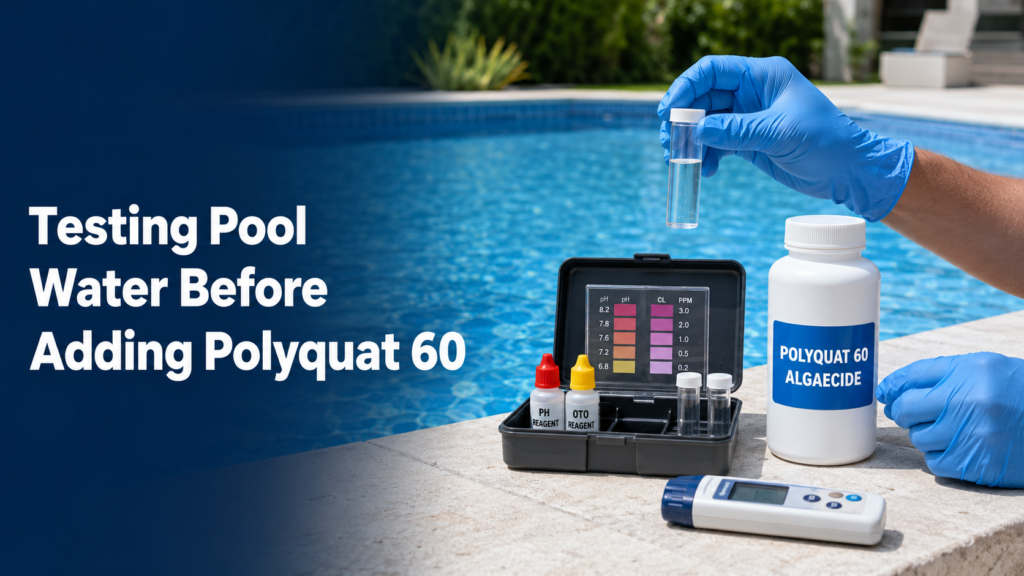
Polyquat 60 works most reliably when it is added to clean, balanced, circulating pool water. That sounds simple, but it points to an important truth: successful algae control starts before the algaecide enters the pool.
A quick water test can reveal whether the pool needs Polyquat 60, chlorine correction, pH adjustment, filtration, or a combination of treatments. Without that information, an operator may add the correct product at the wrong time. The result can be disappointing—even when the algaecide itself is working exactly as designed.
Testing does not need to become a chemistry exam. A few essential readings can tell you a great deal about the condition of the water. Free chlorine, pH, total alkalinity, cyanuric acid, calcium hardness, temperature, and visual signs of algae create a useful picture of the pool’s health.
Let’s look at what should be tested, why each result matters, and how to prepare the pool for a Polyquat 60 treatment.
Why Test the Water Before Adding Polyquat 60?
Polyquat 60 is a polymer-based, non-metallic algaecide commonly used to help prevent algae growth and reduce the chance of algae returning. It is valued for its low-foaming character and because it does not introduce copper or other staining metals into pool water.
Still, it is not a replacement for balanced water or proper sanitation.
If free chlorine is extremely low, algae may already be growing faster than a normal maintenance dose can control it. If the pH is far outside the suitable operating range, chlorine may perform poorly or swimmers may experience irritation. If the filter is blocked, dead algae and suspended particles may remain in the water even after treatment.
Testing helps answer three practical questions:
- Is the pool ready for a preventive dose of Polyquat 60?
- Does another water problem need to be corrected first?
- Is the pool dealing with early algae growth or a mature algae bloom?
These are not small distinctions. Preventing algae in balanced water is quite different from recovering a dark green pool that has been neglected for several weeks.
Think of Polyquat 60 as part of a pool maintenance team. Chlorine, circulation, filtration, brushing, and water balance all have their own jobs. If several members of that team are missing, asking one algaecide to do everything is a bit unfair.
Start with the Pool’s Physical Condition
Before opening the test kit, walk around the pool and look closely at the water, surfaces, fittings, and circulation system.
Clear water does not always mean algae-free water. Early algae growth may appear as a slippery film on steps, shaded walls, ladders, light niches, or areas behind fittings. These sheltered spots often show trouble before the whole pool changes color.
Check for:
- Green, yellow, brown, pink, or dark surface growth
- Slippery walls, steps, and ladders
- Cloudy or dull-looking water
- Debris on the pool floor
- Weak return flow
- Poor movement in corners or behind stairs
- Rising filter pressure
- Unusual chlorine demand
- A musty or earthy smell near affected surfaces
Run a clean pool brush across a shaded wall. If a colored cloud lifts from the surface, algae may already be established. If the material feels gritty rather than soft or slimy, it could be scale, dirt, pollen, or another deposit.
This simple observation matters because not every green or cloudy pool problem is algae. Metals, pollen, fine dust, poor filtration, and unbalanced water can create similar symptoms. Adding more algaecide without identifying the cause may waste product and delay the real correction.
Test Free Chlorine and Combined Chlorine
Free chlorine is one of the most important readings to check before using Polyquat 60. It shows how much active sanitizer is available to control microorganisms and oxidize contaminants.
The appropriate free chlorine level depends on several factors, including local pool rules, cyanuric acid concentration, water temperature, swimmer load, and whether the pool is indoors or outdoors. Always follow the pool’s operating standard and the directions on the sanitizer label.
For many normally maintained pools, a low free chlorine result is a warning sign. The pool may have:
- Received too little sanitizer
- Experienced a heavy swimmer load
- Collected leaves or other organic matter
- Developed early algae growth
- Lost chlorine through sunlight exposure
- Suffered from poor dosing or circulation
Polyquat 60 can support algae control, but it does not replace the disinfecting role of chlorine. If the free chlorine reading is near zero, simply adding a maintenance dose of algaecide may leave the underlying sanitation problem unresolved.
Combined chlorine should also be checked when the testing method allows it. Combined chlorine forms when chlorine reacts with nitrogen-containing contaminants. An elevated reading can point to a need for better oxidation, improved circulation, or closer control of swimmer-related contamination.
A strong “chlorine smell” is not reliable proof that the pool has too much useful chlorine. Quite often, that smell is associated with chloramines and inadequate water treatment. Your nose can notice a problem, but it cannot replace a proper test.
Check pH Before Reaching for the Algaecide
Pool pH affects swimmer comfort, chlorine performance, surface protection, and the stability of the overall water balance.
A commonly used operating range is approximately 7.2 to 7.8, although the exact target should follow local requirements and the needs of the particular pool. Many operators aim for the middle of that range during routine treatment.
When pH is too low, the water may become corrosive. Metal components, heaters, grout, and some pool finishes can be affected over time. Swimmers may also experience eye or skin discomfort.
When pH is too high, scale formation becomes more likely, water may look cloudy, and chlorine generally becomes less effective at a given free chlorine concentration. That can create favorable conditions for algae—even if an algaecide is present.
Polyquat 60 can function across a practical pool pH range, but that does not make pH irrelevant. The goal is not merely to protect the algaecide. The goal is to create a complete water environment in which sanitation, circulation, filtration, and algae prevention can all perform properly.
If pH is significantly outside the required range, correct it first. Allow the adjustment chemical to disperse with the circulation system running, then retest before adding Polyquat 60.
Avoid adding multiple concentrated chemicals to the same spot or mixing them together in a container. Each product should be introduced separately according to its label.
Measure Total Alkalinity—The Quiet Stabilizer
Total alkalinity describes the water’s ability to resist rapid pH changes. You can think of it as the pool’s shock absorber for pH.
When total alkalinity is too low, pH may change quickly. A pool can test correctly in the morning and drift away from the desired range after chemical addition, rainfall, aeration, or heavy use.
When total alkalinity is too high, pH can become difficult to lower and may tend to rise. High alkalinity can also contribute to cloudy water and scale-forming conditions, depending on calcium hardness, temperature, and pH.
A frequently used total alkalinity range is around 80 to 120 ppm as calcium carbonate. However, the preferred target can vary with the sanitizer system, pool surface, and operating conditions.
Why does this matter before applying Polyquat 60? Stable alkalinity makes the pH easier to control. Stable pH, in turn, supports more predictable sanitation and water quality. It is an indirect relationship, but an important one.
If alkalinity needs correction, make the adjustment carefully and allow enough circulation time before testing again.
Do Not Ignore Cyanuric Acid
Cyanuric acid, often called CYA or chlorine stabilizer, protects chlorine from rapid breakdown by sunlight in outdoor pools. A suitable amount can help maintain a useful chlorine residual through a sunny afternoon.
Too much CYA, however, changes the amount of free chlorine needed for effective sanitation. A basic free chlorine reading that looks acceptable on its own may not be sufficient when the CYA concentration is very high.
This is one reason operators sometimes encounter a frustrating situation: the test strip appears to show chlorine, yet algae keeps returning.
Polyquat 60 may help suppress regrowth, but it cannot correct an excessive CYA level. When CYA is high, the pool may need partial draining and replacement with fresh water, depending on local water restrictions and the pool’s operating plan.
Many outdoor residential pools are managed with CYA somewhere around 30 to 50 ppm, but there is no single target for every system. Saltwater chlorine generators and local regulations may call for different concentrations.
The key is to interpret free chlorine and CYA together. Treating them as unrelated numbers can hide a sanitation weakness.
Test Calcium Hardness and Overall Water Balance
Calcium hardness does not directly tell you whether algae is present, but it helps describe the water’s scale-forming or corrosive tendency.
Water with insufficient calcium hardness may become aggressive toward plaster, grout, and other calcium-containing surfaces. Water with excessive hardness may promote scale, especially when pH, alkalinity, and temperature are also high.
Common operating targets often fall somewhere between 200 and 400 ppm, though vinyl, fiberglass, plaster, and commercial pools may follow different specifications.
Scale deserves attention during an algae inspection because rough deposits create protected areas where dirt and microorganisms can collect. A heavily scaled surface is harder to brush and clean. It can look stained, feel rough, and provide algae with countless tiny hiding places.
Professional operators may calculate a saturation index using pH, alkalinity, calcium hardness, temperature, and dissolved solids. For a homeowner, a good-quality test kit or professional water analysis may be enough. The main point is that Polyquat 60 should be added as part of balanced pool care—not as a way to cover up corrosive or scale-forming water.
Record the Water Temperature
Warm water often supports faster algae growth and increases sanitizer demand. During hot weather, a pool that remained stable in spring may begin consuming chlorine faster, particularly when it also receives strong sunlight and heavy use.
Temperature affects more than biology. It also influences water balance, evaporation, swimmer activity, and the operation of heaters or covers.
Write down the water temperature with the other test results. This creates context.
For example, a free chlorine reading that remained steady in cool water may fall much faster during a hot weekend. The Polyquat 60 dose may not necessarily need to change unless the label says so, but the testing frequency and sanitation schedule may need closer attention.
Heated indoor pools, therapy pools, and spas need special care. Their temperature, bather load, and operating rules differ from those of ordinary outdoor swimming pools. Only products specifically labeled for the intended water system should be used.
Consider Phosphates and Other Nutrients Carefully
Phosphates are nutrients that algae can use. They may enter the pool through source water, soil, lawn products, leaves, dust, swimmers, or some pool chemicals.
A phosphate test can be helpful when algae keeps returning despite good sanitation, brushing, circulation, and filter care. Yet phosphate numbers should not distract from more urgent problems.
A pool with no measurable free chlorine does not mainly have a phosphate problem. It has a sanitizer problem.
Likewise, a pool with dead circulation zones does not become healthy just because a phosphate remover was added. Nutrient management may support a broader treatment program, but it should not replace basic water care.
The same reasoning applies to nitrates. They can contribute to favorable growth conditions, but regular sanitation and physical maintenance remain central.
Use a Reliable Testing Method
Pool operators generally choose among test strips, liquid reagent kits, photometers, and professional water analysis.
Test strips are quick and convenient. They work well for frequent screening when stored correctly and read at the specified time. Their limitation is precision. Color differences can be difficult to judge, especially under artificial lighting.
Liquid reagent kits can provide more detailed results. They require careful sample handling, correct drop counts, clean equipment, and fresh reagents.
Photometers measure color changes electronically and can reduce subjective interpretation. They still need clean sample cells, correct reagents, calibration checks, and good testing technique.
Whichever method you use, a sophisticated tester cannot compensate for a careless sample.
Collect water away from return jets, skimmers, chemical feeders, and freshly treated areas. Reach below the surface—often around elbow depth—so the sample represents the pool rather than the thin surface layer.
Test promptly. Do not leave a sample sitting in sunlight or a hot vehicle and expect it to remain unchanged.
Also check expiration dates. Old strips and degraded reagents can produce readings that look convincing but are simply wrong. That is a sneaky problem because false precision feels reassuring.
A Practical Pre-Treatment Testing Sequence
A consistent routine reduces missed steps. Before adding Polyquat 60, use a sequence such as this:
- Inspect the water and pool surfaces for algae, cloudiness, debris, stains, and scale.
- Confirm that the pump and circulation system are operating normally.
- Check the filter pressure and clean or backwash the filter when required.
- Collect a representative water sample.
- Test free chlorine and combined chlorine.
- Measure pH and total alkalinity.
- Check cyanuric acid in stabilized outdoor pools.
- Measure calcium hardness when due or when balance problems are suspected.
- Record the water temperature.
- Review recent weather, swimmer load, rainfall, and chemical additions.
- Correct major water-balance or sanitation problems.
- Allow chemicals to circulate separately and retest when necessary.
- Brush algae-prone surfaces.
- Add Polyquat 60 according to the product label and calculated pool volume.
This order is practical rather than rigid. A commercial facility may use a more detailed standard operating procedure, while a residential pool owner may keep a shorter log. What matters is making decisions from evidence rather than guesswork.
When Should You Delay Adding Polyquat 60?
Polyquat 60 does not need perfect laboratory conditions, but certain problems should be addressed before routine application.
Delay or reassess treatment when:
- The actual pool volume is unknown
- The circulation system is not working
- The filter is blocked or damaged
- pH is far outside the permitted range
- Free chlorine is extremely low and active algae is present
- Another chemical has just been added and has not dispersed
- The water contains heavy debris
- The pool is being drained or diluted
- The product label does not cover the intended application
- The test results appear inconsistent or unreliable
A delay does not mean the product is unsuitable. It means the water needs preparation.
For severe algae growth, the pool may require shock treatment, extensive brushing, vacuuming, filter cleaning, and repeated testing. Polyquat 60 can be incorporated into the recovery or regrowth-prevention plan when permitted by the label, but it should not be presented as a one-bottle rescue for every green pool.
How Much Polyquat 60 Should Be Added?
The dose should come from the product label, not from a universal online formula.
Products sold under the general name “Polyquat 60” can differ in active concentration, registration, intended use, and label directions. Initial treatment, routine maintenance, winter closing, and post-cleanup treatment may each require different doses.
Accurate pool volume is essential. Overestimating the volume can lead to unnecessary chemical use, while underestimating it may produce a weak treatment.
For a rectangular pool, volume is based on length, width, and average depth. Irregular shapes, sloped floors, steps, and connected features require a more careful calculation.
Measure the product with suitable chemical-handling equipment. Add it as directed, usually while the circulation system is running. Do not pour concentrated product onto one small area of the surface unless the label specifically instructs you to do so.
More is not automatically better. Excessive polymer addition may contribute to water-quality or filtration issues, particularly when several polymer-containing products are used close together.
What Should Be Tested After Treatment?
Testing should continue after Polyquat 60 is added. Algae control is a process, not a single event.
Check free chlorine and pH according to the normal maintenance schedule. Watch water clarity, return flow, surface condition, and filter pressure. Brush areas with weak circulation and inspect them again.
If the pool had visible algae, the filter may collect a large amount of fine material after treatment. Rising filter pressure may show that cleaning or backwashing is needed. Removing captured debris is part of the job; otherwise, water clarity may recover slowly.
Keep a written record of:
- Date and time
- Test results
- Water temperature
- Weather conditions
- Products and doses added
- Filter pressure
- Visible changes
- Follow-up actions
Over several weeks, this log can reveal patterns. Perhaps chlorine drops after busy weekends. Perhaps algae first appears behind the ladder. Perhaps heavy rain repeatedly lowers sanitizer levels.
Once those patterns become visible, maintenance becomes less reactive. You stop chasing the same problem and begin preventing it.
Common Mistakes When Testing Before Polyquat 60 Application
Several testing errors appear again and again.
The first is testing immediately beside a return jet or chemical feeder. That sample may contain a higher or lower chemical concentration than the rest of the pool.
The second is adjusting several parameters at once. When pH increaser, sanitizer, algaecide, and clarifier are added within a short period, it becomes difficult to know which change caused the final result.
The third is relying only on water color. Clear water can still be poorly sanitized, while cloudy water may have a cause unrelated to algae.
Another mistake is treating test strips as permanent supplies. Heat, moisture, sunlight, and age can damage them. Reagent bottles also need correct storage and periodic replacement.
Finally, some operators test the water but do not act on the results. Numbers written in a log have little value unless they influence the treatment decision.
Residential Pools and Commercial Pools Need Different Routines
The chemistry principles are similar, but the operating context can be very different.
A residential pool may have long periods of light use followed by a busy weekend. The owner may test a few times per week and apply Polyquat 60 as part of a preventive maintenance schedule.
A hotel, school, club, or public pool can experience rapidly changing swimmer loads. It may be governed by local health codes, automated controllers, daily record requirements, and strict closure rules. Testing may occur several times per day.
Commercial operators should never use an algaecide as a substitute for required disinfectant residuals or mandated operating procedures. Product selection must also consider the pool type, dosing equipment, filtration system, regulatory status, and facility documentation.
For both settings, the principle remains the same: test first, interpret the whole water condition, and then treat.
Testing Turns Polyquat 60 into a More Predictable Treatment
Polyquat 60 is most useful when it has a clear role. It can support algae prevention, help control early growth, and reduce the chance of regrowth after corrective treatment. Its non-metallic chemistry also avoids adding copper that may contribute to surface staining or hair discoloration.
But a good algaecide cannot repair every weakness in pool operation.
When chlorine, pH, circulation, filtration, and water balance are checked first, Polyquat 60 becomes part of a controlled maintenance program. The dosage is easier to calculate, the result is easier to evaluate, and unexplained algae outbreaks become less common.
So, should you test pool water before adding Polyquat 60? Absolutely. Those few minutes at the test station can prevent wasted chemicals, confusing results, and a much longer cleanup later.
Frequently Asked Questions
1. What should I test before adding Polyquat 60 to a swimming pool?
Test free chlorine, combined chlorine, pH, total alkalinity, cyanuric acid, calcium hardness, and water temperature. You should also inspect water clarity, pool surfaces, circulation, and filter condition before treatment.
2. Can I add Polyquat 60 when the chlorine level is low?
A slightly low reading should be assessed against the pool’s required chlorine range and CYA level. If free chlorine is near zero or visible algae is growing, correct the sanitation problem and follow the product label rather than relying on Polyquat 60 alone.
3. Does pH need to be balanced before adding Polyquat 60?
Yes. Although Polyquat 60 can work across a practical pH range, balanced pH supports chlorine performance, swimmer comfort, and surface protection. Correct a seriously high or low pH, allow the water to circulate, and retest before applying the algaecide.
4. Can Polyquat 60 be added immediately after pool shock?
Timing depends on the shock product, chlorine level, and Polyquat 60 label. A very high oxidizer concentration may reduce the polymer and waste part of the treatment. Let the shock treatment complete its work, verify the water with testing, and follow the stated interval on the product labels.
5. Why does algae return even after using Polyquat 60?
Recurring algae can result from insufficient sanitizer, excessive CYA, inaccurate dosing, poor circulation, dirty filters, hidden growth on surfaces, heavy swimmer load, or inconsistent brushing. Polyquat 60 supports algae control, but these underlying conditions must also be corrected.