
Outline
- What concentration means in Polyquat 60 products
- Active concentration versus concentration in pool water
- How concentration changes the required product dose
- Why equal active doses should deliver comparable performance
- The effect of concentration on algae prevention and control
- Dispersion, viscosity, and application accuracy
- Under-dosing and over-dosing
- Water conditions that influence real-world performance
- How manufacturers and buyers should compare formulations
- Frequently asked questions
How Concentration Affects Polyquat 60 Performance?
Concentration has a direct effect on how Polyquat 60 is packaged, measured, transported, formulated, and added to swimming pool water. Yet it does not work quite the way many people assume.
A 60% product is more concentrated than a 30% product. That part is straightforward. However, it is not automatically twice as effective after both products have been dosed correctly.
Why not?
Because the pool responds mainly to the amount of active polymer that reaches the water—not simply to the number printed on the container.
If a 30% formulation and a 60% formulation deliver the same active dose to the same pool, their fundamental algae-control contribution may be similar, provided that the active ingredient, formulation quality, water conditions, and application method are also comparable. The 60% product simply delivers that active material in a smaller volume.
That distinction is the key to understanding Polyquat 60 performance.
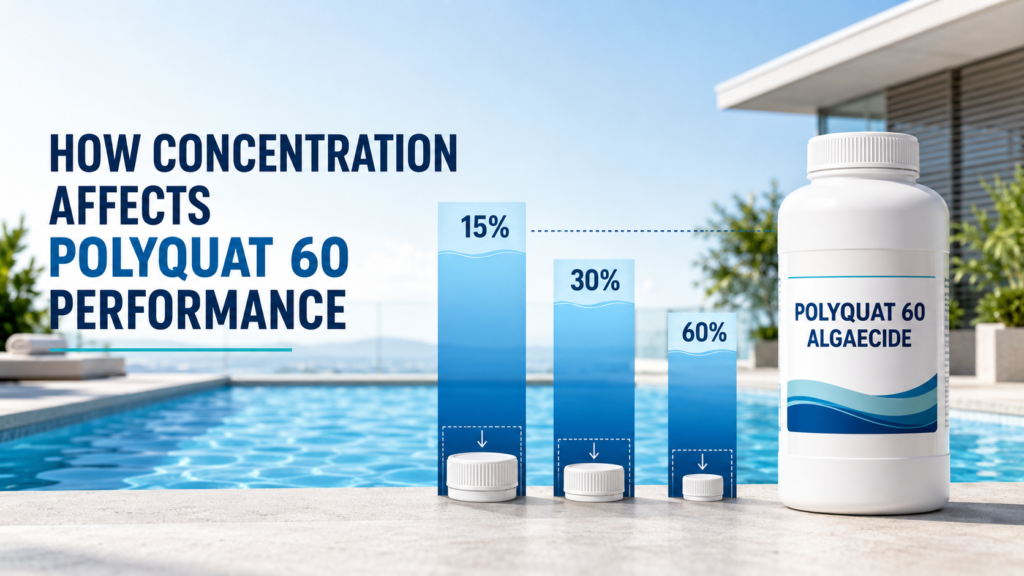
First, What Does the “60” in Polyquat 60 Mean?
Polyquat 60 commonly refers to a concentrated polymeric quaternary ammonium algaecide containing approximately 60% active ingredient. One active chemistry associated with this type of product is polixetonium chloride, also described by the chemical name poly[oxyethylene(dimethyliminio)ethylene(dimethyliminio)ethylene dichloride].
The US Environmental Protection Agency identifies CAS No. 31512-74-0 under its Busan 77 assessment and reports 60% as the highest active-ingredient concentration evaluated for that chemistry. The same EPA document includes swimming pool and spa algaecide applications among its registered uses.
In practical commercial language, then, “60” generally describes the strength of the concentrated product.
It does not mean:
- The pool water contains 60% algaecide.
- The product should represent 60% of a treatment blend without calculation.
- Every product using the words “Polyquat 60” has exactly the same specification.
- A 60% product should be dosed at the same volume as a 15% or 30% product.
- Concentration alone guarantees better field performance.
That last point deserves attention. Two materials may both claim approximately 60% active content while differing in viscosity, residual monomers, color, pH, density, storage stability, and formulation consistency.
The number is important, but it is not the whole quality story.
Product Concentration and Pool-Water Concentration Are Different Things
People often use the word concentration without saying what is being concentrated. That creates avoidable confusion.
There are two separate values to consider.
Product concentration is the proportion of active polymer in the bottle, drum, or intermediate bulk container. A formulation containing 60% active ingredient carries more active polymer per kilogram than one containing 30%.
Use concentration is the amount of active ingredient delivered into the pool water after dosing and dilution.
This is a little like concentrated fruit juice. A small amount of concentrate and a larger amount of a diluted drink can contain the same quantity of juice solids. The containers look different, but the final glass may receive an equivalent amount.
Polyquat dosing follows the same basic logic.
Suppose two formulations have the same active chemistry:
| Formulation | Product used | Approximate active material delivered |
|---|---|---|
| 15% active | 400 mL | Equivalent to 60 mL of 100% active material |
| 30% active | 200 mL | Equivalent to 60 mL of 100% active material |
| 60% active | 100 mL | Equivalent to 60 mL of 100% active material |
This simplified example assumes percentages and measurements are being compared on a consistent basis. Real commercial calculations may need to account for whether the specification is expressed by weight, volume, or another defined test method.
Still, the core lesson holds: higher product concentration reduces the volume required to supply an equivalent active dose.
Does Higher Concentration Make Polyquat 60 More Powerful?
Yes—and no.
A higher-concentration product is more powerful per unit of product. One liter of a 60% active formulation contains substantially more active polymer than one liter of a 15% formulation.
But once the products have been adjusted to deliver the same active dose, the difference becomes less dramatic.
For example, dosing 100 mL of a 60% material cannot be compared fairly with dosing 100 mL of a 30% material. The first treatment delivers roughly twice as much active ingredient. Of course its effect may appear stronger.
A fair comparison would use approximately:
- 100 mL of a 60% product
- 200 mL of a 30% product
- 400 mL of a 15% product
The exact relationship depends on the specification basis and density, but the principle is clear.
This is why professional formulators compare products on an active-equivalent basis, not only on cost per drum or dose volume.
A cheap diluted formulation may become rather expensive once its active content is considered. On the other hand, a high-strength concentrate that is difficult to measure, disperse, or register for its intended market may not be the most convenient finished product.
Concentration creates options. It does not remove the need for good formulation work.
How Concentration Changes Preventive Performance
Polyquat 60 is often used as a preventive algaecide. In a properly maintained pool, a label-directed dose can help make conditions less favorable for algae before a visible bloom takes hold.
Concentration affects preventive treatment in three main ways.
First, it controls how much product must be added. A concentrated formulation delivers the required active dose with less liquid.
Second, it affects dosing accuracy. When the required volume becomes very small, a minor measuring error can represent a large percentage of the intended dose.
Third, it influences how the product is distributed. Concentrated polymer must disperse through a large body of water before it can provide even coverage.
The practical aim is not to create a high-polyquat zone near one return jet. It is to deliver the intended active amount throughout the circulating pool.
For this reason, routine preventive performance depends on more than concentration. It also depends on:
- Correct pool-volume calculation
- Adequate pump operation
- Good circulation around steps and corners
- Regular brushing of low-flow surfaces
- Suitable filtration
- Consistent sanitizer residual
- Label-directed dosing frequency
- Water replacement through splash-out or backwashing
A correctly measured maintenance dose applied on schedule is usually more dependable than occasional heavy additions made after someone remembers the pool has not been treated for several weeks.
What Happens When the Active Dose Is Too Low?
Under-dosing is one of the most common reasons an algaecide appears to “stop working.”
Imagine that a service technician normally uses a 30% formulation. The company later changes to a 15% product, but the technician continues adding the same volume. The pool now receives only half the former active dose.
The bottle may still say polyquat. The maintenance routine may look unchanged. Yet the chemical protection has dropped.
An insufficient active dose may lead to:
- Shorter preventive coverage
- Weak control in circulation dead zones
- Faster algae return during warm weather
- Poor performance under heavy swimmer load
- Disappointing winterization results
- Repeated corrective treatments
- The mistaken belief that the chemistry itself is ineffective
Low dosing becomes particularly risky when several pressures arrive together—high water temperature, intense sunlight, rainfall, pollen, debris, and a temporary fall in sanitizer residual.
Algae rarely wait for one perfect cause. They take advantage of several small weaknesses at once.
If the product concentration changes, the application rate must therefore be recalculated. Never carry the old volume-based dose forward without checking the new active percentage and product label.
For concentration-adjusted planning examples, see the Polyquat 60 Dosage Guide for Swimming Pool Applications. The registered label for the final product must still take priority.
And What If the Dose Is Too High?
More chemical does not always mean a cleaner pool.
An excessive dose may waste product without solving the underlying cause of an algae problem. If poor circulation, inadequate sanitizer, dirty filtration, or heavy organic contamination is driving the problem, an oversized algaecide dose cannot repair the equipment or remove the contamination.
Polyquat is also a cationic polymer. At suitable doses, that chemistry can interact with negatively charged biological surfaces and fine suspended matter. At excessive concentrations, however, unnecessary polymer loading may affect water appearance, filtration behavior, or interactions with other treatment products.
Possible consequences of over-application may include:
- Increased treatment cost
- Temporary cloudiness in some water conditions
- Greater loading on the filtration system
- Product accumulation from repeated dosing
- Difficult troubleshooting when several polymers are used
- No proportional improvement in algae control
Severe foaming is less characteristic of polymeric quats than of many conventional small-molecule quaternary ammonium algaecides. Still, “non-foaming” should never be interpreted as permission to pour in an unlimited amount.
The product label defines the usable range. Stay within it.
Higher Concentration Also Changes Handling
A 60% concentrate offers clear commercial advantages. It can reduce packaging, warehouse space, and freight volume for each kilogram of active ingredient delivered.
For distributors and private-label formulators, that efficiency matters. Shipping water across long distances is rarely attractive.
A concentrated product may offer:
- More active material per container
- Lower packaging demand per active kilogram
- Reduced storage volume
- Flexible dilution into several finished-product strengths
- Better economics for bulk formulation
- Easier development of professional-strength products
Yet there is another side to the equation.
Concentrated polymeric products may have higher viscosity than more diluted formulations. They can require suitable pumps, transfer equipment, and mixing procedures. Cold storage conditions may further increase viscosity, making the liquid slower to pour or meter.
Small-volume dosing also demands accurate measuring equipment. A 10 mL error is minor when the intended dose is 500 mL. It becomes significant when the intended dose is 50 mL.
So, yes, higher concentration can simplify logistics. At the application point, though, it may call for better control.
Dispersion Can Matter as Much as the Number on the Label
Polyquat cannot perform evenly if it remains concentrated in one small section of the pool.
When label directions permit, the product is normally added with the circulation system operating so the liquid can move through the water. It should not be mixed directly with concentrated chlorine, shock products, or other chemicals in the same container.
Each chemical should be applied separately according to its own directions.
Good dispersion becomes especially important in pools with:
- Large water volumes
- Long or complicated plumbing
- Weak return flow
- Steps, benches, and recessed areas
- Attached spas
- Decorative water features
- Infrequent pump operation
- Known algae problems in corners
A concentrated Polyquat 60 product can provide the correct total active dose and still produce uneven results if circulation is poor.
That is not a contradiction. Total dose and spatial distribution are two different parts of performance.
Think of watering a lawn with one bucket. The amount of water may be correct for the whole lawn, but pouring it onto one square meter will not help the dry grass at the other end.
Concentration Does Not Replace Chlorine
Polyquat 60 is a non-oxidizing algaecide. Chlorine is primarily an oxidizing sanitizer.
These products can support the same maintenance program, but they do different jobs.
Polyquat 60 helps prevent or control algae. It does not replace an approved primary sanitizer for managing the broader microbial risks associated with swimming pool water.
This distinction becomes even more important during visible algae treatment. A higher polyquat concentration does not remove the need to:
- Test and balance the water.
- Restore an adequate sanitizer level.
- Brush algae from affected surfaces.
- Maintain circulation.
- Clean or backwash the filter when required.
- Remove settled debris.
- Follow the algaecide label.
Pool chemistry works as a system. Asking one product to do everything is a little like expecting the goalkeeper to play every position on the field. Helpful? Certainly. A complete team? Not quite.
The Polyquat 60 Algaecide product page provides more information for buyers seeking concentrated, non-foaming, metal-free algae-control formulations.
Water Conditions Can Change the Apparent Performance
Even when the concentration and active dose are correct, two pools may respond differently.
Why? Because real pool water contains far more than water and algaecide.
Organic matter, algae cells, dust, pollen, sunscreen, body oils, leaves, and other contaminants can interact with the treatment program. Water is also lost and replaced through backwashing, splash-out, overflow, and filter cleaning.
Performance may be influenced by:
Algae Pressure
Warm, sunny water with recurring sanitizer dips presents a greater challenge than cool, well-maintained water. A maintenance dose that works comfortably in spring may face more pressure during the hottest weeks of summer.
Circulation
Poor flow leaves local areas less protected. Algae often first appears behind ladders, around steps, in corners, or on shaded surfaces where brushing is irregular.
Organic Loading
Heavy swimmer use and debris add material to the water. This can increase sanitizer demand and may also consume or bind part of the cationic polymer.
Water Replacement
Backwashing and splash-out physically remove treated water. Fresh water added afterward dilutes the remaining active material.
Filtration
Polyquat can associate with cells and fine particles, but the filtration system must still remove material from the water. A dirty, undersized, or poorly operated filter limits the overall result.
Treatment Timing
Preventive application usually requires less corrective effort than waiting for a mature algae bloom. Once algae are firmly attached to surfaces, brushing, sanitation, and filtration become essential.
Concentration affects the dose, but these operating conditions decide how hard that dose must work.
Concentration and Water Clarity: Related, but Not Identical
Some pool operators notice clearer-looking water after using a polymeric algaecide. This can happen because cationic polymers may interact with algae cells and some suspended particles.
However, Polyquat 60 should not automatically be treated as a replacement for a dedicated clarifier.
An algaecide is formulated mainly for algae control. A clarifier is designed mainly to bring fine suspended particles together so they can be removed more efficiently by filtration.
When algae are controlled but the water remains dull or hazy, a Polymer Pool Clarifier may be more suitable—provided that its label permits use with the existing treatment program.
Avoid stacking several cationic polymer products without checking compatibility and total dosage. The water does not care that each container was purchased for a different purpose; it responds to the complete chemical mixture.
How Should B2B Buyers Compare Different Concentrations?
Price per kilogram of product tells only part of the story.
A useful commercial comparison should calculate the cost per kilogram of active ingredient:
Active cost = Product price ÷ Active fraction
For example:
- A 30% formulation costing USD 1.50/kg has an active-equivalent cost of USD 5.00/kg.
- A 60% formulation costing USD 2.70/kg has an active-equivalent cost of USD 4.50/kg.
In that simple example, the concentrated product looks more expensive by product weight but less expensive by active weight.
Buyers should also examine:
- Verified active-ingredient range
- Test method used to determine active content
- Chemical identity and CAS number
- Product density
- Viscosity range
- Appearance and color
- pH specification
- Storage stability
- Freeze–thaw behavior where relevant
- Packaging options
- Batch consistency
- Regulatory status in the destination market
- Safety Data Sheet and technical documentation
- Suitability as a raw material or finished pool product
A raw 60% concentrate and a registered consumer algaecide are not automatically interchangeable. The concentrate may be intended for further formulation, while the finished product may include water, processing aids, color, fragrance, or other functional components.
The intended use must be clear before a dose is established or a label is prepared.
Choosing the Right Finished-Product Concentration
A 60% active concentrate is often attractive for bulk supply and professional formulation. A lower-concentration finished product may still make sense for certain consumer markets.
Why sell a diluted version?
Because it may offer:
- Easier household measurement
- A larger margin for small dosing errors
- Lower viscosity
- Faster dispersion
- Familiar bottle-based instructions
- A lower active load per accidental over-measurement
- Greater flexibility in multi-functional formulations
Meanwhile, professional service companies may prefer a concentrated format because they treat many pools and want to reduce the volume transported on each service route.
There is no single correct concentration for every market. The suitable choice depends on who will use the product, how accurately it can be measured, what claims are permitted, and how the final formulation will be registered and labeled.
For seasonal programs, formulation concentration also needs to reflect the treatment interval and expected winter algae pressure. A specialized Winter Algaecide can be designed around pool closing and off-season maintenance rather than ordinary weekly use.
The Bottom Line
Concentration affects Polyquat 60 performance mainly by changing how much active polymer is delivered in a given product volume.
A 60% formulation supplies more active material per liter or kilogram than a 15% or 30% formulation. It therefore requires a smaller product dose to reach an equivalent active level in the pool.
But concentration alone does not guarantee better results.
Strong performance depends on the complete picture:
- Correct active dose
- Accurate pool-volume calculation
- Uniform dispersion
- Appropriate dosing frequency
- Adequate sanitizer
- Good circulation and filtration
- Regular brushing
- Controlled organic loading
- Suitable formulation quality
- Compliance with the final product label
So, when comparing Polyquat products, do not ask only, “Which one has the highest percentage?”
Ask the more useful question: “How much verified active ingredient reaches the pool, and how reliably can the product deliver it?”
That is where concentration becomes meaningful.
Frequently Asked Questions
1. Is 60% Polyquat twice as effective as 30% Polyquat?
A 60% formulation contains roughly twice as much active ingredient per equal product weight as a 30% formulation. However, if both products are dosed to deliver the same active amount, their basic algae-control contribution may be similar, assuming comparable chemistry and formulation quality.
2. Can I use the same dosage when changing from Polyquat 30 to Polyquat 60?
No. Using the same volume would approximately double the active dose. Recalculate the amount according to the new active concentration and follow the final product label.
3. Does a higher Polyquat 60 concentration provide longer algae protection?
It can provide a higher active dose if the same product volume is used, but protection time is also affected by water replacement, organic loading, temperature, algae pressure, circulation, and treatment frequency. Do not exceed label rates to chase longer protection.
4. Why might a correctly dosed 60% Polyquat product still perform poorly?
Possible causes include inadequate chlorine, incorrect pool-volume estimates, poor circulation, dirty filtration, heavy organic contamination, missed maintenance doses, or established algae attached to pool surfaces.
5. What Polyquat 60 concentration is most suitable for private-label pool products?
A concentrated 60% raw material offers formulation and shipping efficiency, while lower-strength finished products may be easier for consumers to measure and disperse. The suitable concentration depends on the target customer, required dose, packaging, local registration, and intended product claims.