
GET IN TOUCH
Ask For Sample?
Polyquat 60 vs Chlorine Shock Treatment: What Is the Difference?
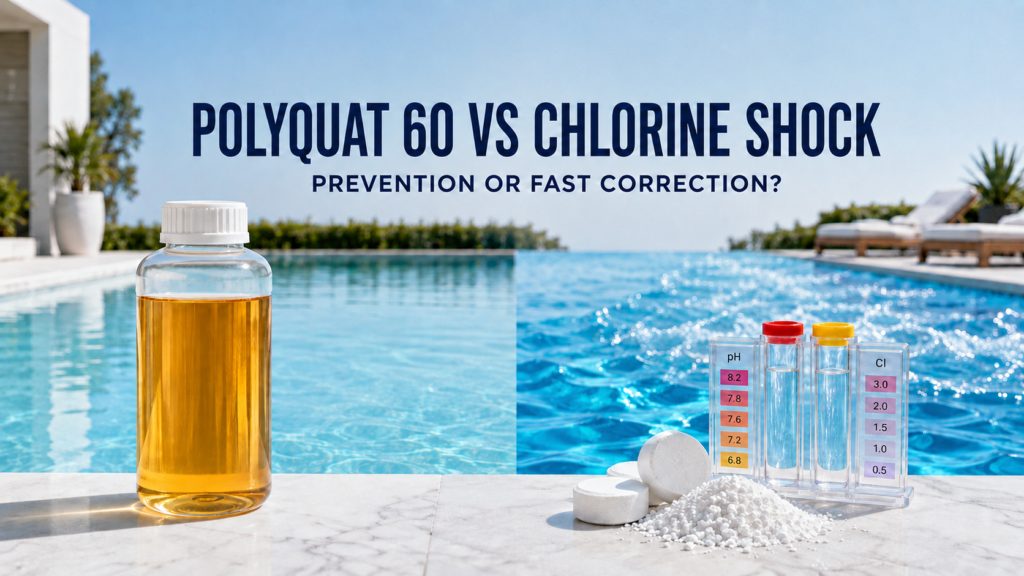
A clear swimming pool does not stay clear by accident. Sunlight, warm water, heavy rain, dust, pollen, and swimmers all add pressure to the water-treatment system. When algae appear—or conditions suggest they may soon appear—pool operators often compare two familiar options: Polyquat 60 and chlorine shock treatment.
Yet this comparison can be misleading. Polyquat 60 and chlorine shock are not two versions of the same treatment.
Polyquat 60 is mainly used to prevent and control algae over time. Chlorine shock rapidly raises the chlorine concentration to oxidize contaminants and deal with an immediate water-quality problem. One provides targeted algae control; the other delivers a strong, short-term oxidative response.
So, which one should you use? Often, the practical answer is both—but at different times and for different jobs.
What Is Polyquat 60?
Polyquat 60 is a concentrated polymeric quaternary ammonium algaecide. It is commonly supplied as a liquid containing approximately 60% active ingredient, although the exact concentration and formulation must always be confirmed from the product specification and label.
Unlike chlorine, Polyquat 60 is a non-oxidizing treatment. It does not control algae by creating a high oxidation level in the water. Instead, its positively charged polymer interacts with negatively charged algae cells and suspended particles.
This interaction can damage normal cell functions, disrupt algae growth, and encourage fine material to gather into larger particles that the filtration system can remove more easily. That combination helps explain why Polyquat 60 may support both algae control and water clarity.
The polymeric structure also separates Polyquat 60 from many simple quaternary ammonium algaecides. Traditional monomeric quats can produce noticeable foam, especially in pools with strong circulation, water features, or attached spas. Polyquat 60 is generally regarded as a non-foaming or very low-foaming algaecide when used at the labeled dosage.
It is also metal-free. It does not add copper or other stain-forming metals to pool water. This makes it especially useful where operators want preventive algae control without increasing the risk of blue-green staining, discolored surfaces, or metal-related hair discoloration.
Still, Polyquat 60 has an important limitation: it is not a primary pool sanitizer.
It may control algae, but it should not replace the disinfectant residual required to control bacteria and other disease-causing organisms. The CDC advises maintaining an appropriate free chlorine concentration and pH because proper disinfection depends on both values. For residential pools, the CDC recommends at least 1 ppm free chlorine—or at least 2 ppm when cyanuric acid is being used—with pH between 7.0 and 7.8. Local regulations and product labels may set different requirements.
In simple terms, Polyquat 60 helps guard the pool against algae. Chlorine remains responsible for routine sanitation.
What Is Chlorine Shock Treatment?
Chlorine shock treatment means adding a relatively large dose of a chlorine-based product to raise the free chlorine concentration for a limited period.
Depending on the product, the active chlorine source may be calcium hypochlorite, sodium hypochlorite, lithium hypochlorite, or a stabilized chlorinated compound. Each type can affect pool chemistry differently. Calcium hypochlorite adds calcium, for example, while stabilized chlorine may add cyanuric acid.
The word “shock” is sometimes used loosely. It can refer to superchlorination for algae control, oxidation of organic contaminants, or the treatment of combined chlorine. The US Environmental Protection Agency notes that claims involving shock treatment or superchlorination to kill or control visible algae are pesticidal claims and must be supported by the registered product label.
That distinction matters. A bag marked “shock” does not automatically tell you its chemistry, dosage, or approved purpose. Some shock products contain chlorine and can sanitize the water. Others are non-chlorine oxidizers and should not be treated as substitutes for a registered sanitizer.
A chlorine shock treatment may be used when:
- Algae are already visible
- The pool has experienced unusually heavy swimmer use
- Heavy rain has introduced contaminants
- Free chlorine has repeatedly fallen below the required range
- Organic contamination is creating excessive chlorine demand
- Combined chlorine or chloramine problems need corrective action
- A pool is being opened after a long shutdown
Chlorine shock acts fast, but it is not a stand-alone maintenance plan. Once the elevated chlorine concentration falls, the pool still needs a stable sanitizer residual, correct pH, good circulation, filtration, brushing, and routine testing.
Polyquat 60 vs Chlorine Shock Treatment at a Glance
| Comparison point | Polyquat 60 | Chlorine shock treatment |
|---|---|---|
| Primary role | Prevention and control of algae | Rapid oxidation, sanitation support, and corrective treatment |
| Chemistry | Polymeric quaternary ammonium compound | High dose of a chlorine-releasing chemical |
| Treatment type | Non-oxidizing | Oxidizing |
| Relative speed | Gradual, better suited to preventive control | Fast, suited to urgent corrective action |
| Sanitizes pool water | No; not a replacement for chlorine sanitizer | Chlorine-based shock can raise disinfectant concentration |
| Controls visible algae | May help, especially with brushing and filtration | Often preferred for rapid treatment of an active bloom |
| Routine algae prevention | Strong fit | Possible, but repeated shocking alone is not an ideal preventive program |
| Effect on chlorine level | Does not create a chlorine residual | Rapidly raises free chlorine |
| Metal content | Normally metal-free | Normally metal-free, though the full formulation must be checked |
| Staining risk | Does not introduce copper staining | Does not introduce copper, but unbalanced water can still affect surfaces |
| Foam tendency | Low or non-foaming at the correct dosage | Not normally associated with quat-type foam |
| Effect on pH | Usually limited at normal dosage | Depends on the chlorine source and treatment dose |
| Swimmer access | Follow the label | Swimming may need to stop until chlorine returns to the label-approved range |
| Best timing | Routine maintenance, before high-risk periods, and seasonal closing | Visible algae, high organic load, poor sanitizer residual, or contamination events |
Prevention or Rescue? That Is the Real Question
The most useful way to compare these products is to ask what condition the pool is currently in.
If the pool is clean, balanced, and free of visible algae, Polyquat 60 may be the more suitable supplemental product. It adds another layer of algae prevention without adding metals and without relying on a sudden spike in chlorine.
If the water is green, the walls feel slippery, or a clear algae bloom is spreading, chlorine shock usually becomes the main corrective tool. A strong chlorine treatment, combined with brushing and filtration, can act more quickly against an established outbreak.
Think of it this way: Polyquat 60 is similar to maintaining a secure fence around a property. Chlorine shock is closer to calling an emergency response team after something has already crossed the fence. Both have value, but their value appears at different moments.
Could Polyquat 60 treat an existing algae problem? Some registered formulations include remedial treatment rates, so it may contribute to algae removal. However, severe blooms usually involve more than live algae cells. The pool may also contain dead organic material, suspended debris, depleted chlorine, poor circulation, and an overloaded filter.
That broader problem often requires oxidation—not just an algaecide.
Which Treatment Works Faster?
Chlorine shock generally acts faster.
When the pH and other water conditions are appropriate, a shock dose can quickly raise the available chlorine concentration. This gives the pool a strong oxidative response against algae and other oxidizable contaminants.
Polyquat 60 works differently. It does not create a sudden oxidizing residual, and operators should not expect it to produce the same dramatic overnight change as correctly performed superchlorination.
That does not make Polyquat 60 weak. It means its strengths lie elsewhere.
A preventive dose can reduce the chance that algae gain a foothold between maintenance visits. That can be especially valuable in warm outdoor pools, lightly staffed properties, holiday homes, commercial facilities, or pools exposed to frequent rain and dust.
Speed matters during an outbreak. Persistence and prevention matter between outbreaks.
Why Chlorine Shock Is Better for a Severe Algae Bloom
A heavy bloom can consume chlorine rapidly. The pool may look cloudy or green because millions of algae cells and fine organic particles are suspended in the water. Some growth may also be attached to steps, ladders, corners, grout lines, or areas with weak circulation.
In that situation, chlorine shock provides several advantages:
- It raises the oxidizer concentration quickly
- It attacks living algae
- It oxidizes part of the associated organic load
- It can help restore an adequate disinfectant residual
- It supports treatment after brushing exposes protected growth
Even then, chlorine cannot perform the entire cleanup by itself. Physical maintenance remains essential.
Brush the affected surfaces so that the treatment can reach attached growth. Keep the circulation system operating as directed. Clean or backwash the filter when pressure rises. Vacuum settled debris rather than expecting every particle to disappear chemically.
Water balance also matters. Chlorine becomes less effective as pH rises. The CDC notes that a high pH, particularly above 8.0, reduces chlorine’s germ-killing performance.
Adding more shock without first checking the water can therefore waste chemicals and delay recovery. Sometimes the dramatic-looking dose is not the clever part. Accurate testing is.
Why Polyquat 60 Is Better for Routine Algae Prevention
Repeatedly shocking a clean pool to compensate for weak routine maintenance can be inefficient. It creates peaks and valleys in chlorine concentration instead of maintaining stable control.
Polyquat 60 supports a more measured program. It can be added at a labeled maintenance dose to reduce algae pressure while normal chlorine sanitation continues.
This approach can be useful:
- During hot weather
- Before a period of heavy pool use
- After long stretches of rain
- In pools with recurring algae around steps or shaded areas
- When a property will be unattended
- During seasonal closing or winterization
- Where operators want to avoid copper-based algaecides
- In saltwater pools that already maintain chlorine through a salt chlorine generator
Notice the wording: Polyquat 60 supports the program. It does not repair poor circulation, correct high pH, clean the filter, or replace chlorine.
If algae return every week, the root cause may be inadequate sanitizer, excessive cyanuric acid, a dirty filter, poor circulation, hidden growth, or an incorrect pool-volume calculation. Adding more algaecide may hide the problem for a while, but it will not solve the underlying maintenance fault.
Does Polyquat 60 Consume Chlorine?
Polyquat 60 is commonly described as compatible with normal chlorinated-pool maintenance. However, a high chlorine concentration may gradually attack or degrade organic polymer molecules.
This is one reason timing matters.
Adding Polyquat 60 at the exact moment of a very strong shock treatment may reduce the useful life of the polymer. The products are not necessarily incompatible in the general sense; rather, the elevated oxidizer level may weaken the algaecide before it has delivered its full preventive value.
A sensible sequence is usually:
- Test and balance the water.
- Perform the chlorine shock treatment according to its label.
- Brush, circulate, and filter the water.
- Allow free chlorine to return to the range specified by the relevant labels.
- Add Polyquat 60 at the labeled maintenance or treatment rate.
- Continue normal circulation.
Some product labels may permit a different sequence or specify a particular waiting period. Those directions take priority. Pool size, water temperature, stabilizer level, chlorine source, and local rules can all change the correct dosage.
Never estimate chemical quantities by eye. A small error in pool volume can become a large dosing error in a commercial pool.
Can Polyquat 60 Replace Chlorine Shock?
No—not when chlorine shock is required for rapid oxidation or sanitation.
Polyquat 60 does not establish a free chlorine residual. It should not be presented as a replacement for a registered sanitizer, and it should not be relied on to make microbiologically unsafe water safe for swimmers.
This point is especially important in public and commercial pools. Algae are visible and annoying, but disease-causing organisms may be present without changing the water’s appearance. Crystal-clear water is not automatic proof of adequate disinfection.
Chlorine-based shock treatment, meanwhile, should not be treated as a replacement for stable daily chlorination. A pool that swings between nearly zero chlorine and occasional shock doses remains poorly controlled.
The stronger program is layered:
- Maintain the required sanitizer residual
- Keep pH within the correct range
- Support circulation and filtration
- Brush and clean surfaces
- Use Polyquat 60 when extra algae prevention is justified
- Shock when water conditions or the product label call for corrective oxidation
What About Chloramines and the “Chlorine Smell”?
A strong chlorine smell does not necessarily mean that a pool contains too much useful free chlorine.
Chlorine can react with sweat, urine, dirt, skin cells, cosmetics, and other nitrogen-containing contamination to form chloramines. These compounds can irritate the eyes and respiratory tract while reducing the amount of chlorine available for disinfection.
Polyquat 60 does not oxidize chloramines. If combined chlorine is high, an appropriate shock or breakpoint chlorination procedure may be needed, depending on the test results, operating rules, and product directions.
This illustrates the basic division once again: Polyquat 60 targets algae control; chlorine shock addresses oxidation-related problems.
Does Either Treatment Cause Pool Surface Staining?
Polyquat 60 is metal-free, so it does not introduce the copper ions associated with blue, blue-green, or dark surface staining.
Chlorine shock products also do not normally add copper unless a particular blended formulation contains additional ingredients. Nevertheless, shock treatment can sometimes make an existing metal problem more visible.
For example, if source water already contains dissolved iron or copper, a strong oxidizing treatment may convert those metals into forms that discolor the water or deposit on surfaces. The shock product did not necessarily introduce the metal—it may have revealed contamination that was already present.
High localized chlorine concentration can also bleach some pool finishes or damage liners if granules are allowed to settle. Always follow the application instructions. Do not pour different chemicals into the same container, feeder, or concentrated treatment area.
What About Saltwater Pools?
Both treatments may be used in many saltwater pools, provided their labels allow the application.
A saltwater pool is still a chlorinated pool. Its salt chlorine generator converts chloride ions into active chlorine, so it still depends on correct free chlorine, pH, circulation, and filtration.
Polyquat 60 can add non-metal algae protection when warm water, heavy use, a temporary generator shutdown, or winter closing creates extra risk.
Chlorine shock may be needed when the generator cannot raise chlorine quickly enough to handle an active bloom or a sudden contaminant load. Some operators increase the generator output instead, but prolonged operation at maximum capacity may not deliver the same rapid response as a properly calculated shock dose.
Check the equipment manufacturer’s guidance before adding chemicals, and never add concentrated treatment directly through the salt cell unless the instructions specifically permit it.
Common Mistakes When Comparing Polyquat 60 and Chlorine Shock
Treating every cloudy pool as an algae problem
Cloudiness may come from algae, but it can also result from poor filtration, high calcium hardness, unbalanced pH, suspended debris, or recently added chemicals. Test first.
Using Polyquat 60 as the only sanitizer
Polyquat 60 is an algaecide, not a substitute for the required chlorine or bromine residual.
Shocking without checking pH
If pH is too high, chlorine works less effectively. A larger dose does not automatically fix that chemistry.
Adding Polyquat 60 during peak shock conditions
Very high chlorine may shorten the polymer’s useful life. Follow both labels and separate the treatments when directed.
Pouring chemicals together
Never mix concentrated pool chemicals. Add each product separately and exactly as its label instructs. Mixing chlorine with incompatible chemicals can generate heat, toxic gas, fire, or an explosion.
Ignoring brushing and filtration
Chemicals kill or weaken algae; the pool system still has to remove the debris. Dead algae left in the water can keep the pool cloudy and place a heavy load on the filter.
Assuming more chemical means faster results
Overdosing increases cost and may create new water-quality problems. Accurate pool volume and accurate testing are far more useful than guesswork.
How to Choose the Right Treatment
Use chlorine shock treatment when the pool needs rapid corrective action—especially where visible algae, depleted chlorine, high organic load, or a sanitation-related event is involved.
Use Polyquat 60 when the goal is additional, metal-free algae prevention during normal chlorinated maintenance.
Use both as a coordinated sequence when an algae outbreak must first be corrected and future regrowth must then be discouraged.
The decision can be summarized simply:
- Clear, balanced pool with recurring algae risk: consider Polyquat 60.
- Visible green algae or slippery surfaces: shock, brush, filter, and retest.
- High combined chlorine or strong chloramine odor: investigate and apply the appropriate oxidation procedure.
- Seasonal closing: balance the water, complete the required chlorine treatment, and add the labeled winter dose of Polyquat 60 at the appropriate time.
- Unsafe or unknown water chemistry: close the pool to swimmers, test it, and restore the required operating conditions before reopening.
The Bottom Line: Polyquat 60 and Chlorine Shock Have Different Jobs
Polyquat 60 and chlorine shock treatment should not be judged by asking which product is universally stronger. That question misses the point.
Chlorine shock is the faster corrective treatment. It rapidly increases oxidation and available chlorine, making it the more suitable option for many active algae outbreaks and contamination-related problems.
Polyquat 60 is the preventive specialist. It provides non-oxidizing, metal-free, low-foaming algae control and can help reduce the chance of regrowth after the pool has been restored.
A well-maintained pool rarely depends on one dramatic chemical. It depends on layers: balanced water, a stable sanitizer residual, circulation, filtration, physical cleaning, and well-timed supplemental treatment.
That may sound less exciting than throwing in a bag of shock and hoping for blue water by morning. Still, steady control usually wins. Pool chemistry has a funny way of rewarding patience and punishing guesses.
Frequently Asked Questions
Is Polyquat 60 better than chlorine shock for green pool algae?
Chlorine shock is generally more suitable for quickly treating a significant green algae bloom. Polyquat 60 is better suited to supplemental prevention and control after water balance, sanitation, brushing, and filtration have been addressed.
How long after shocking a pool can I add Polyquat 60?
Wait until free chlorine has returned to the range allowed by the Polyquat 60 label. The exact interval varies with shock dose, sunlight, water chemistry, and product directions; it should not be based on a universal number of hours.
Can I use Polyquat 60 instead of chlorine in a swimming pool?
No. Polyquat 60 controls algae but does not replace chlorine as the pool’s primary sanitizer. A proper disinfectant residual must still be maintained.
Should I add Polyquat 60 before or after chlorine shock treatment?
For an active algae problem, shock and clean the pool first. Add Polyquat 60 after the elevated chlorine level has fallen to the range permitted by the label. Seasonal-closing directions may specify a particular sequence, so follow the products used.
Does Polyquat 60 prevent algae from returning after pool shock?
It can help reduce algae regrowth when used at the correct maintenance dose. However, lasting control also depends on adequate chlorine, balanced pH, clean filtration, good circulation, and regular brushing.