
GET IN TOUCH
Ask For Sample?
The Evolution of Swimming Pool Algaecides: From Simple Treatments to Smarter Algae Control
A sparkling swimming pool looks simple from the deck. Clear water, clean walls, maybe a faint smell of chlorine—that’s about it, right?
Behind that clear water, though, there’s quite a bit of chemistry at work.
Algae control is a good example. Pool owners once relied heavily on chlorine, copper salts, and relatively simple algaecidal chemicals. Over time, the industry learned that killing algae was only part of the job. An algaecide also had to behave well with other pool chemicals, avoid excessive foam, limit staining, remain useful under changing water conditions, and make routine maintenance easier.
That shift has shaped the evolution of swimming pool algaecides.
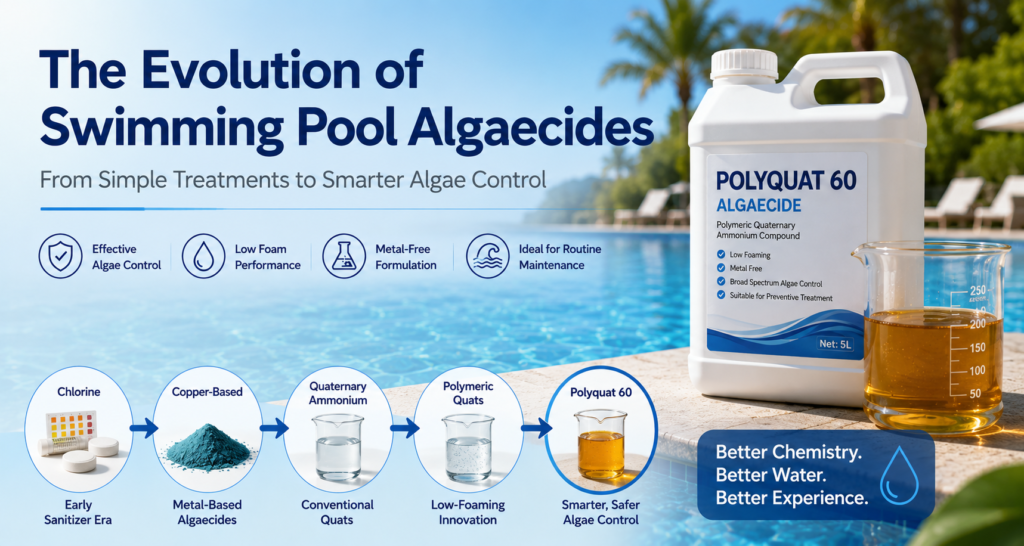
Modern products now range from traditional copper-based treatments to quaternary ammonium compounds and polymeric, non-foaming algaecides such as Polyquat 60. Each chemistry reflects a different stage in the industry’s understanding of algae control.
So, how did we get here?
It Started With the Obvious Choice: Chlorine
For decades, chlorine has been the backbone of swimming pool sanitation.
And for good reason.
When maintained at an appropriate level and under suitable water conditions, chlorine helps control a broad range of microorganisms. It can also oxidize organic contamination introduced by swimmers, leaves, insects, rainwater, and the surrounding environment.
Naturally, early pool maintenance programs leaned heavily on chlorine for algae control as well.
But pool operators gradually encountered an inconvenient reality: a chlorinated pool could still develop algae.
Why?
Because algae growth isn’t determined by one number on a test strip.
Low sanitizer levels, poor circulation, dead spots, incorrect pH, high bather load, sunlight, warm weather, accumulated debris, and inconsistent maintenance can all create conditions where algae gains a foothold.
Once algae begins colonizing pool surfaces, the problem may become harder to manage.
This led to a simple idea: rather than asking chlorine to do everything, why not add a chemical specifically intended to help control algae?
And that’s where dedicated swimming pool algaecides became increasingly important.
Copper Entered the Picture—and It Worked
Copper-based compounds became one of the classic answers to swimming pool algae.
Copper ions can interfere with biological processes in algae, which explains why copper-containing products have long been used for algal control in water systems.
For pool owners dealing with persistent algae, that could be attractive.
Copper-based algaecides also have another practical characteristic: copper isn’t consumed in exactly the same manner as an oxidizing sanitizer such as chlorine. Depending on water chemistry and treatment conditions, copper can remain present in pool water for some time.
Sounds useful. And it can be.
But there’s a catch.
Actually, several.
The staining problem
Copper doesn’t simply disappear after doing its job.
Under unfavorable water chemistry, dissolved copper can precipitate or contribute to staining on pool surfaces. Light-colored plaster and other finishes can make discoloration particularly noticeable.
Anyone who has dealt with metal staining knows how frustrating that can be. You solve one visual problem—algae—only to create another.
Copper can also contribute to discoloration of light-colored hair under certain pool conditions. The familiar “chlorine turned my hair green” story is somewhat misleading; deposited copper is often involved.
That doesn’t make copper-based algaecides inherently bad. It means their use requires attention to dosage and water chemistry.
As pool finishes, treatment systems, and customer expectations evolved, manufacturers began looking for alternatives.
Then Came Quaternary Ammonium Compounds
Quaternary ammonium compounds—usually shortened to “quats”—represented another important chapter in algaecide development.
These are cationic, or positively charged, compounds. Biological cell surfaces generally contain negatively charged sites, so the interaction between cationic chemicals and microorganisms can disrupt normal membrane functions.
Put simply, the positive charge matters.
Quats found applications in disinfectants, industrial water treatment, surface sanitation, and pool algae control.
For swimming pools, they offered a particularly interesting benefit: algae could be controlled without intentionally introducing metals such as copper into the water.
That addressed one concern.
Unfortunately, conventional quat formulations introduced another.
Foam.
Great, the Algae Is Gone. Why Is the Pool Foaming?
Traditional quaternary ammonium algaecides can behave somewhat like surfactants.
Add enough of certain formulations to agitated water and foam may appear.
A quiet residential pool may show relatively little at first. Turn on return jets, waterfalls, spa features, or other high-agitation equipment, though, and the difference can become obvious.
That’s not exactly the premium pool experience anyone had in mind.
Foaming may be especially noticeable when products are overdosed. It can also become more troublesome in pools with attached spas or water features.
This limitation encouraged another round of chemical development.
Could manufacturers retain the useful cationic properties of quaternary ammonium chemistry while reducing its tendency to foam?
Polymeric quaternary ammonium compounds offered an answer.
Polymeric Quats Changed the Conversation
Instead of relying on relatively small conventional quat molecules, polymeric quaternary ammonium algaecides use larger chain-like structures containing multiple cationic sites.
Think of the difference this way.
A traditional quat is somewhat like a small hook carrying a positive charge. A polymeric quat is more like a charged chain with numerous interaction points along its structure.
That’s an oversimplification, of course, but it captures the basic idea.
One of the best-known examples in swimming pool treatment is Polyquat 60, a name commonly used for concentrated polymeric quaternary ammonium algaecide formulations.
Its emergence represented an important step in pool algaecide development because it addressed several practical concerns at once.
Why polymeric algaecides became attractive?
Depending on formulation and use conditions, polymeric quat algaecides can offer:
- Effective algae control
- Low-foaming or non-foaming performance
- Metal-free algae treatment
- Compatibility with many routine pool maintenance programs
- Suitability for preventive treatment
- Useful performance across a range of typical pool conditions
Notice something?
The conversation is no longer simply about whether a chemical kills algae.
It’s about how that chemical behaves inside the entire pool system.
That’s a much more modern way of looking at water treatment.
From “Kill It” to “Prevent It”
Perhaps the biggest change in pool algaecide use isn’t a new molecule at all.
It’s a change in philosophy.
Historically, many pool owners thought about algaecide only when the water turned green.
Green pool? Add treatment.
Clear pool? Forget about it.
Modern pool maintenance increasingly treats algae control as preventive rather than purely corrective.
That makes sense when you think about how algae develops.
Visible green water is a late warning sign. Algae may begin establishing itself on surfaces or in areas of poor circulation before the whole pool changes color.
Preventive algaecide treatment can therefore serve as another layer of protection alongside proper sanitizer levels, filtration, circulation, brushing, and balanced water chemistry.
This doesn’t mean an algaecide should replace chlorine.
It shouldn’t.
An algaecide and a sanitizer perform related but different roles.
Chlorine remains responsible for core sanitation and oxidation. An algaecide provides additional, targeted support against algae.
That distinction is important.
Why Non-Metal Algaecides Have Gained Attention?
As pool systems became more sophisticated, manufacturers and pool-care professionals began paying closer attention to secondary effects.
Does the product stain?
Does it foam?
Does it add metals?
How does it interact with other treatment chemicals?
Can it fit into a weekly maintenance program?
These questions have helped increase interest in non-metal algaecides.
Polymeric quaternary ammonium compounds fit neatly into this trend because they don’t depend on copper ions for algal control.
For pool brands developing maintenance-oriented products, that can be useful.
A non-metal formulation may be particularly attractive when avoiding metal accumulation and related staining concerns is a priority.
This is one reason polymer-based algaecides have become an established part of the modern pool chemical market.
Polyquat 60 and the Rise of the Maintenance Algaecide
Polyquat 60 is particularly interesting because it illustrates how the role of an algaecide has changed.
Rather than being viewed only as an emergency treatment for an already-green pool, Polyquat 60-type products can be incorporated into routine algae prevention and maintenance programs.
Its low-foaming characteristics make it suitable for situations where conventional quat foam would be undesirable.
Its metal-free chemistry also separates it from copper-based alternatives.
And because concentrated polymeric algaecide raw materials can be incorporated into different finished formulations, they give pool chemical manufacturers considerable flexibility.
A manufacturer might develop products for routine maintenance, seasonal treatment, or private-label pool-care ranges, subject to the formulation, dosage, regulatory requirements, and intended market.
For readers who want to understand this chemistry in more detail, our Polyquat 60 Algaecide information explains its characteristics and role in swimming pool algae-control formulations.
Winter Pool Care Added Another Requirement
Algae control isn’t only a summer problem.
When pools are closed for extended periods, water may sit under covers for months. Sanitizer levels can gradually decline, organic matter may enter the water, and conditions can change considerably before the pool is reopened.
Nobody wants to pull back the cover in spring and discover a miniature swamp.
This created demand for algaecides suited to seasonal closing programs.
A winter algaecide needs to support longer-term algae prevention while fitting into the chemistry used during pool closing.
Polymeric, low-foaming algaecides can be useful ingredients in these formulations, which is another example of how algaecide chemistry has moved beyond emergency treatment.
Seasonal treatment also shows something broader about the evolution of pool chemistry: manufacturers increasingly design products around how and when people maintain pools, rather than simply around what a chemical can kill in a laboratory test.
Today’s Algaecide Is Part of a System
Here’s the key point: there is no chemical that compensates indefinitely for poor pool maintenance.
Even a good algaecide can’t fix a filter that isn’t working, circulation dead zones, wildly incorrect pH, or sanitizer levels that are consistently neglected.
Modern algae management is therefore better viewed as a system.
Sanitation controls potentially harmful microorganisms.
Filtration removes suspended contaminants.
Circulation distributes treatment chemicals.
Brushing disrupts material attached to surfaces.
Balanced water chemistry helps sanitizers and other treatment products perform as intended.
And algaecides provide another line of defense against unwanted algal growth.
When these pieces work together, pool maintenance becomes far more predictable.
This is also why the question “Which algaecide is strongest?” isn’t always the most useful question.
A better one might be:
Which algaecide fits the overall pool treatment program?
That’s a subtle change, but an important one.
How the Major Algaecide Types Compare?
The evolution becomes easier to understand when we place the major approaches side by side.
| Algae-Control Approach | Main Strength | Common Limitation | Typical Role |
|---|---|---|---|
| Chlorine/oxidizing sanitizer | Strong sanitation and oxidation | Performance depends heavily on water conditions and maintenance | Primary sanitizer |
| Copper-based algaecide | Established algae-control chemistry | Potential metal accumulation and staining | Preventive or corrective algae control |
| Conventional quaternary ammonium algaecide | Metal-free cationic treatment | Can produce foam | Economical algae treatment |
| Polymeric quat algaecide | Low-foaming, metal-free algae control | Cost and formulation requirements may differ from basic quats | Routine and preventive algae management |
There isn’t necessarily a universal winner.
Different products exist because pools, treatment programs, budgets, regulations, and customer expectations differ.
Still, the direction of development is clear: pool chemistry has gradually moved toward products that solve the target problem while creating fewer secondary problems.
Formulation Has Become Just as Important as the Active Ingredient
There’s another change that’s easy to overlook.
Modern pool chemical development isn’t only about discovering new active ingredients. It’s increasingly about formulation.
A concentrated algaecidal raw material can become the foundation for several finished products with different active levels, packaging formats, dosage instructions, and market positions.
For example, a manufacturer might develop a concentrated professional algaecide, a lower-strength weekly maintenance product, and a seasonal pool-closing formulation from related polymeric chemistry.
This is particularly relevant to private-label pool chemical brands.
A distributor doesn’t necessarily need exactly the same formulation as another company selling into a different market. Climate, pool size, customer habits, treatment routines, packaging preferences, and local regulations can all influence product design.
Packaging has evolved too.
Consumer pool products may appear in 1 L or 5 L containers, while professional, commercial, and private-label supply chains can require larger packaging.
That flexibility matters because the swimming pool market isn’t really one market.
A homeowner maintaining a backyard pool has very different needs from a service company caring for dozens of pools every week.
Modern Algaecides Are About Fewer Unwanted Side Effects
Look back over the history and a pattern begins to appear.
The industry hasn’t simply chased stronger algae-killing chemicals.
Instead, each generation has tried to address weaknesses exposed by the previous approach.
Chlorine is essential, but sanitizer levels can fluctuate and algae can still appear under unfavorable conditions.
Copper controls algae, but metals can introduce staining concerns.
Conventional quats provide metal-free algae control, but some can foam.
Polymeric quats address much of that foaming concern while retaining the benefits of cationic, non-metal algae-control chemistry.
That’s how chemical technology often develops—not through one dramatic leap, but through a long series of practical improvements.
A pool professional doesn’t want to solve one problem and create two more.
Neither does the homeowner standing beside the pool wondering why the water suddenly looks like bubble bath.
The Next Stage: More Precise Pool Chemistry
Where does swimming pool algaecide development go from here?
Probably not toward one miracle chemical.
The more likely direction is greater precision.
Manufacturers are paying closer attention to how active ingredients behave with sanitizers, clarifiers, filtration systems, pool surfaces, automated dosing equipment, and different water conditions.
Environmental and regulatory considerations also influence formulation decisions.
Meanwhile, consumers want products that are straightforward to use. Pool professionals want reliable chemistry that doesn’t create another service call two days later.
Private-label brands have their own requirements. They may need concentrated products, maintenance-strength formulations, seasonal treatments, or customized packaging for specific markets.
That combination encourages manufacturers to think beyond the active ingredient itself.
Concentration matters.
Foaming matters.
Metal content matters.
Compatibility matters.
Storage stability matters.
And, of course, real-world algae-control performance matters.
The evolution of algaecides, in other words, is becoming an evolution of the whole treatment program.
So, Have Modern Algaecides Replaced the Old Ones?
Not exactly.
Copper didn’t suddenly disappear when quats arrived. Traditional quats didn’t vanish when polymeric quats became available. And none of these products replaced chlorine as the foundation of swimming pool sanitation.
Instead, each stage added another tool.
That’s how water treatment chemistry usually develops. Older technologies remain useful where their strengths match the application, while newer chemistry addresses limitations that have become more important over time.
The progression from metal-based products to conventional quats and then polymeric algaecides reflects a broader lesson:
Good pool chemistry isn’t simply about stronger treatment. It’s about better-controlled treatment.
A product that controls algae but causes staining creates a new problem.
A product that controls algae but produces excessive foam creates a new problem.
A product that works well but is used as a substitute for basic sanitation creates an even bigger problem.
Modern algaecide programs try to avoid those trade-offs.
The Bottom Line
Swimming pool algaecides have come a long way.
Early algae management depended heavily on oxidizing sanitizers and metal-based chemistry. Quaternary ammonium compounds provided a metal-free alternative but brought foaming concerns in some formulations. Polymeric quaternary ammonium compounds then offered another route—one particularly suited to low-foaming, preventive pool care.
Today, products such as Polyquat 60 represent more than another chemical for killing algae. They reflect a broader shift toward integrated pool maintenance.
Keep the sanitizer where it should be. Maintain circulation and filtration. Balance the water. Brush the surfaces. Then use an appropriate algaecide as an additional layer of algae control.
It’s less dramatic than rescuing a bright-green pool on a Saturday morning.
But that’s rather the point.
The best algae problem is the one swimmers never see.
Frequently Asked Questions
1. How have swimming pool algaecides changed over time?
Swimming pool algae control evolved from heavy reliance on chlorine and metal-based treatments toward conventional quaternary ammonium compounds and later polymeric quat algaecides. The trend has increasingly focused on reducing unwanted effects such as metal staining and foam while supporting preventive pool maintenance.
2. Why are polymeric algaecides used in modern swimming pools?
Polymeric algaecides can provide metal-free algae control with low-foaming characteristics. This makes them useful in routine pool maintenance programs, especially where conventional quat foaming or copper-related staining is undesirable.
3. What is Polyquat 60 algaecide used for?
Polyquat 60 is commonly used as a polymeric, low-foaming swimming pool algaecide. Depending on the finished formulation, it may be used for routine algae prevention, maintenance treatment, and seasonal pool-care programs.
4. Is copper algaecide better than Polyquat 60?
Neither chemistry is automatically better for every application. Copper-based algaecides have established algae-control properties but can introduce concerns about metal accumulation and staining. Polyquat 60 offers a metal-free, low-foaming alternative that can be attractive for preventive maintenance.
5. Can swimming pool algaecide replace chlorine?
No. An algaecide should not be treated as a replacement for proper pool sanitation. Chlorine or another approved sanitizer performs the primary sanitation role, while an algaecide provides additional support for preventing or controlling algae.